Pricing Overview :

Melio pricing in 2026 is clearer than that of a lot of finance software, but it still needs to be read carefully. The official pricing page not only lists plans. It also shows usage rules, free ACH limits, per-user pricing on some tiers, and transaction fees for certain payment methods.

That is actually a good thing. It means buyers can price the platform with less guesswork.

The official plan anchors reviewed on Melio’s pricing page are:

  • Go: $0, free forever, limited to one user.
  • Core: $25 per month, plus $10 per month per additional user.
  • Boost: $55 per month, plus $10 per month per additional user.

The same page also shows annual-billing equivalents for Core and Boost:

  • Core: $20 per month billed annually, plus $8 per month per additional user.
  • Boost: $44 per month billed annually, plus $8 per month per additional user.

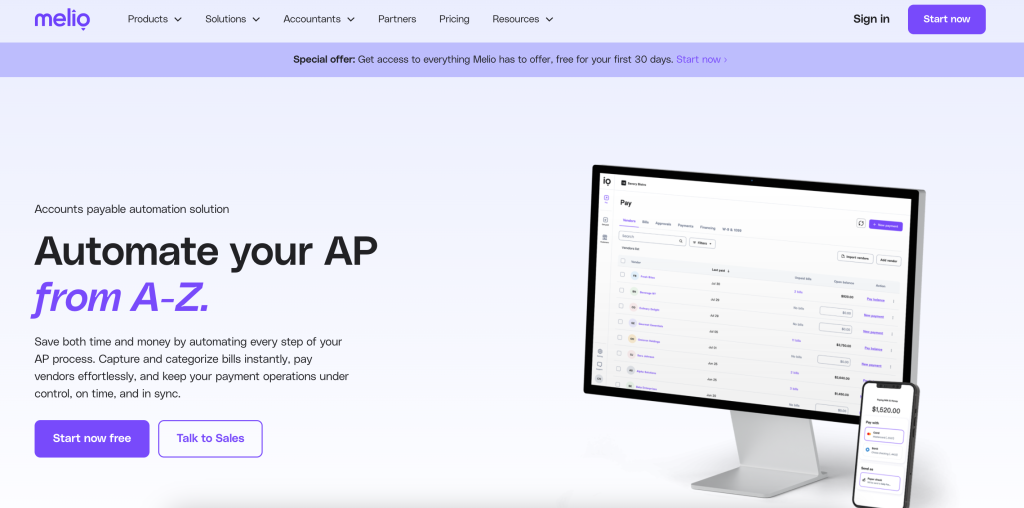
The official site also promotes free ACH payments within plan limits and a broader accounts payable and receivables platform that includes bill capture, approval workflows, accounting sync, W-9 collection, and 1099 support.

If you want to check the official pricing page yourself, start with Melio here.
All Pricing Tiers Explained :

Go –

Go is Melio’s entry plan and is officially listed at $0, free forever, limited to one user.

The plan still includes a meaningful AP toolkit:

  • 5 free ACH payments per month.
  • ACH payments, wires, or checks.
  • Fast and instant payments.
  • Auto-pay.
  • Bill payment by card.
  • AI bill capture.
  • Dedicated bills inbox.
  • International payments in USD or local currencies.
  • Free AR and invoicing features.

This is a stronger free plan than many buyers expect. It is best for solo owners or very lean businesses that want bill-pay structure without adding a full team workflow yet.

Core –

Core is listed at $25 per month, plus $10 per month per additional user, or $20 per month plus $8 per additional user on annual billing.

This is where Melio starts looking more operationally complete. The official page adds:

  • 20 free ACH payments per month.
  • QuickBooks Online sync.
  • Xero sync.
  • Batch payments.
  • Approval workflows.
  • W-9 collection.
  • 1099 automation through Tax1099 sync.
  • AI assistant.
  • Priority chat support.
  • Branded invoices.

Core is the real starting point for teams that want Melio to behave like shared AP infrastructure instead of a solo pay-bills utility.

Boost –

Boost is listed at $55 per month, plus $10 per additional user monthly, or $44 per month plus $8 per additional user on annual billing.

The official page positions Boost around deeper automation and control, including:

  • 50 free ACH payments per month.
  • Advanced user roles.
  • Vendor credits, with QuickBooks Online-specific support called out.
  • Custom approval workflows.
  • Vendor-based and gradual approvals.
  • QuickBooks Desktop sync.
  • Premium phone support.

This is the plan where Melio starts feeling much more serious about multi-user finance workflows.

Hidden Costs And Gotchas :

This is where buyers need to read slowly instead of stopping at the subscription line.

Melio’s official pricing page makes a few important things clear:

  • Go includes only 5 free ACH payments per month.
  • Core includes 20 free ACH payments per month.
  • Boost includes 50 free ACH payments per month.
  • After those free monthly ACH payments are used, a $0.50 charge applies to each payment.

That is a very important detail. A team can say “Melio has free ACH” and still misunderstand the real monthly cost if it processes enough payments to exceed the included amount.

The official page also makes clear that card-based payment behavior carries fees in some cases. The pricing page shows:

  • ACH bank transfer receiving can be free in the Get Paid flow.
  • Credit card receiving to an ACH bank transfer path carries a 2.9% fee.

Melio also publicly highlights:

  • International payments.
  • Fast payments.
  • Pay by card.

Those capabilities are valuable, but teams should expect payment-method-specific pricing logic rather than assuming every path is free.

If you want to evaluate the real bill instead of the headline plan fee, open Melio here and model your expected ACH volume, extra users, and payment-method mix.

There is also a planning lesson hidden in the official page: Melio is not pricing around seat vanity. It is pricing around finance activity. That means the total cost moves more with payment behavior and collaboration needs than with generic software usage. Buyers who understand this usually forecast the platform more accurately.

ROI Calculation Example :

The cleanest Melio ROI model is not about pretending AP automation prints money by itself. It is about time saved, reduced error risk, and cleaner finance operations.

Here is a simple example:

If that team currently spends hours re-entering invoices, chasing approvals, syncing with accounting software manually, and cleaning up tax paperwork later, the platform can pay for itself quickly in saved labor alone.

The official feature mix that supports that ROI argument includes:

  • AI bill capture.
  • Batch payments.
  • Approval workflows.
  • QuickBooks Online or Xero sync.
  • W-9 collection.
  • 1099 automation.

Those are exactly the kinds of features that reduce repetitive admin rather than simply making the dashboard look sophisticated.

Cost Comparison To Alternatives :

Melio’s pricing is appealing because it starts at zero and scales into structured team workflows without immediately forcing an enterprise sales process.

Compared with many AP tools, Melio is easier to understand in three ways:

  • The entry plan is clear.
  • The mid-market plan jumps are visible.
  • Some usage-based fee rules are published instead of buried.

The tradeoff is that the final monthly cost can still shift based on:

  • Number of users.
  • ACH volume.
  • Card usage.
  • International or faster payment paths.

That means Melio is not “cheap” or “expensive” in isolation. It is best judged against your actual bill volume and workflow complexity.

Best Value Tier Recommendation :

For most small but growing teams, Core looks like the best value tier.

Why?

  • Go is great for solo use, but one-user limits make it restrictive for shared finance work.
  • Core introduces the accounting sync, approvals, W-9, 1099, and batch-payment features that make the product materially more useful.
  • Boost is worth it when advanced roles, more customization, and stronger approval logic are already necessary.

So the clean practical read is:

  • Go for solo operators.
  • Core for the majority of collaborative SMB AP workflows.
  • Boost for more structured multi-user finance operations.

That makes Melio easier to buy than tools that jump too quickly from “free” to “call sales.”

If your team is right on the line between free and paid, start with Melio here and compare your actual user count, ACH volume, and approval needs before assuming the zero-dollar tier will stay the cheapest in practice.

Discounts And Annual Billing :

Melio’s annual billing on the official pricing page lowers the subscription layer for Core and Boost:

  • Core drops from $25 monthly to $20 monthly, with additional users dropping from $10 to $8.
  • Boost drops from $55 monthly to $44 monthly, with additional users also dropping from $10 to $8.

That is not a tiny difference if the team expects to stay on the platform for a while.

Annual billing makes the most sense when:

  • The AP workflow is already stable.
  • Multiple users are involved.
  • The business expects recurring monthly bill volume.

Monthly billing makes more sense when the team is still validating fit or expecting process changes soon.

One more thing buyers should watch: the subscription fee is only the visible part of the stack. The hidden cost in many AP processes is still human effort. If Melio removes repeated invoice entry, approval chasing, bookkeeping sync cleanup, and tax-document scrambling, a paid tier can outperform the free tier financially even before you look at transaction fees. That is why evaluating Melio only by the monthly sticker price can be misleading.

If you want to compare the annual and monthly structures directly, start with Melio here and run the math against your user count and ACH volume instead of judging only by the starter plan.

Verdict: Is Melio Worth It?

Melio pricing is strong in 2026 because it gives buyers a realistic ladder.

The official pricing page shows:

  • A true free starting point.
  • A collaborative mid-tier with a useful AP structure.
  • A more advanced tier with stronger controls.
  • Transparent user-based pricing on paid plans.
  • Published free-ACH thresholds and overage behavior.

That is a healthier pricing story than many finance tools offer.

Melio is worth it when your business needs better bill capture, cleaner approvals, accounting sync, and less AP chaos. It is less compelling if you only pay a handful of bills and do not need shared workflow or automation.

FAQ :

How Much Does Melio Cost In 2026?

The official pricing page lists Go at $0, Core at $25 per month plus user fees, and Boost at $55 per month plus user fees, with lower annual billing options for Core and Boost.

Does Melio Have A Free Plan?

Yes. Go is officially listed as free forever and limited to one user.

Are ACH Payments Always Free On Melio?

Not completely. The official plans include a set number of free ACH payments each month, and then a $0.50 fee applies to each additional ACH payment.

What Is Melio’s Best Value Plan?

For most collaborative SMB finance workflows, Core looks like the best value because it adds accounting sync, approvals, W-9 collection, and 1099 automation without jumping to the highest tier.

Does Melio Charge Card Fees?

Yes. The official pricing page shows a 2.9% fee in certain credit-card-related receiving/payment flows, so payment-method choice matters.

Leave a Reply

Your email address will not be published. Required fields are marked *