


In this guide
- Why Features Matter
- Feature 1: Broad Vulnerability Discovery
- Feature 2: Prioritization With Compliance And Risk Context
- Feature 3: Plugin Depth And Threat Freshness
- Feature 4: Reporting And Usable Output
- Feature 5: Licensing Paths That Match Different Users
- Features Coming Soon
- What Is Unique Versus Competitors
- Verdict
- FAQ
Why Features Matter :
Tenable Nessus is one of those products where the feature set is the entire reason to buy. The official site calls it the first tool in your cybersecurity toolbox and the industry’s most trusted vulnerability assessment solution. That is a bold claim, but the public feature story is strong enough to make the claim worth examining.
Disclosure: Stack99 earns a commission if you buy through links on this page. It costs you nothing extra and never changes our assessment.
Nessus is not trying to be a vague security umbrella. It is trying to do vulnerability assessment extremely well. That means the feature ranking should focus on the capabilities that help security teams find weaknesses, prioritize them, and fix them faster.
The official Nessus pages point to a few especially strong themes:
- Fast and broad vulnerability scanning.
- Strong prioritization and scoring.
- Built-in compliance checks.
- Clear reporting and remediation guidance.
- Flexible licensing from free evaluation to professional use.
If you want to explore the product while you read, start with Tenable here.
Feature 1: Broad Vulnerability Discovery
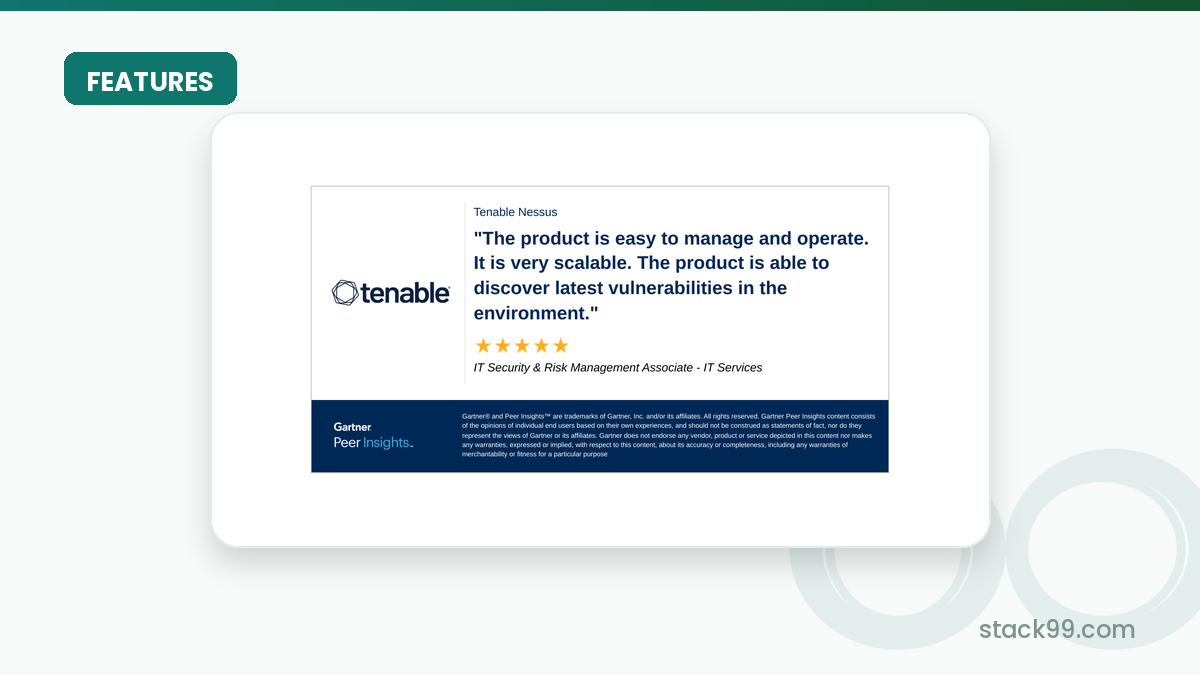
This is the core of the product, and the official Nessus page makes it clear. Nessus is designed to identify software flaws, missing patches, and misconfigurations across operating systems, devices, and applications.
That sounds simple, but it matters because discovery is where a lot of security tooling either earns trust or creates noise.
The official site frames Nessus as delivering:
- Fast and accurate scans.
- Broad visibility across environments.
- Fewer blind spots.
- Unlimited vulnerability assessments in commercial tiers.
This is the feature that makes everything else possible. If discovery is weak, reporting and prioritization do not matter much.
Feature 2: Prioritization With Compliance And Risk Context
Nessus is not only about finding issues. The official site says it helps teams cut through the noise with built-in compliance checks, CVSS and EPSS risk scoring, and easy-to-read reports that guide focus.
That is a strong feature set because modern security teams do not struggle only with “finding things.” They struggle with knowing what matters first.
The public feature language points to a practical prioritization stack:
- Vulnerability scoring.
- Configuration and compliance checks.
- Risk-focused remediation guidance.
- Better focus on issues that matter most.
That is exactly the kind of capability that separates a serious vulnerability assessment tool from a giant list generator.
If you want to compare the offering directly, start with Tenable here and look at how the product balances discovery and remediation context.

Feature 3: Plugin Depth And Threat Freshness
One of the more convincing public data points on the official page is the scale behind Nessus:
- 113K+ CVEs.
- 295,000+ plugins.
- 100+ new plugins released weekly.
That matters a lot. Vulnerability assessment tools only stay useful if the content layer remains fresh and wide enough to track a fast-changing threat landscape.
Tenable’s public positioning on plugin updates and research support makes Nessus feel less like a static scanner and more like a maintained security engine. The site also ties the offering to Tenable’s Zero Day Research and fast vulnerability updates, which reinforces that depth.
Feature 4: Reporting And Usable Output
The official site repeatedly highlights reporting as a core capability. That includes:
- Easy-to-read reports.
- Configurable reports.
- PDF, HTML, and CSV reporting on relevant tiers.
- Data export.
- Live results on commercial plans.
This matters because raw findings are not enough. Security teams need output they can use to communicate with IT teams, prioritize action, and show progress over time.
Real talk: a security product can be technically powerful and still become operationally annoying if the output is hard to act on. Nessus seems to understand that.
Feature 5: Licensing Paths That Match Different Users
This is a useful feature in a broader sense because the official purchase pages give several clear entry points.
The official Tenable pages currently show:
| Plan | Price |
|---|---|
| Nessus Essentials | Free |
| Nessus Professional | $4,790/yr |
| Nessus Expert | $6,790/yr |
They also explain the difference between entry evaluation use, hobbyist or education-style use, and full commercial professional use.
That ladder matters because it lets different users start where they actually fit:
- Very small evaluation or lab use.
- Ongoing limited-scope use.
- Professional vulnerability assessment work.
- Expanded functionality with Expert.
The pricing context is not the main reason Nessus is attractive, but it does make the product easier to evaluate honestly.
If you want to pressure-test the higher-tier value, start with Tenable here and compare Professional or Expert against your real scan and reporting needs.

Features Coming Soon :
The current official pages focus far more on present-day feature depth than on a public roadmap. That is actually fine. Security buyers should evaluate the platform on what it demonstrably does now, not on vague promises.
So the safest public takeaway is:
- Nessus already emphasizes core scanning depth.
- The plugin and research engine are already central.
- Reporting and prioritization are already mature themes.
- Higher-tier differentiation is already clear.
That is enough for a serious 2026 evaluation.
What Is Unique Versus Competitors :
Nessus stands out because it combines:
- Strong vulnerability discovery.
- Large plugin depth.
- Clear compliance and risk prioritization.
- Practical reporting output.
- Well-defined commercial tiers.
Plenty of security tools can surface issues. Fewer become the default vulnerability assessment reference point for so many teams. The official site leans into that “gold standard” reputation, and the public feature story supports it reasonably well.
The public pricing structure also helps. Teams can see a clear path from free Essentials use through to Professional and Expert, which makes evaluation easier than platforms that hide the real entry point behind multiple sales steps.
Another subtle strength is clarity of purpose. Nessus is not trying to be every kind of security product at once on these pages. It is clearly focused on vulnerability assessment, prioritization, reporting, and remediation support, which makes the value proposition easier to understand.
That focus also helps procurement teams, consultants, and security leads explain the tool internally. A tightly scoped product story is usually easier to defend than a platform that promises everything but is vague about actual day-to-day use.
That clarity also lowers evaluation friction. Teams can see what the product is for, who it is for, and which paid tier matches their actual environment without too much guesswork.
That is a practical advantage because internal evaluation cycles are rarely short, and simpler product framing often speeds up buying and rollout conversations.
Verdict :
Tenable Nessus has a strong feature stack in 2026. The best parts are broad vulnerability discovery, risk-based prioritization, massive plugin depth, useful reporting, and a clear licensing ladder from Essentials through Professional and Expert.
It looks especially strong for security practitioners who need a focused vulnerability assessment tool instead of a vague all-things-security pitch.
That focus is part of the appeal. Teams that want a direct, mature vulnerability assessment workflow often do better with a product that knows its job well instead of trying to wrap fifteen unrelated promises into one interface.
It is the kind of product that makes more sense the more disciplined your security process already is, because its strengths show up in routine assessment, prioritization, and reporting cadence.
And that is exactly where mature security tooling should show its value.
The more repeatable your scanning and remediation process is, the easier it becomes to appreciate a tool that keeps returning usable findings in a disciplined format.
That consistency matters.
If that is your use case, start with Tenable here and compare the tool against your current scanning, prioritization, and reporting workflow.

FAQ :
What are the top Tenable Nessus features in 2026?
Its strongest features are vulnerability discovery, CVSS and EPSS-based prioritization, compliance checks, plugin depth, reporting, and flexible licensing options.
Does Nessus have a free version?
Yes. The official site lists Nessus Essentials as free.
How much does Nessus Professional cost?
The official Tenable purchase page lists Nessus Professional at $4,790 per year and Nessus Expert at $6,790 per year.
Is Nessus mainly for vulnerability scanning?
Yes. The official site positions it as a focused vulnerability assessment solution designed to expose and help close security gaps across the attack surface.
Before You Choose, Compare These
Hand-picked guides to help you choose the right tool — no fluff.
 ComparisonsTenable vs Alternatives 2026The strongest competitors compared side by side.
 Use CasesWho Is Tenable Best For? Use Cases & Fit (2026)Who gets the most out of it – and who should skip it.
 TutorialsBolt for Business Beginner's Guide 2026A clean start-here walkthrough with no jargon.
 Case StudiesDeel Case Study 2026What actually happened when teams rolled it out.