

Why Spocket’s Features Matter :
Spocket still matters in 2026 because it is not trying to win dropshippers only with a giant catalog. The official homepage and pricing pages position it around supplier geography, product discovery, automation, and multi-store practicality.
That matters because dropshipping tools all claim they make selling easier. In real life, the winners are usually the ones that help you find sellable products faster, source from regions your customers trust, and keep the day-to-day order flow from turning into a mess.
If you want to look at the platform while you read, start with Spocket here.
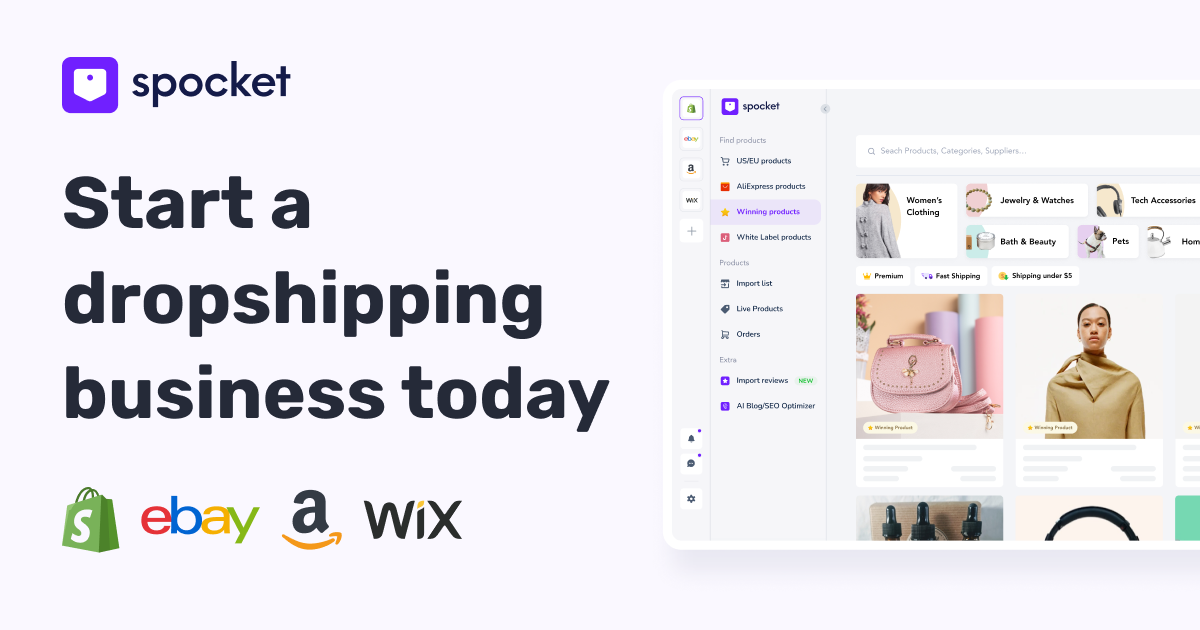
Feature #1: US And EU Supplier Access
This is still one of Spocket’s clearest differentiators.
The official homepage leads with US and EU suppliers, and that is not a small detail. For many store owners, supplier geography directly affects:
- Shipping expectations.
- Customer trust.
- Refund pressure.
- Product consistency.
That is why this feature ranks first. A huge catalog means less if the shipping reality makes your store feel unreliable.
For store owners targeting customers who expect faster delivery or who are tired of fully import-dependent workflows, this can be a practical edge instead of a marketing slogan.
Feature #2: Winning Product Discovery
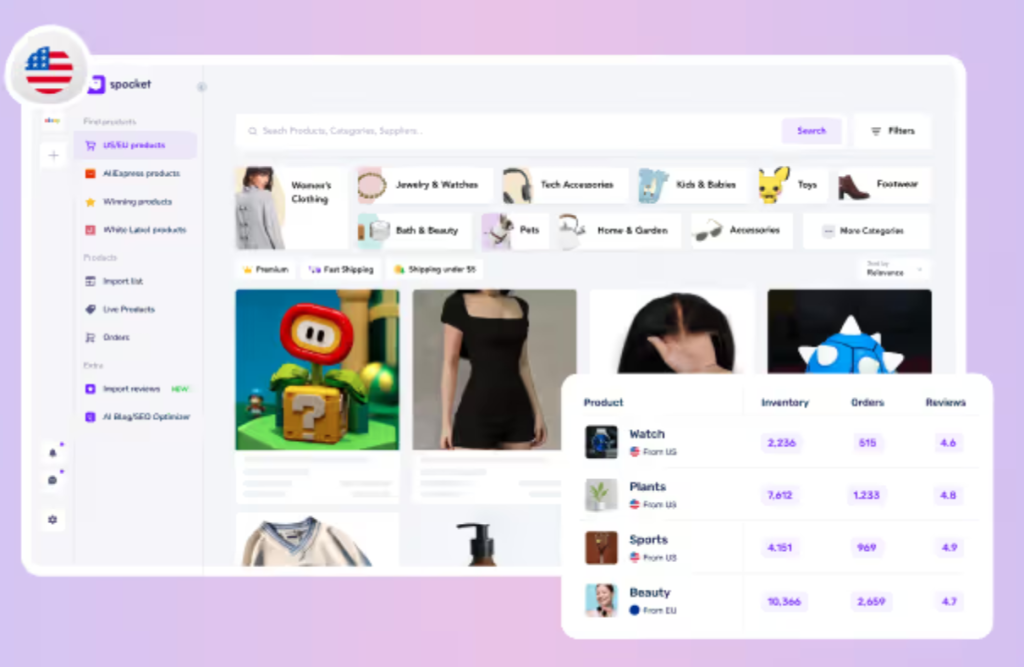
Spocket repeatedly highlights winning products and product discovery across the homepage experience.
That matters because product selection is where many dropshipping stores stall. Store owners do not only need inventory. They need direction.
The official interface emphasizes:
- Trending categories.
- Product discovery.
- Curated browsing paths.
- Research-oriented browsing rather than raw catalog chaos.
That gives Spocket a more guided feel than a platform that just throws thousands of listings at you and hopes you guess correctly.
If product research is your main bottleneck, start with Spocket here and pressure-test the discovery flow against the niches you actually want to sell in.
Feature #3: Product Research Tools
Spocket also calls out product research tools directly.
That deserves its own spot because many merchants do not fail on store setup. They fail on product judgment. Research tools help narrow that gap by making it easier to compare what looks promising before money gets wasted on weak offers.
The practical value here is not only speed. It is decision quality.
With the right research workflow, merchants can:
- Filter faster.
- Compare categories more clearly.
- Avoid blindly copying low-signal product choices.
- Build a more intentional catalog.
That is especially useful for people running smaller teams where one bad product bet can waste a full week of testing.
Feature #4: Automated Dropshipping Workflows
Automation is one of the strongest reasons to take Spocket seriously.
The homepage explicitly highlights automated dropshipping, and the pricing page reinforces that the product is meant to reduce manual handling once a store is running.
This matters because order routing, product syncing, and store maintenance become annoying much faster than most beginners expect.
When automation is working well, the merchant gets more room to focus on:
- Offer testing.
- Creative work.
- Customer support.
- Store economics.
Instead of spending hours on repetitive admin.
That does not make the business easy. It makes the operations cleaner.
Feature #5: Broad Channel And Catalog Support
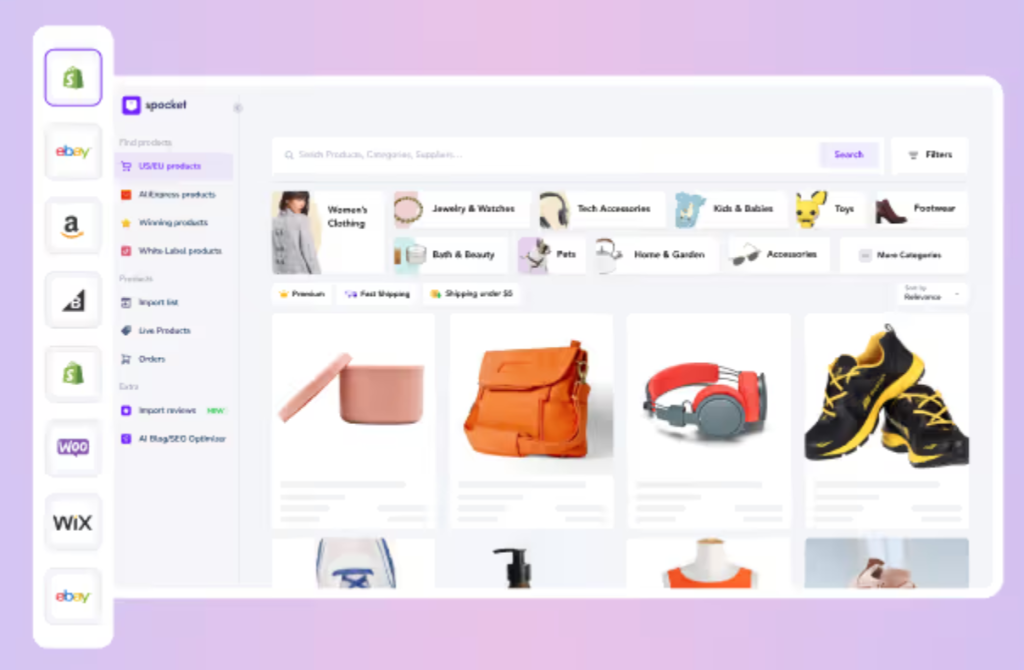
Spocket’s pricing page also makes a broader point about channel and catalog flexibility.
The public plans highlight:
- A 100 million plus product catalog.
- Multiple store support.
- AliExpress dropshipping.
- Higher plans that surface eBay and Amazon dropshipping support.
- Bulk checkout and unlimited orders on upper tiers.
That combination matters because sellers do not all scale the same way. Some need one clean starter store. Others need a broader operational setup with more product volume, more store complexity, and more fulfillment coordination.
This is where Spocket starts feeling less like a starter tool and more like something that can stay relevant as a store matures.
Pricing Context :
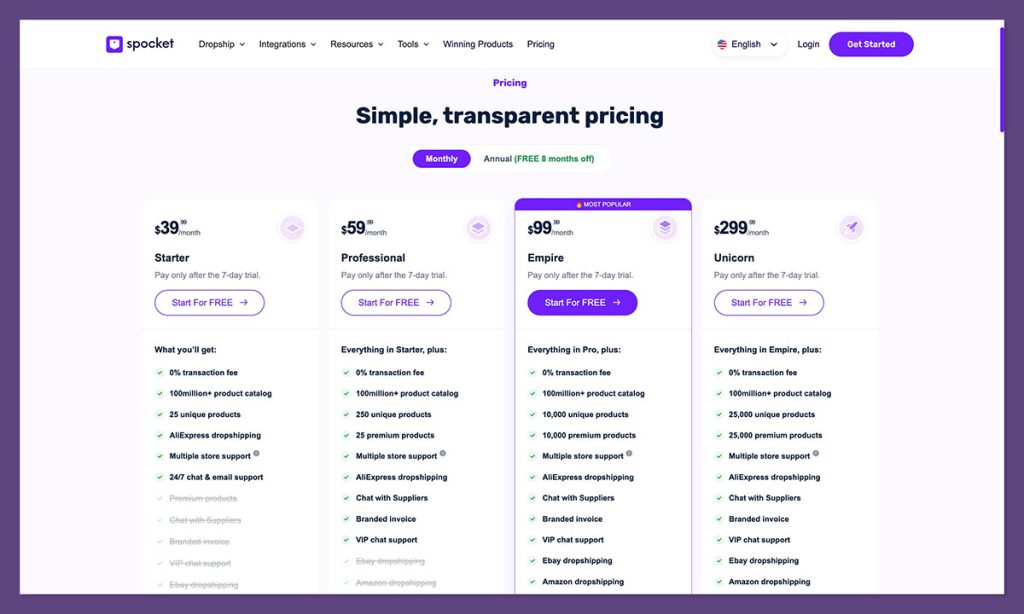
Spocket’s official pricing page is clearer than many dropshipping tools, and it also gives enough detail to understand how the feature ladder expands.
The page currently shows:
- Starter at $39.99 per month.
- Empire at $99.99 per month.
- Unicorn at $299.99 per month.
The same page also mentions:
- A 7-day trial on the visible plan cards.
- A 14-day free trial in the FAQ.
- An annual toggle marketed as offering free months off the regular cost.
Feature expansion is tied closely to plan growth. For example, the pricing page surfaces bigger product allowances, more premium products, marketplace channel support, and stronger scale-oriented capabilities as you move upward.
That means the practical buying question is not just, “What is the cheapest plan?”
It is:
- How many products do I need?
- Do I need higher-tier marketplace support?
- Am I running one store or several?
- Am I still validating or already scaling?
If you want to compare those plan jumps directly, start with Spocket here and match the public plan ladder against your expected catalog size and channel strategy.
What Makes Spocket Feel Different :
A lot of dropshipping platforms talk about quantity.
Spocket feels strongest when it talks about operating quality:
- Better supplier geography.
- More guided product discovery.
- Research support.
- Automation.
- Clearer scaling paths.
That is a better story than “we have more stuff than everyone else.”
It is also more useful to real merchants, because most stores do not need endless product noise. They need a cleaner path to selecting, listing, testing, and fulfilling products that can actually convert.
What Is More Niche Than It Looks :
One thing to keep in mind is that some of Spocket’s best features matter more to certain sellers than others.
For example:
- US and EU suppliers matter a lot for stores selling to delivery-sensitive customers.
- Product research and trending views matter more for merchants still refining offer selection.
- Bigger plan tiers matter more once store complexity starts rising.
That is why the feature ranking is not one-size-fits-all. The right Spocket feature depends partly on where the store is in its maturity curve.
For beginners, winning-product discovery and supplier access often matter first.
For scaling sellers, automation and multi-store flexibility usually start climbing the list.
Verdict :
Spocket’s top features in 2026 are the ones that reduce uncertainty and operational drag.
US and EU suppliers help with shipping confidence. Winning-product discovery and research tools help with selection quality. Automation helps keep order handling cleaner. And the larger plan tiers show that the platform is trying to support scale, not just signup growth.
That is why Spocket remains interesting. It is not only a product catalog. It is a workflow tool for merchants who want more structure around what they sell and how they run the store.
Another subtle strength is that the pricing page keeps the product allowances highly visible. That matters because sellers can tell pretty quickly whether they are buying a starter workflow, a scaling workflow, or a far larger catalog-and-channel workflow.
If you want to test that yourself, start with Spocket here and compare one live store idea against the supplier access, discovery flow, and automation stack the platform currently shows publicly.
[IMAGE: Spocket verdict on the platform’s most valuable dropshipping capabilities]
That is usually where the real value shows up.
Not in a feature checklist, but in whether the platform makes the next product decision and the next fulfillment process feel easier instead of heavier.
That is also where the plan ladder becomes more useful than it first appears, because it helps sellers see whether they are still validating a concept or already building a larger operating system around multiple products and channels.
FAQ :
What is Spocket’s best feature in 2026?
For many merchants, the best feature is still access to US and EU suppliers because it affects shipping expectations and customer trust more directly than flashy catalog size claims.
Does Spocket still offer a free trial?
Yes. The official pricing and FAQ sections currently reference a trial, including visible 7-day trial language on plan cards and a 14-day free trial mention in the FAQ.
How much does Spocket cost?
The official pricing page currently shows Starter at $39.99 per month, Empire at $99.99 per month, and Unicorn at $299.99 per month, with annual billing savings also promoted.
Who should care most about Spocket’s advanced features?
Merchants scaling past the earliest testing phase usually get the most value from automation, higher product limits, broader marketplace support, and multiple-store flexibility.