

Who This Post Is For :
This guide is for startup founders, technical co-founders, small product teams, and early operators who need hosting that feels scalable without sounding like an enterprise procurement project.
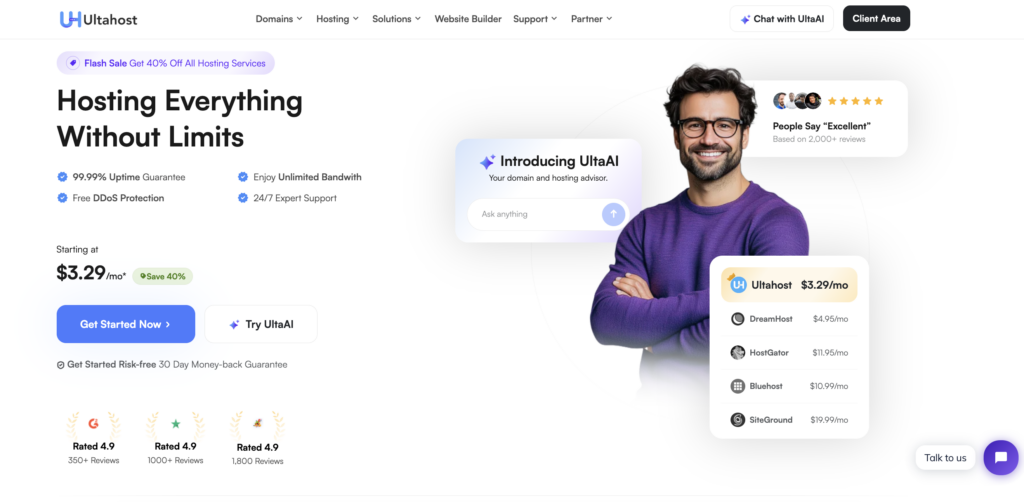
Ultahost’s official homepage makes a straightforward promise in 2026: hosting that scales, faster performance, strong security, and broad infrastructure coverage across different hosting types.
That is exactly the kind of positioning startups pay attention to, because early-stage teams rarely want ten disconnected vendors just to launch and maintain one product stack.
If you want to look at the platform while you read, start with Ultahost here.
Why Ultahost Fits Startups :
The official homepage highlights several themes that map well to startup needs:
- Hosting plans that scale with you.
- Up to 20x faster than traditional web hosting.
- Enterprise-grade security.
- Free migration.
- Broad hosting coverage across web, Windows, email, game, and Mac hosting categories.
That combination matters because startups do not only need a server. They need room to change direction without rebuilding their infrastructure choices from scratch every few months.
A good startup hosting partner should help with three things:
- Keeping launch costs sensible.
- Making growth less painful.
- Reducing technical friction during changes.
Ultahost’s public positioning speaks directly to those concerns.
Top Feature #1: Low-Friction Entry Pricing
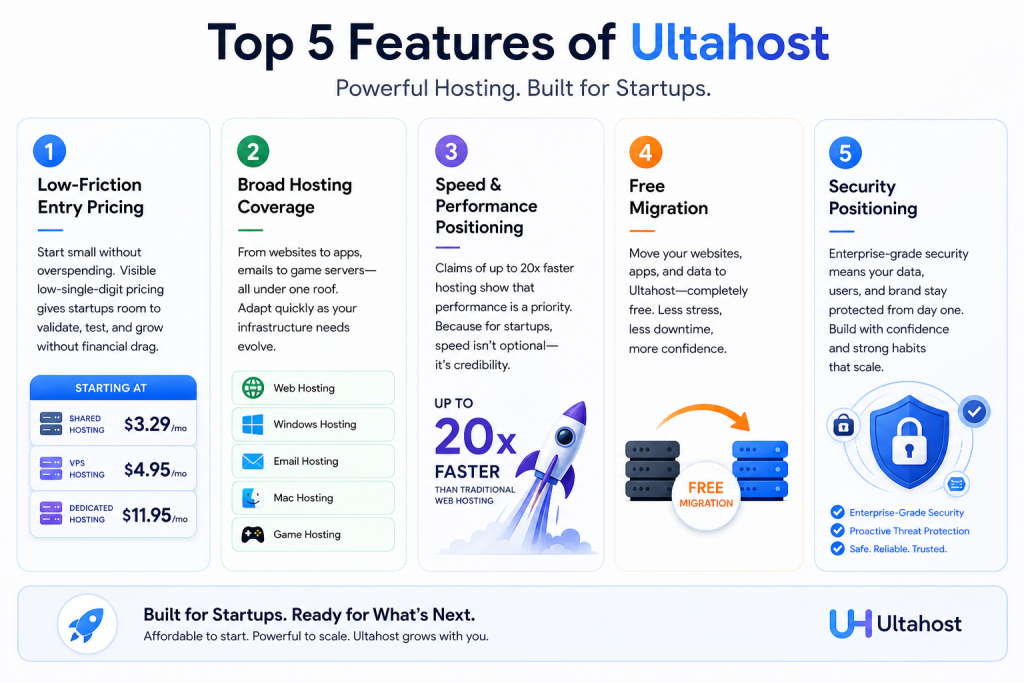
The homepage currently surfaces low entry pricing in the main plan area, with visible promotional numbers such as $3.29, $4.95, and $11.95 for different hosting options.
That matters for startups because the early question is rarely, “What is the perfect forever stack?”
It is more often:
- What can we launch on now?
- What will not embarrass us later?
- What can we still justify if traffic is uneven?
Visible low-single-digit entry pricing is useful because it gives founders room to validate before overspending.
That does not automatically make a host better, but it does make the platform easier to test without creating financial drag too early.
Top Feature #2: Broad Hosting Coverage
Ultahost does not present itself as a one-lane product.
The homepage explicitly surfaces categories like:
- Web hosting.
- Windows hosting.
- Email hosting.
- Mac hosting.
- Game hosting.
That is useful for startups because infrastructure needs can shift quickly. A company might start with a marketing site and a lightweight app, then later need different hosting types for customer portals, test environments, or operational services.
The broader the platform coverage, the less likely the team is to hit an awkward wall and start another migration cycle too early.
Top Feature #3: Speed And Performance Positioning
The official homepage claims hosting that is up to 20x faster than traditional web hosting.
Whether a startup takes the exact number literally or not, the commercial point is clear: performance is a core sales argument, not a side note.
That matters because startups live and die on user patience.
Slow product pages, slow dashboards, or unstable early user experiences do real damage when a company is still earning trust.
Performance-focused positioning is a healthy sign because it shows the host understands that speed is not a luxury feature. It is part of product credibility.
Top Feature #4: Free Migration
Free migration is one of those features that looks simple on a website and feels huge in real life.
Startups change hosts, move projects, or consolidate environments more often than they expect. The homepage highlights free migration, which immediately lowers the fear of making a hosting move.
That is valuable because migrations are usually where early teams lose time, energy, and confidence.
If a host is willing to reduce that burden, it becomes much easier to justify trying the platform.
This is especially relevant for startups leaving:
- Shared hosting that has become too weak.
- Agency-managed infrastructure they want to own directly.
- Temporary launch setups that were never meant to scale.
Top Feature #5: Security Positioning
Ultahost also leans into enterprise-grade security on the homepage.
That matters even for startups, maybe especially for startups, because young companies often underinvest in infrastructure safeguards until a problem forces the issue.
Security positioning by itself does not prove perfect execution, but it does show that the platform understands what buyers care about once real users and live data are involved.
For startups, the right security conversation is not “Are we huge enough to care yet?”
It is:
- Are we building habits that will age well?
- Are we reducing obvious risks early?
- Are we choosing tools that do not make security an afterthought?
That makes this feature more meaningful than many teams initially assume.
Pricing In Startup Context :
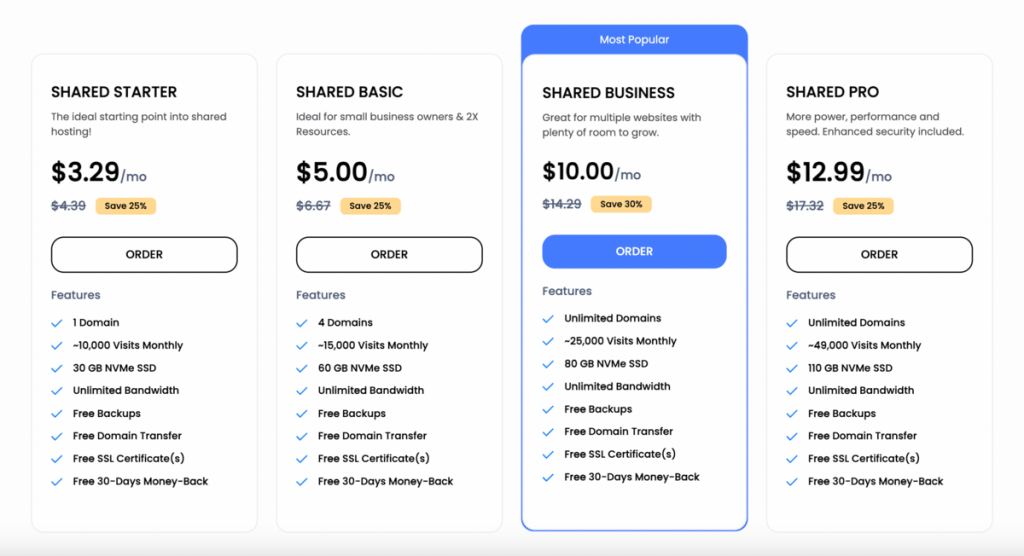
The official homepage surfaces a spread of promotional entry prices, which is normal in hosting.
The useful takeaway is not only the lowest number on the page. It is the visible ladder:
- Lower-cost starter options exist.
- Mid-tier options are visible.
- Higher-value plans are also present for more demanding workloads.
That structure is exactly what startups need.
Very early teams can start lighter.
Growing teams can step up when traffic, storage, environments, or operational needs increase.
If you want to compare that fit directly, start with Ultahost here and map the public plan ladder to your expected product stage rather than only to today’s traffic.
That gives you a better answer than buying solely on the lowest promo price.
Real-World Startup Example :
Imagine a startup launching a SaaS landing page, docs site, and first customer dashboard.
At day one, the main requirements are usually:
- Reasonable launch cost.
- Enough speed to avoid a bad first impression.
- A path to scale without panic.
- Support when migration or setup gets annoying.
Ultahost’s public positioning fits that scenario well because it combines cost visibility, scale language, migration help, and broad hosting choices.
The startup still has to execute well. No hosting provider replaces product quality or growth strategy.
But the infrastructure choice becomes less of a blocker when the platform is built to cover both launch and early scaling phases.
Alternatives Startups Might Compare :
A startup evaluating Ultahost will probably compare it with:
- Budget-first shared hosts.
- Developer-first cloud platforms.
- More premium managed hosting options.
Ultahost looks strongest when a team wants a middle path:
- More scale language than cheap basic hosting.
- More cost visibility than many higher-touch enterprise options.
- More hosting variety than a single narrow product line.
That makes it attractive to startups that want flexibility without immediately jumping into a much heavier infrastructure stack.
Setup Advice For Startups :
If you are evaluating Ultahost as a startup, the practical setup approach is:
- Start with the smallest plan that still respects your app’s real performance needs.
- Use free migration if you are moving from an existing host.
- Keep security and backup expectations part of the decision from day one.
- Choose the hosting type that matches your product architecture, not just the cheapest headline price.
That is the startup-safe way to evaluate hosting.
It keeps spending disciplined without pretending infrastructure never matters.
Verdict :
Ultahost looks like a strong startup fit in 2026 because its official homepage speaks directly to startup concerns: visible entry pricing, hosting breadth, speed positioning, security language, and migration support.
The platform looks best for startups that want a host that can begin affordably and still feel credible as the product grows.
If that sounds like your stage, start with Ultahost here and compare the public hosting options against your launch workload, expected growth path, and migration needs.
That sort of grounded comparison is usually more useful than chasing whichever host has the loudest discount banner.
FAQ :
Is Ultahost good for startups?
Yes, it looks like a solid startup option because the official homepage combines low entry pricing, broad hosting coverage, scale messaging, security positioning, and free migration.
What makes Ultahost startup-friendly?
The most startup-friendly traits are visible promotional entry pricing, hosting variety, speed claims, and the promise that plans scale as the business grows.
Does Ultahost help with migration?
Yes. The official homepage currently highlights free migration.
Why would a startup choose Ultahost over a cheaper host?
A startup may choose Ultahost when it wants a better balance between affordability, growth flexibility, migration help, and broader infrastructure options than the very cheapest hosts usually provide.
That is especially relevant for founders who want to stay lean now without choosing a platform that feels disposable the moment traffic, environments, or security expectations begin to rise.
If that is the exact balancing act you are dealing with, start with Ultahost here and compare the visible starter plans against the product stage you expect to reach in the next six to twelve months, not only the one you are in today.
That longer view usually produces a better hosting decision than buying only around today’s cheapest promo number.
It also reduces the odds of paying twice for the same decision later.