


CallHippo makes the most sense for startups that need a business phone system before they are ready to…
Imagine a startup with two founders, one SDR, and one customer-success hire.
In this guide
Who This Post Is For :
CallHippo makes the most sense for startups that need a business phone system before they are ready to build a complicated enterprise telephony stack. The official site positions it as AI-powered voice software for modern businesses, with cloud calling, contact-center tools, analytics, and workflow features that help small teams look more organized without acting like a Fortune 500 company overnight.
Disclosure: Stack99 earns a commission if you buy through links on this page. It costs you nothing extra and never changes our assessment.
That is a very startup-shaped problem.
Early teams usually do not need endless telecom complexity. They need:
- A proper business number.
- Calling workflows for sales or support.
- Basic reporting.
- Better collaboration than personal phones can give them.
- Room to grow without redoing the whole setup in three months.
If that sounds like your stage, start with CallHippo here.
Why CallHippo Fits Startups :
The strongest thing about CallHippo’s official positioning is that it does not force startups to jump straight into giant contact-center theater. The homepage and pricing pages frame the product as cloud telephony that can work for startups, small businesses, and growing teams that want virtual numbers, call routing, AI assistance, analytics, and CRM-friendly integrations in one place.
That matters because startups often grow through a few specific communication pain points:
- Founders answering everything themselves.
- Sales reps needing a cleaner outbound setup.
- Support getting messy as volume rises.
- Remote teams needing one shared phone workflow.
- Local numbers becoming limiting when expansion starts.
CallHippo fits that environment because the official pricing ladder starts low enough for small teams while still exposing more advanced features higher up.
The public pricing page currently shows monthly list prices such as:
- Basic at $0.
- Bronze at $18 per user per month.
- Silver at $30 per user per month.
- Platinum at $42 per user per month.
- Enterprise with custom pricing.
That is not cheap-cheap, but it is understandable.
Top Features For Startups :
CallHippo is feature-heavy, but a startup should care about the features that reduce chaos first.
Virtual Numbers And Fast Setup
The official product pages emphasize instant activation, international numbers, and cloud-based calling. That helps startups look more established quickly without needing a physical office phone system.
AI-Powered Calling Tools
The official site now leans into AI capabilities such as call transcriptions, conversation intelligence, and support for better analysis. For a startup, that can be useful because it helps managers review sales or support quality without manually listening to everything.
Call Routing And Team Collaboration
The features pages highlight IVR, call queues, forwarding, call transfer, and related workflow tools. These matter for startups once more than one person is handling incoming conversations.
Integrations
The pricing page says CRM integrations become available on higher tiers. That matters because a startup phone system is much more useful if it does not sit alone in a corner while sales data lives somewhere else.
If you want to compare those features to your current workflow, start with CallHippo here and map one live inbound or outbound process against the product.
Real-World Startup Example :
Imagine a startup with two founders, one SDR, and one customer-success hire. At first, everybody just uses personal phones, Slack, and scattered notes. That works until it does not.
Then the same problems show up every week:
- Missed follow-ups.
- No clean call tracking.
- No consistent team number.
- Weak visibility into who handled what.
- Harder handoffs between sales and support.
That is where a tool like CallHippo starts making practical sense.
The startup does not necessarily need a full contact center. It just needs one place to:
- Route calls properly.
- Give reps business numbers.
- Track performance.
- Record conversations.
- Improve follow-up discipline.
That is a much more realistic early-stage use case than pretending every startup needs an enterprise customer-service floor.
Pricing In Context :
CallHippo’s public pricing page is helpful because it shows a full tier ladder rather than hiding everything behind demos.
The free Basic plan lowers the barrier to testing, while Bronze, Silver, and Platinum create a clear progression based on feature depth. The page also shows annual billing discounts and plan-based differences around users, minutes, integrations, AI, and management tools.
For a startup, the pricing question is usually not “what is the absolute cheapest telephony option?” It is “when does the calling setup become good enough to stop slowing the team down?”
That is why Bronze or Silver often look like the more realistic evaluation points. Free is fine for a test. Paid tiers are where the team starts to see whether the system can become a serious operating tool.
Alternatives For Startups :
A startup considering CallHippo is usually also weighing:
- Simpler virtual phone providers.
- Heavier business telephony suites.
- CRM-attached calling tools.
- “Do nothing for now” and keep using personal numbers.
CallHippo looks strongest when the team wants a middle-ground setup:
- Broader than a barebones number app.
- More accessible than a large enterprise call-center suite.
- Flexible enough for sales and support growth.
That balance is what gives it startup appeal.
Another reason it appeals to startups is that the official site does not force a fake either-or between “tiny team” and “giant call center.” The pricing ladder and feature set leave room for a company to start simple and then add more structure as volume rises.
That matters because communication tools often fail not when they are too small, but when they force a painful migration the moment a team becomes slightly more serious.
Setup Steps For A Startup :
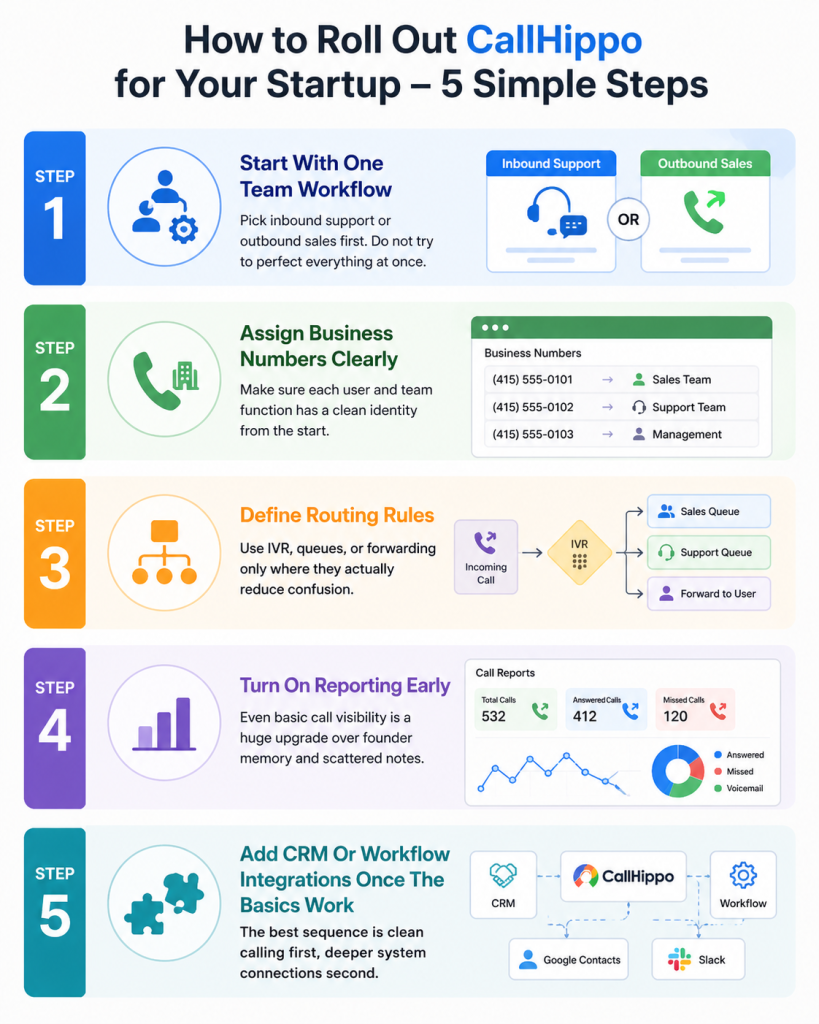
If I were rolling out CallHippo for a startup, I would keep it simple:
Step 1: Start With One Team Workflow
Pick inbound support or outbound sales first. Do not try to perfect everything at once.
Step 2: Assign Business Numbers Clearly
Make sure each user and team function has a clean identity from the start.
Step 3: Define Routing Rules
Use IVR, queues, or forwarding only where they actually reduce confusion.
Step 4: Turn On Reporting Early
Even basic call visibility is a huge upgrade over founder memory and scattered notes.
Step 5: Add CRM Or Workflow Integrations Once The Basics Work
The best sequence is clean calling first, deeper system connections second.
If you want to test that rollout path, start with CallHippo here and pilot it with one real revenue or support workflow.
Where Startups Get The Most Value :
The biggest value usually appears when a team has already outgrown informal calling but still needs cost discipline.
That usually means:
- Early sales teams.
- Customer-facing SaaS startups.
- Remote-first support teams.
- Internationally expanding small businesses.
The more important calling becomes to daily work, the more valuable proper routing, recording, analytics, and business identity become.
It is also where startup managers start to notice a second-order benefit: clearer accountability. Once calls, routing, and follow-ups live inside a structured platform, it becomes much easier to see whether the team is actually responding quickly, handling conversations well, and keeping sales momentum alive.
That operational clarity is often what turns a phone tool into a real startup system instead of another app no one takes seriously.
There is also a hiring benefit hidden inside that shift. When a startup brings in its first SDR, account executive, or support rep, a real phone system shortens onboarding because the workflow already exists. New hires do not have to guess which number to use, how to route urgent calls, or where to log conversations.
That matters more than founders expect. Fast-growing startups usually feel operational pain right when new people join, not only when customer volume rises. A cleaner calling setup reduces that friction early.
It also makes founders less likely to become the accidental fallback for every missed call. Once the process is distributed correctly, the team can actually operate like a team.
And once a startup reaches that point, the value conversation becomes much easier.
Verdict :
CallHippo looks like a strong fit for startups in 2026 because the official site combines a relatively accessible pricing ladder with features that matter in the early growth stage: business numbers, cloud calling, AI-assisted analysis, routing, reporting, and room to integrate with broader sales or support workflows later.
It is not the only startup phone option out there, and not every early team needs more than the free tier. But for companies that are already feeling friction around team calling, start with CallHippo here and compare the paid tiers against the cost of continuing with a messy setup.
FAQ :
Is CallHippo good for startups in 2026?
Yes. The official site and pricing structure make it a practical option for startups that need business calling, routing, analytics, and room to scale.
How much does CallHippo cost?
The public pricing page shows Basic at $0, Bronze at $18 per user per month, Silver at $30, Platinum at $42, and Enterprise with custom pricing.
Which CallHippo plan is best for startups?
For many startups, Bronze or Silver are the most realistic starting points because they move beyond the free test tier into more useful daily operations.
What makes CallHippo better than using personal phones?
It gives startups shared business numbers, cleaner routing, reporting, recordings, and more structured team communication than informal personal-device workflows.
More on CallHippo
Hand-picked guides to help you choose the right tool — no fluff.
 PricingCallHippo Pricing 2026Real tier prices and what each plan actually includes.
 AlternativesCallHippo Alternatives 2026Credible alternatives and when each one wins.
 TutorialsWhatConverts Beginner's Guide 2026A clean start-here walkthrough with no jargon.
 Advanced GuidesKartra, WebinarJam & EverWebinar Advanced Guide 2026Deeper workflows once the basics are in place.