

When To Consider Alternatives :
SurveySparrow is a strong product in 2026 if you want conversational surveys, branded feedback workflows, and a broader customer-experience style platform rather than a plain old form builder.
The official pricing and product pages make that positioning pretty clear. SurveySparrow is not just trying to be a lightweight survey toy. It is trying to cover surveys, CX feedback, automation, integrations, and more structured team workflows.
So why look at alternatives?
Usually for one of these reasons:
- You want simpler forms with less platform weight.
- You need deeper enterprise research tooling.
- You care more about form-building flexibility than conversational survey style.
- You want a different pricing shape or lower-complexity entry point.
- You need a product that fits a very specific feedback workflow better.
If you want to compare SurveySparrow itself while you read, start with SurveySparrow here.

Alternative 1: Typeform
Typeform is one of the most natural SurveySparrow alternatives because it is well known for polished, conversational, one-question-at-a-time experiences.
Why it is relevant:
- Strong form and survey presentation.
- Clean user experience.
- Good fit for lead capture, quizzes, and branded interactions.
- Familiar option for marketing teams and creators.
Compared with SurveySparrow, Typeform often appeals to buyers who care most about front-end survey feel. SurveySparrow usually looks stronger when the buyer wants a more layered feedback platform with CX-oriented depth.
That difference matters because “great survey experience” and “great feedback program” are not always the same thing. Typeform often wins the first conversation. SurveySparrow is often more compelling in the second.
Alternative 2: QuestionPro
QuestionPro is relevant when the buyer wants broader survey and research capability with more classic research-program depth.
Why buyers consider it:
- Strong survey and research positioning.
- Better fit for teams running more formal feedback programs.
- Good relevance for NPS, research, and structured analysis.
Compared with SurveySparrow, QuestionPro can feel more research-program oriented, while SurveySparrow often feels more experience-led and interface-friendly.
That makes QuestionPro especially relevant for teams with more formal research habits, while SurveySparrow often feels more natural for teams that want a modern feedback engine without pushing straight into heavyweight research software.
Alternative 3: Qualtrics
Qualtrics is the heavyweight option in this conversation. Its official positioning leans into enterprise experience management, research, and large-scale organizational feedback programs.
That makes it relevant if:
- You need enterprise-scale experience management.
- Complex reporting and governance matter more than lightweight usability.
- The business wants a very established enterprise category leader.
The tradeoff is obvious: Qualtrics is not the tool most smaller teams choose for simple speed. SurveySparrow usually feels more approachable for leaner organizations.
That is why Qualtrics belongs in the comparison, but not always at the top of the shortlist for growing teams. It solves a different scale problem.

Alternative 4: Jotform
Jotform is a strong alternative when form-building flexibility matters as much as classic survey use cases.
Why it matters:
- Broad form-building use cases.
- Strong template culture.
- Good fit for operational forms, applications, registrations, and internal workflows.
Compared with SurveySparrow, Jotform can make more sense when the buyer’s needs stretch beyond surveys into all-purpose form operations. SurveySparrow stays stronger when the priority is customer feedback and conversational experience design.
That distinction is useful because many businesses start by saying they need “survey software” when what they really need is a mix of forms, questionnaires, and feedback collection. Jotform can absorb more of that broader form workload.
Alternative 5: Survicate
Survicate is another meaningful alternative, especially for teams that care about customer feedback loops across digital products, websites, and support workflows.
Why it is relevant:
- Strong feedback-program orientation.
- Good fit for SaaS and product-led teams.
- Useful for teams that want customer sentiment signals closer to the product journey.
That makes Survicate especially interesting if the survey program is deeply tied to product feedback and in-journey responses rather than broader multi-use survey publishing.
It is a strong reminder that some alternatives win by being more specialized, not by trying to be everything for everyone.
Comparison Matrix :
Here is the simple practical read:
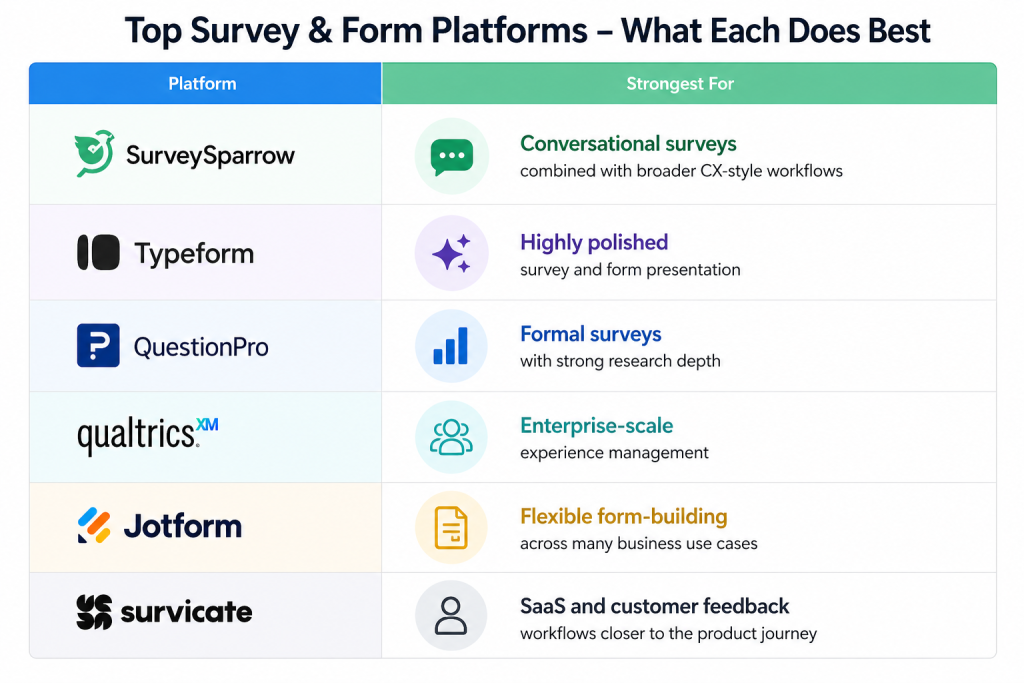
- SurveySparrow: strongest for conversational surveys plus broader CX-style workflows.
- Typeform: strongest for polished survey and form presentation.
- QuestionPro: strongest for formal survey and research depth.
- Qualtrics: strongest for enterprise-scale experience management.
- Jotform: strongest for flexible form-building across many business use cases.
- Survicate: strongest for SaaS and customer-feedback workflows closer to the product journey.
That does not give one universal winner. It gives six different priorities.
That is why alternatives research matters here. Survey tools start to look similar until you compare:
- Survey experience style.
- Form flexibility.
- CX depth.
- Enterprise governance.
- Product-feedback fit.
Those differences become obvious very quickly once a team is doing more than sending one simple questionnaire.
They also become expensive quickly when chosen badly. A platform that is great for lead-gen forms may feel weak for lifecycle NPS. A tool that is brilliant for enterprise research may feel too heavy for simple customer pulse checks.
Pricing Context :
SurveySparrow’s official pricing page currently highlights:
- A forever free plan.
- Basic for students, freelancers, and personal projects.
- Starter for solo creators, blogs, and early-stage founders.
- Business for teams that need branding, collaboration, workflows, and automation.
- Enterprise for larger organizations with custom requirements.
The same public page also shows practical usage limits like responses, users, contacts, emails, and API calls, which is helpful because feedback software can get expensive fast when limits are vague.
That means SurveySparrow’s pricing story is not just about the headline plan names. It is really about how much response volume, collaboration, and automation your team needs.
That is a healthier way to evaluate survey software. The cheapest plan often stops being the cheapest once the team hits real response volume, needs more collaborators, or wants workflow automation instead of manual exports.
Alternatives tend to split into a few pricing styles:
- Simple form-first pricing.
- Research-program pricing.
- Enterprise custom pricing.
- Product-feedback pricing.
That is why the right question is not only “what is the cheapest plan?” It is “which pricing model matches how our team actually collects, analyzes, and acts on feedback?”
If you want to compare that directly, start with SurveySparrow here and map one live survey program against the usage limits that matter to you most.
When To Stick With SurveySparrow :
SurveySparrow remains especially compelling if you want:
- Conversational survey delivery.
- A broader CX-friendly platform feel.
- Stronger team collaboration than a bare form tool.
- Feedback workflows that go beyond simple one-off forms.
- Practical plan progression from free to enterprise.
Another reason to stay is usability balance. SurveySparrow sits in a useful middle ground between ultra-light form tools and heavier enterprise feedback platforms.
That middle ground matters a lot.
Many teams do not want a survey product that feels too basic, but they also do not want enterprise software that feels like it needs a committee just to launch one feedback flow.
SurveySparrow’s middle-ground appeal is exactly why it keeps showing up in this conversation. It is polished enough to feel modern, but it is still easier to grasp than some larger CX suites.
It also gives buyers a more balanced path if they expect their feedback needs to grow. A team can start with smaller survey programs and still move toward more structured workflows without immediately changing categories.
If that sounds like your team, start with SurveySparrow here and compare it against one real feedback program instead of a generic feature checklist.
Verdict :
The best SurveySparrow alternatives in 2026 depend on what kind of feedback operation you are really building.
Typeform is attractive for elegant survey presentation. QuestionPro is attractive for research depth. Qualtrics is attractive for enterprise-scale experience management. Jotform is attractive for broader form operations. Survicate is attractive for product-oriented feedback loops.
SurveySparrow itself stays attractive when you want conversational surveys with a more complete customer-experience feel than a basic form builder gives you.
That is why the better decision is usually about workflow fit, not brand familiarity.
If SurveySparrow still looks close to your sweet spot, start with SurveySparrow here and test it against the exact response, branding, and automation needs your team has right now.
That practical comparison is usually what prevents buying a survey platform that looks impressive in demos but awkward in daily use.
It is also the best way to avoid overbuying. Teams often assume they need an enterprise feedback stack when a more focused conversational survey platform would already solve the actual problem.
That kind of discipline matters because survey software tends to spread quietly across a business. Once different teams start launching forms, collecting responses, and automating follow-up, the wrong foundation becomes annoying very quickly.
It can also become expensive quickly once response limits, collaborator counts, and integration needs start expanding. That is why product fit matters just as much as headline polish.
It is also why teams should compare the software against one real feedback workflow, one real reporting need, and one real response-volume assumption before committing.
That kind of comparison usually tells you very quickly whether you need a lighter survey tool, a stronger CX platform, or a more specialized alternative.
It is also the best way to keep the buying decision grounded in real team needs instead of demo-day excitement.
FAQ :
What are the best SurveySparrow alternatives in 2026?
Strong alternatives include Typeform, QuestionPro, Qualtrics, Jotform, and Survicate, depending on whether you prioritize presentation, research depth, enterprise scope, or product-feedback fit.
Does SurveySparrow have a free plan?
Yes. The official pricing page includes a forever free plan, along with Basic, Starter, Business, and Enterprise options.
When should you choose SurveySparrow over Typeform?
SurveySparrow makes more sense when you want conversational surveys plus a broader feedback and CX workflow instead of a mostly presentation-led form experience.
When does an alternative make more sense than SurveySparrow?
An alternative makes more sense when you need deeper enterprise research tooling, broader general-purpose forms, or a more specialized feedback workflow than SurveySparrow’s sweet spot.