

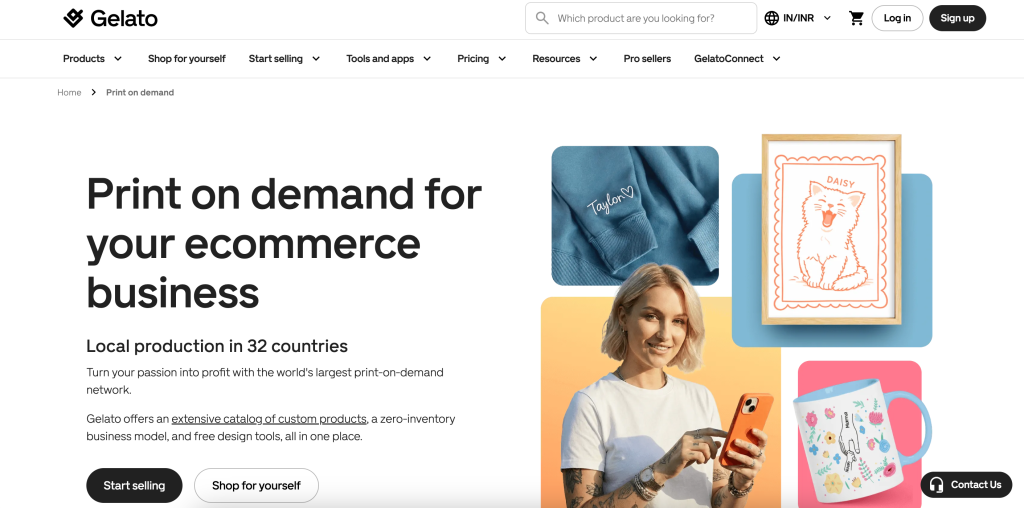
Gelato is a strong print-on-demand platform because it sells a simple promise: create and sell custom products without the usual inventory headache. The official site talks about local production in 32 countries, no monthly fees or minimums, 500+ customizable products, and a network built for global selling. If you want to see the official entry point while reading, start here.
But every print-on-demand business eventually asks the same question: is the platform you picked still the best fit once you actually start selling? That is why alternatives matter. Sometimes the answer is “yes, stay put.” Sometimes the answer is “compare a local print partner, a different POD network, or an in-house setup.” The useful part is not changing for the sake of change. It is matching the tool to the business model.
When To Consider Alternatives :
You should look at alternatives if your product mix has changed, if your customer geography is more concentrated than before, or if your fulfillment needs are more custom than Gelato’s standard model. You should also compare alternatives if you want a different pricing structure, if your catalog requirements are narrower, or if you need more control over how products are produced and shipped.
Gelato’s own pages make a strong case for the platform. The official site says it is free to use, has no minimum orders, and charges you only when you sell. The Shopify and Etsy pages add another big point: local production and fast fulfillment are central to the model. That means alternatives are not about finding a better “print-on-demand” category. They are about finding a better fit for your specific business shape.
Alternative 1: A More Centralized POD Network
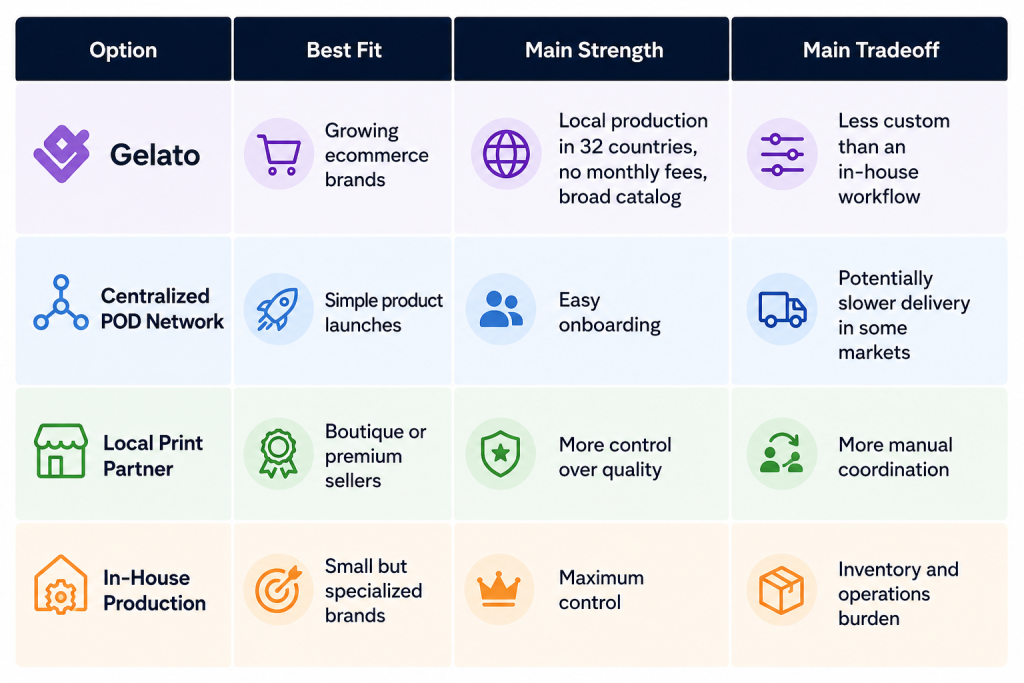
A centralized POD network can be appealing if you want a familiar app-style experience and a narrow product selection. The upside is usually simplicity. The downside is that centralized production can mean less local routing and slower delivery for some customers. Gelato’s local production story is one of its biggest advantages, so this category is worth comparing carefully if shipping speed matters to you.
For sellers with broad international demand, a centralized model can feel easier at first and less flexible later. Gelato’s official positioning around local production in 32 countries is exactly the reason many merchants choose it. If you do compare away from Gelato, make sure you are not trading speed for a nicer marketing page.
Alternative 2: A Local Print Partner Model
A local print partner model makes sense when you want hands-on quality control or regional specialization. Instead of letting a platform route every order the same way, you can work with printers that already understand your market and product types. That can be useful for premium art, custom campaigns, or brands that need more of a bespoke finish.
The tradeoff is operational effort. A local partner model can mean more vendor coordination, more manual setup, and less software convenience. Gelato’s big advantage is that it gives you the local-production story without forcing you to manage the printer relationship every day. So if you compare against local partners, the real question is whether your team wants control or convenience.

Alternative 3: An In-House Production Setup
In-house production is the cleanest alternative if you want total control. You decide the gear, the timing, the packaging, the quality checks, and the shipping process. That can be excellent for brands that are small but obsessive, or for teams that want to differentiate on craftsmanship rather than software.
The downside is obvious: you own the inventory risk and the operational overhead. Gelato’s no-minimum, pay-only-when-you-sell model exists specifically to remove those headaches. If your business is still proving demand, in-house production can create more stress than leverage. For many merchants, that is the exact reason a POD platform exists in the first place.

Comparison Matrix :
When To Stick With Gelato :
Gelato remains a very strong choice if your store benefits from global reach, local fulfillment, and a broad product catalog. The official pages emphasize 500+ customizable products, 32 countries of production, and the ability to sell without upfront fees or minimums. That is a combination many sellers will never outgrow.
Gelato also makes sense if your business lives on ecommerce integrations. The official site highlights Shopify, Etsy, WooCommerce, and TikTok Shop paths. That means the platform is designed to plug into the places merchants already sell, which is exactly what you want from a POD tool. The fewer steps it takes to launch a product, the more likely it is that you will actually launch it.
Pros And Cons :
The Upside –
- Free to start with no minimum orders.
- Local production in 32 countries is a real competitive advantage.
- The catalog is broad enough for many brands.
- Official integrations make setup easier.
- The pricing story is simple: sell first, pay as you go.
The Tradeoffs –
- Not every seller needs global local-production routing.
- A niche brand may prefer a more specialized printer.
- Some merchants will still want tighter operational control.
- A platform this broad is not always the best fit for hyper-bespoke production.

Pricing And Operating Notes :
The official pricing story is simple enough to repeat without guesswork: Gelato is free to use, there are no monthly fees or minimum orders, and you pay when you sell. That is a strong entry point for a new store or a side project because it removes the pressure to justify software spend before you have demand. For many merchants, that is exactly the kind of pricing model that lowers the barrier to trying a new catalog or expanding into a new country.
The operating story is just as important. Gelato’s pages keep pointing to local production, broad product coverage, and easy ecommerce integrations. That means the platform is designed for merchants who care about shipping reach and product variety at the same time. If you compare it against a narrower alternative, make sure you are not losing the thing Gelato is best at just to gain a feature you may never use. If you want the official seller experience, the Gelato platform is the cleanest place to evaluate it directly.
The practical takeaway is straightforward: if your business needs breadth, scale, and simple entry pricing, Gelato is hard to beat. If you need a very special production workflow, compare away. But do it with a real reason, not just because alternatives exist.
Another useful way to think about alternatives is by geography and product depth. If your orders are concentrated in one region, a local specialist may feel easier. If your catalog is narrow but premium, a bespoke printer might be a better fit. If your store is still testing demand, the free-to-start model is a huge win because you can learn without carrying inventory risk. Those are real tradeoffs, and they are the kind that matter more than a generic comparison table.
Gelato’s official seller flow is also attractive because it lowers the number of moving parts. That is not a small thing. Every extra vendor in a commerce stack adds another place for delays, support tickets, or configuration drift. If Gelato is already doing the main job well, the burden of proof for switching should be high, not casual.
So the best alternative question is not “what else exists?” It is “what specific problem am I solving by leaving this platform?” If you cannot name the problem clearly, you probably do not need to move.
There is also a growth angle worth keeping in mind. A seller who is just getting started may care most about simplicity and low risk, which is exactly where Gelato’s no-monthly-fee setup helps. A seller who is already shipping at scale may care more about geography, catalog breadth, and the ability to test products without tying up cash in inventory. That is why the official Gelato flow remains competitive even when you start looking at alternatives. It is not trying to win on one tiny feature. It is trying to remove enough friction that you can keep building.
If you are comparing options in a spreadsheet, add one more line item: how much time does the platform save you every week? That is often the hidden cost that decides the winner.
Verdict :
Gelato is one of those platforms that is easy to recommend until your business needs become very specific. For many sellers, the official combination of no monthly fees, local production, and a large catalog is exactly what they need. For others, the better move is to compare alternative fulfillment models before committing.
If you want the simplest possible test, keep Gelato and run one real product line through it. If the delivery speed, catalog fit, and workflow feel right, the official platform probably belongs in your stack. If not, compare the alternatives against your real fulfillment bottlenecks rather than against marketing claims.
FAQ :
Is Gelato free to use?
Yes. The official site says there are no monthly fees or minimums, and you only pay when you sell.
How many countries does Gelato produce in?
The official pages say local production is available in 32 countries.
Does Gelato have a large product catalog?
Yes. The site highlights more than 500 customizable products.
What should I compare Gelato against?
Compare it against a centralized POD network, a local print partner, or an in-house setup depending on how much control you want.
Is Gelato a bad choice if I want more control?
Not necessarily. It is just a different tradeoff. Gelato is built for scale, convenience, and global routing, while other models may offer more hands-on control.