


In this guide
Why This Comparison Matters :
ThorData sits in the web data and proxy infrastructure category, which means the buying decision is usually not about flashy features. It is about reliability, geo coverage, success rates, and whether the platform makes large-scale public web access easier or harder.
Disclosure: Stack99 earns a commission if you buy through links on this page. It costs you nothing extra and never changes our assessment.
The official ThorData homepage positions the product around:
- Global proxy infrastructure.
- Scraper APIs.
- Residential, mobile, ISP, and datacenter proxy options.
- Precise geo-targeting and session control.
- Structured data delivery through scraping tools and datasets.
That makes ThorData a serious option for teams that need data collection at scale, not just a few requests a day.
If you want a good mental model while you read, start with ThorData here.
Quick Comparison Table :
| Tool | Starts at | Free option | Best for |
|---|---|---|---|
| ThorData ↗THIS GUIDE | Usage-based | free trial | Proxy network |
| Bright Data ↗ | Usage-based | 7-day trial | Proxy / web data |
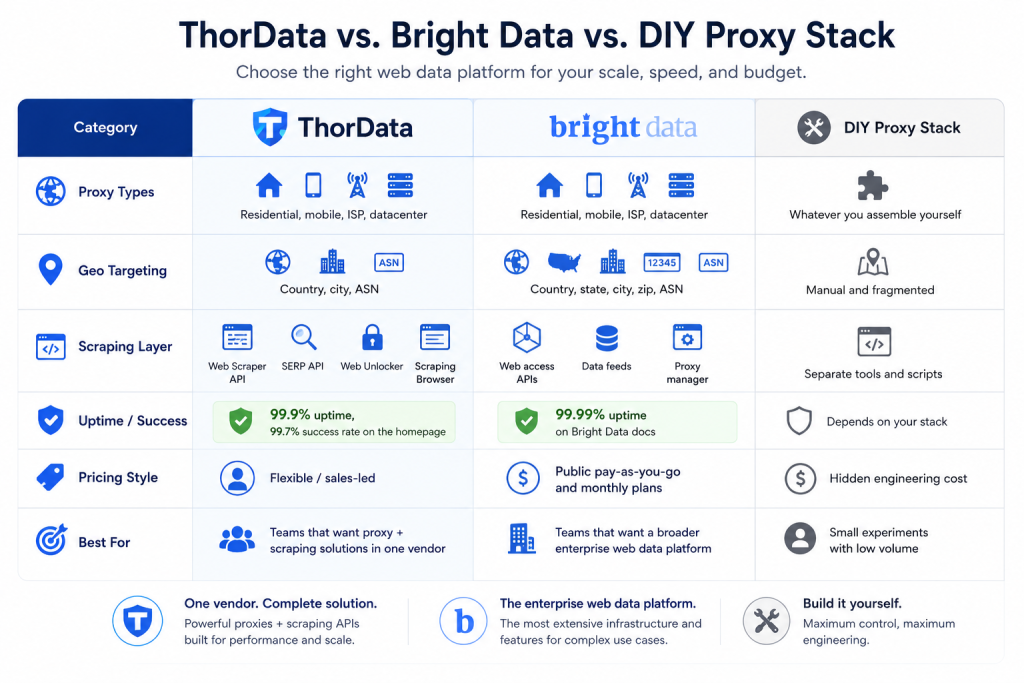
The real choice is not just vendor A versus vendor B. It is whether you want a managed web data platform or a do-it-yourself infrastructure problem.
ThorData Deep Dive :
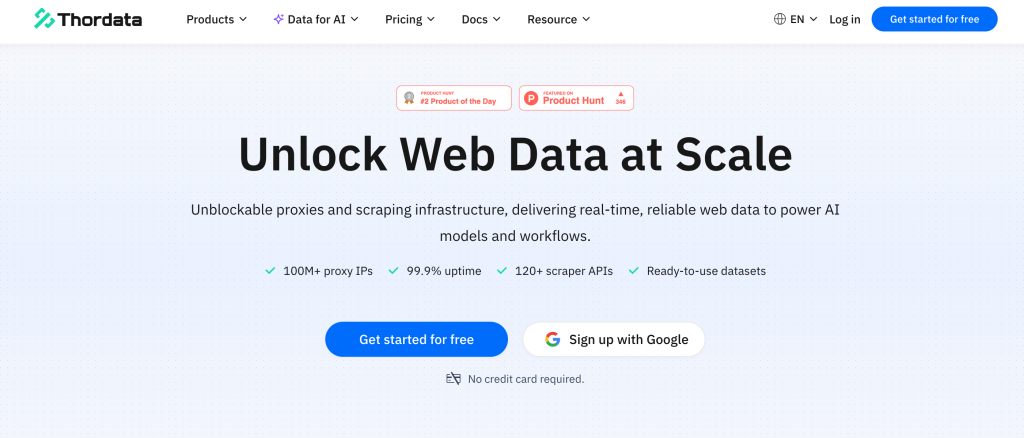
ThorData is built around access and execution. The official site highlights more than 100 million ethical proxies, 190+ countries, and several proxy classes:
- Residential proxies.
- Mobile proxies.
- Static ISP proxies.
- Datacenter proxies.
- High-bandwidth proxy options for large transfers.
That broad set matters because not every scraping job has the same shape. Some jobs need stable residential sessions. Some need mobile traffic. Some need more predictable bandwidth. Some need low-cost datacenter access for simpler tasks.
The official site also pushes scraper APIs and structured data tools:
- Web Scraper API.
- SERP API.
- Web Unlocker.
- Scraping Browser.
- Datasets.
That is a strong sign that ThorData wants to reduce how much custom engineering teams need to write. The less your team has to maintain, the faster the data operation stays usable.
If you want to centralize access instead of maintaining proxy scripts yourself, start with ThorData here.
Bright Data Deep Dive :
Bright Data is the more expansive platform in this comparison. The official docs describe it as a web data platform with proxy infrastructure, web access APIs, data feeds, and an MCP server for live web intelligence.
Its strongest selling points are:
- Very large proxy coverage.
- Broad enterprise tooling.
- Public pricing pages for proxies.
- Proxy Manager for control and monitoring.
- Data feeds and prebuilt scraping options.
Bright Data is attractive when your team is not only collecting data, but also standardizing how the data pipeline is controlled, monitored, and delivered into downstream systems.
That said, it can also feel heavier. If your needs are focused on proxy access and scrape execution rather than a full enterprise data platform, Bright Data may be more infrastructure than you need.
Feature Matrix :
Here is the practical split:
ThorData Strengths
- Strong proxy variety.
- Good geotargeting.
- Scraper APIs and browser tools.
- Mobile and high-bandwidth options.
- Flexible pricing positioning.
- Simple dashboard and 24/7 support emphasis.
Bright Data Strengths
- Larger-scale proxy network.
- Public pricing for residential and ISP proxies.
- Proxy Manager for traffic control.
- Web access APIs and datasets.
- Strong enterprise story.
- Clear developer and AI-data positioning.
DIY Stack Strengths
- Maximum control.
- Lowest entry price if you already have engineering capacity.
- Easier to customize for highly unusual workflows.
DIY Stack Weaknesses
- Maintenance burden.
- Higher failure risk.
- Harder geo coverage.
- More time spent debugging than shipping.
Pricing Comparison :
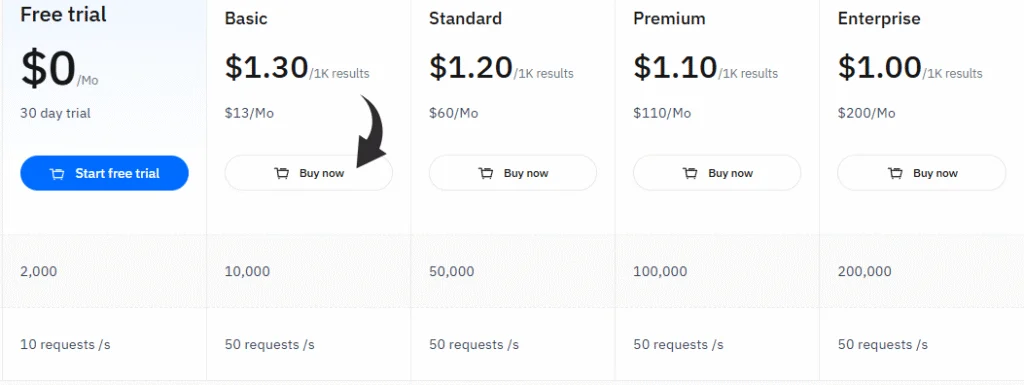
ThorData does not market itself as a simple one-price product. The official site emphasizes flexible pricing plans, free trials, and different proxy classes. That usually means sales-led packaging that changes with usage and volume.
Bright Data, by contrast, publishes explicit residential proxy pricing. The current pricing page shows pay-as-you-go at $4 per GB and monthly bundled plans for heavier usage.
That gives you a clear tradeoff:
- ThorData is easier to frame if you want a proxy and scraping vendor that can size around your needs.
- Bright Data is easier to estimate if you want a public price ladder and a broader platform.
- DIY is cheaper on paper but usually more expensive in engineering time.
The best buying question is not “Which one is cheaper?” It is “Which one costs less once my team factors in setup, breakage, retries, and maintenance?”
If you are still weighing that, start with ThorData here and compare it against your current proxy spend and engineering overhead.
Use Case Recommendations :
ThorData is a strong fit for:
- Teams that want proxy infrastructure plus scraping tools from one vendor.
- Companies that need mobile or high-bandwidth access.
- Operations that depend on geo-targeted public web collection.
- Teams that need stable access without building every piece themselves.
Bright Data is a strong fit for:
- Bigger data teams with established web data operations.
- Organizations that want public pricing and a broader platform surface.
- Teams that need a proxy manager and enterprise-scale web access tooling.
DIY stacks are best for:
- Tiny proof-of-concepts.
- Technical teams that already own the maintenance burden.
- Highly specialized systems where the off-the-shelf tools do not fit.
What To Watch Before You Buy :
There are three things to watch closely.
1. Failure Handling
If your scraping workflow falls apart when a site changes markup or starts blocking requests, the vendor matters less than the operational model. You need retries, monitoring, and a fallback path.
2. Geo Requirements
If you need city, ASN, or mobile traffic in specific regions, check the coverage map before committing.
3. Team Ownership
Proxy infrastructure is not self-driving. Someone has to own quotas, auth, usage patterns, and error handling.
That sounds obvious, but it is where most teams lose time. They buy access and then discover they bought a new operational habit too.
What The Workflow Feels Like In Practice :
ThorData makes the most sense when the workflow is repeatable, not experimental.
A typical team might start with a shortlist of target domains, a set of geo requirements, and a data format target. Then the team picks the right proxy class, sets the scraper layer, and tests the extraction path before scaling the request volume.
That sounds procedural because it is. Web data work is mostly about removing surprises. If the proxy class is wrong, the job fails for avoidable reasons. If the geotargeting is too broad, the data is noisy. If the parsing layer is not tested, the output becomes hard to trust.
ThorData is useful because it gives teams enough surface area to adapt without forcing them to build every part from scratch. You get proxy options, scraping APIs, browser support, and datasets. That is enough to cover a lot of real-world collection jobs without turning the project into an internal platform rewrite.
For teams that are still getting organized, the main benefit is pace. You can get from idea to first test quickly, then tighten the workflow once you know what the real bottleneck is.
Practical Buying Checklist :
Before you buy, ask these questions:
- Do I need proxy infrastructure only, or proxy plus scraping tools?
- Do I need mobile or ISP traffic, or is residential enough?
- Do I need city-level targeting?
- Will one team own this, or will multiple teams share it?
- Do I need a flexible vendor relationship or public self-serve pricing?
If the answers point toward managed access with a decent amount of control, ThorData starts to make sense very quickly.
If the answers point toward a giant enterprise platform, Bright Data may be the closer fit.
If the answers point toward “we just need a one-time test,” then the whole category may be too heavy for the job.
Where ThorData Sits In The Stack :
ThorData is easiest to understand as the middle layer between raw internet access and usable data.
It is not trying to be your analytics warehouse. It is not trying to be your BI tool. It is the access and retrieval layer that helps you get data out of public web environments without fighting every edge case yourself.
That makes it useful for teams that already know what they want to collect. You do not need a philosophical web data strategy to use it. You need target sites, output requirements, and a stable process.
Once that process is in place, the rest of the stack gets simpler:
- Data engineering gets cleaner inputs.
- Product teams get more reliable datasets.
- Operations teams spend less time on blocker-level debugging.
Practical Rollout Sequence :
The easiest rollout is:
- Pick one site or source category.
- Define the fields you need.
- Choose the proxy type that fits the target.
- Validate the scrape with a small sample.
- Increase volume only after the output is stable.
That sequence matters because the biggest mistake in this category is trying to scale the wrong setup. A few clean tests are worth more than a large broken crawl.
Verdict :
ThorData is strongest when you want a practical balance of proxy infrastructure, scraper APIs, and global reach without turning the project into a giant internal platform build.
Bright Data is the better fit if you want a more expansive web data platform with more public pricing and a heavier enterprise footprint.
DIY is only the right answer if your team already has the engineering capacity to maintain it.
If you want a vendor that can cover proxy access, scraping, and structured data in one place, start with ThorData here.

FAQ :
Does ThorData offer different proxy types?
Yes. The official site highlights residential, mobile, ISP, datacenter, and high-bandwidth proxy options.
Does ThorData support scraping tools?
Yes. The site highlights Web Scraper API, SERP API, Web Unlocker, Scraping Browser, and datasets.
Is Bright Data cheaper?
Not necessarily. Bright Data publishes some public pricing, but the cheaper choice depends on your usage shape and support needs.
Who should skip ThorData?
Teams that only need a one-off proof of concept or teams that do not want to own proxy usage and monitoring at all.
What is the biggest hidden cost in this category?
Engineering time. Even if the sticker price looks manageable, the real cost shows up in retries, monitoring, and maintenance.
When does Bright Data make more sense?
When you want a more expansive web data platform, public pricing, and a broader enterprise footprint.
What is the main benefit of managed proxy infrastructure?
It reduces the amount of custom code and maintenance your team needs to own.
Who should avoid this category entirely?
Teams that only need tiny one-off tasks and do not want to manage access, retries, or monitoring.
More on ThorData
Hand-picked guides to help you choose the right tool — no fluff.
 PricingThorData Pricing 2026Real tier prices and what each plan actually includes.
 AlternativesThorData Alternatives 2026Credible alternatives and when each one wins.
 Case StudiesPlayroll Case Study 2026What actually happened when teams rolled it out.
 PricingLeadpages Pricing 2026Real tier prices and what each plan actually includes.