


In this guide
Vista Social has a strong official pitch in 2026. Its pricing page positions it as a social media management platform for professionals and teams, with planning and publishing tools, engagement features, reporting, AI assistance, and yearly savings. The Professional plan on the public pricing page includes 15 social profiles and 3 users, which already gives it a decent mid-market starting position.
Disclosure: Stack99 earns a commission if you buy through links on this page. It costs you nothing extra and never changes our assessment.
So why look for alternatives at all?
Usually for one of three reasons:
- You want a different pricing model.
- You need stronger enterprise depth or collaboration.
- You want a simpler or more specialized workflow.
That is why the best Vista Social alternatives are not automatically “better.” They are tools that solve a slightly different version of the same social-management problem.
If you want to compare Vista Social while you read, start with Vista Social here.

Alternative 1: Hootsuite
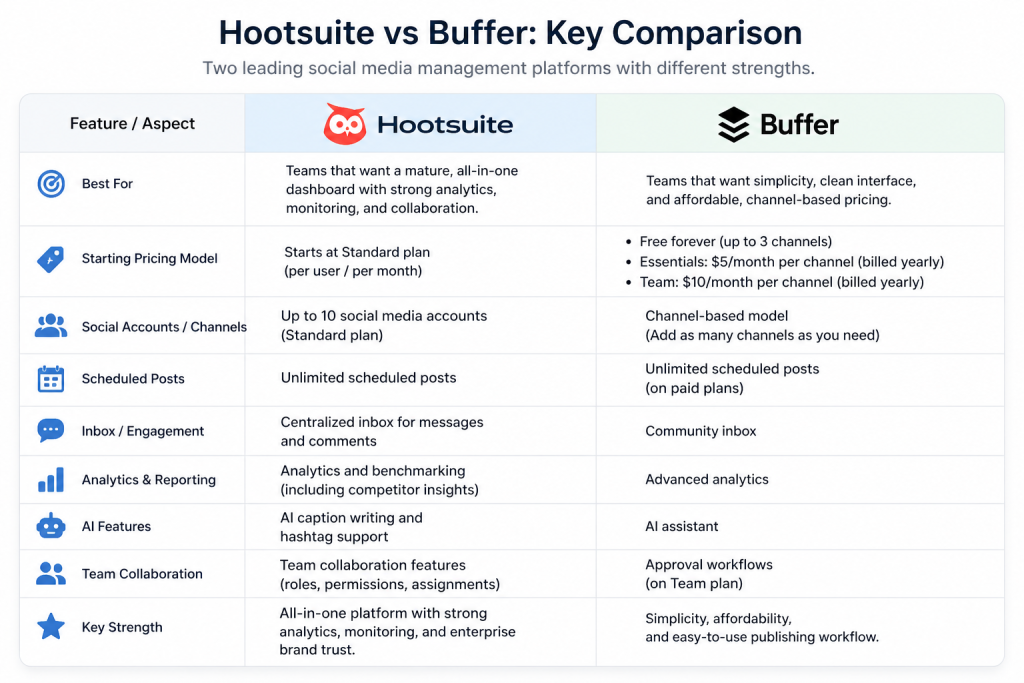
Hootsuite remains one of the most obvious alternatives because its official Standard plan page is built around multi-platform publishing, analytics, inbox management, competitor benchmarking, AI writing, and collaboration.
The official Hootsuite Standard page highlights:
- Up to 10 social media accounts.
- Unlimited scheduled posts.
- A centralized inbox.
- Analytics and benchmarking.
- AI caption writing and hashtag support.
- Team collaboration features.
That makes Hootsuite especially relevant for teams that want a mature all-in-one dashboard with strong analytics and monitoring language. It can be a good fit if your team wants a more established enterprise-style brand with stronger competitor and sentiment positioning.
Alternative 2: Buffer
Buffer is a strong alternative for teams that want simplicity, cleaner entry pricing, and a channel-based pricing model.
The official Buffer pricing page highlights:
- Free forever with up to 3 channels.
- Essentials at $5 per month per channel billed yearly.
- Team at $10 per month per channel billed yearly.
- Unlimited scheduled posts on paid plans.
- Community inbox.
- AI assistant.
- Advanced analytics.
- Approval workflows on Team.
That makes Buffer attractive for smaller teams that do not want a heavier dashboard or big seat-based spend. It is often the cleaner choice when simplicity and lower entry cost matter more than broader enterprise-style depth.
If you want to compare that lightweight model against Vista Social’s broader feature bundle, start with Vista Social here and map your actual number of users and profiles before deciding.
Alternative 3: SocialPilot
SocialPilot is a very relevant alternative because its official pricing page leans heavily into value and agency-friendly scaling.
The official pricing page shows:
- Essentials at $17 per month billed annually.
- Standard at $34 per month billed annually.
- Premium at $85 per month billed annually.
- Ultimate at $170 per month billed annually.
- Bulk scheduling.
- Social inbox.
- Analytics.
- Team collaboration.
- Client approval.
- White label reports on higher tiers.
That makes SocialPilot especially attractive for agencies, freelancers, and growing teams that want more profiles and collaboration at relatively accessible pricing levels.
Compared with Vista Social, SocialPilot can look more aggressively value-oriented, especially once team collaboration and client-facing workflows matter.
Alternative 4: Sprout Social
Sprout Social is the premium-priced alternative in this group.
The official pricing page lists:
- Standard at $199 per seat per month.
- Professional at $299 per seat per month.
- Advanced at $399 per seat per month.
- Consolidated inbox and collaboration tools.
- Keyword and location monitoring.
- Competitor, tag, and paid insights.
- API access on Advanced.
That positioning makes Sprout Social most relevant for organizations that want deeper enterprise-style workflows, more advanced insight layers, or are comfortable paying significantly more for a broader premium platform.
It is not the value play. It is the “we want a big-team social management platform and can pay for it” play.
Alternative 5: Hootsuite Versus Value Platforms
The reason I am calling Hootsuite back out here is because its official plans page also frames the jump from Standard to Advanced around unlimited accounts, deeper analytics and listening, and more collaboration depth. That makes it a useful midpoint between lighter tools like Buffer and pricier tools like Sprout Social.
For many buyers, the real choice set is not one tool versus one tool. It is this:
- Vista Social for a balanced mid-market feature bundle.
- Buffer for simplicity and lower-cost entry.
- SocialPilot for value and agency scaling.
- Hootsuite for a broad established dashboard.
- Sprout Social for higher-end team and insight depth.

Comparison Matrix
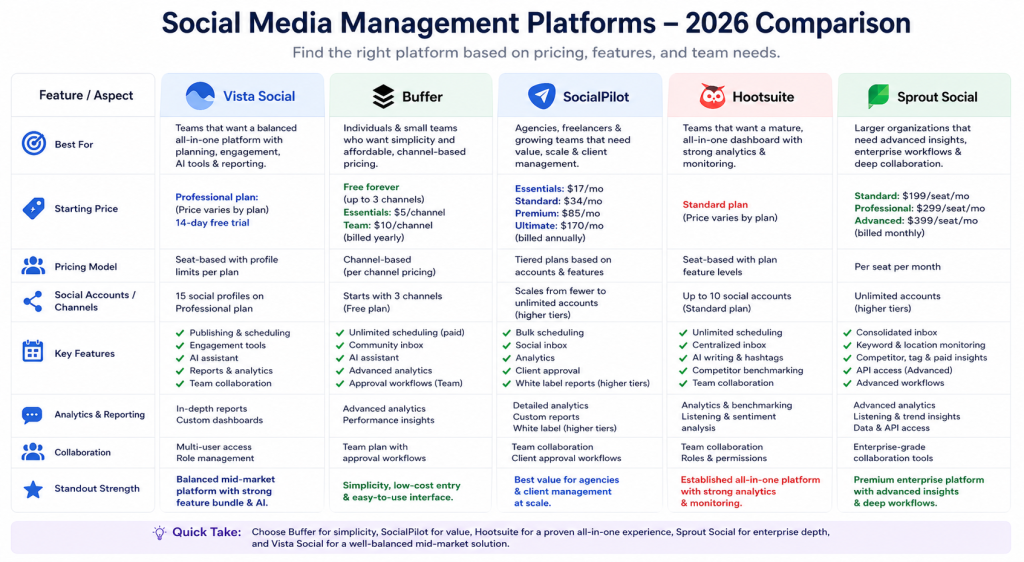
Here is the simple practical read from the official pricing and product pages:
- Vista Social: good mid-market balance with planning, engagement, AI help, and multi-user profile coverage.
- Hootsuite: strong all-in-one dashboard with analytics, inbox, monitoring, and collaboration.
- Buffer: cleanest low-friction option for smaller teams and channel-based budgeting.
- SocialPilot: strong value and agency-friendly scaling with approvals and white-label reporting.
- Sprout Social: premium enterprise-style option with high per-seat pricing and broader advanced insights.
That does not make one universal winner. It makes five different fit profiles.
It also shows why Vista Social still deserves consideration. It sits in a useful middle zone where buyers can get multi-user access, a healthy profile count, planning and engagement tools, and AI assistance without immediately stepping into Sprout-level pricing or channel-by-channel billing logic.
Budget And Team Size Tradeoffs
The alternatives split into very different economic shapes:
- Buffer keeps the entry point low and simple.
- SocialPilot pushes value for agencies and growing teams.
- Hootsuite balances broad functionality with a heavier platform feel.
- Sprout Social charges much more per seat, but also targets larger workflow depth.
- Vista Social stays attractive when a team wants more than a lightweight scheduler without buying a premium enterprise stack.
That tradeoff matters because social software costs usually scale through one of three levers:
- Channels or profiles.
- User seats.
- Advanced workflow depth.
The best tool is often the one whose pricing model matches the way your team actually scales.
That is why a direct price screenshot is rarely enough to make the decision. The operational model behind that price usually matters just as much as the number itself.
The wrong pricing shape can create friction fast once profile counts, approval steps, and teammate access start growing.
When To Stick With Vista Social
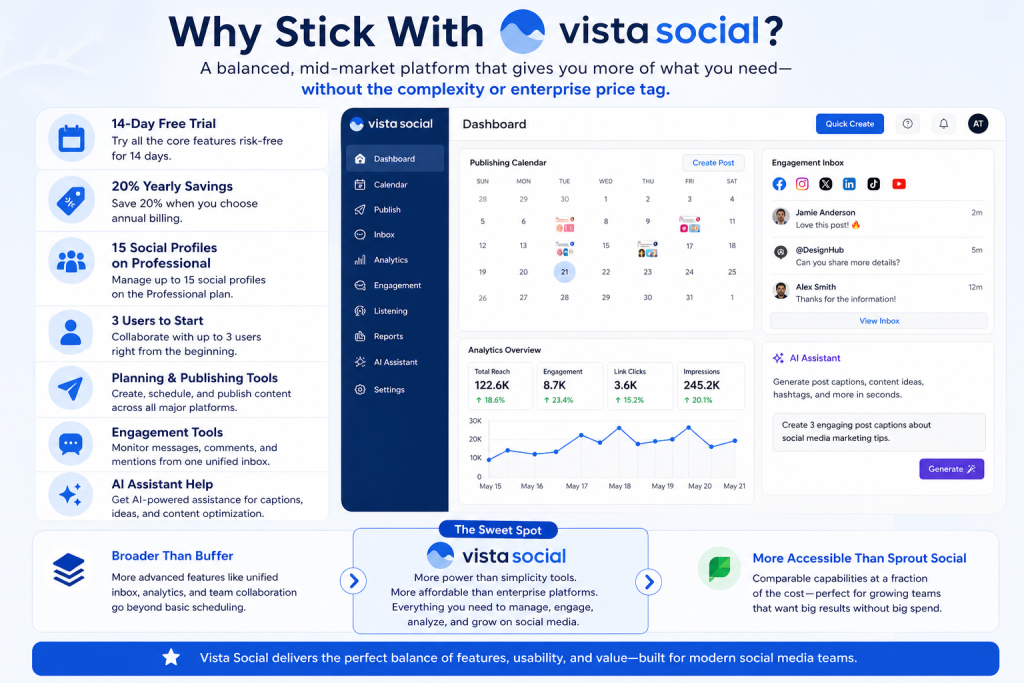
The official Vista Social pricing page makes the product attractive if you want:
- A 14-day free trial.
- 20% yearly savings.
- 15 social profiles on Professional.
- 3 users to start.
- Planning and publishing tools.
- Engagement tools.
- AI assistant help.
That is a healthy middle-ground package.
Stick with Vista Social if you want a platform that feels broader than Buffer, more accessible than Sprout Social, and still modern enough to cover publishing, inbox, reporting, and AI-assisted social work without pushing immediately into enterprise pricing.
It is also worth staying if your team values a balanced collaboration setup more than a “cheapest possible” tool. The Professional tier’s 15 profiles and 3 users already make it easier to operate as a small team instead of a solo scheduler.
That extra room can be a real advantage for teams that want shared publishing, response handling, and reporting without jumping immediately to a much more expensive platform.
It gives smaller teams a bit of operational breathing room.
If you want to compare the fit directly, start with Vista Social here and weigh your real profile count, user count, and reporting needs against the alternatives.
Verdict
The best Vista Social alternatives in 2026 depend on what you are optimizing for. Buffer is stronger for lightweight simplicity. SocialPilot is stronger for value and agency scaling. Hootsuite is stronger for an established all-in-one dashboard. Sprout Social is stronger for premium enterprise-style depth. Vista Social itself remains appealing for buyers who want a balanced multi-user social platform without jumping to top-tier pricing right away.
That means the smartest move is not to ask “which tool is best?” The smarter question is “which tool matches our team size, number of profiles, collaboration needs, and budget?”
That framing usually leads to better decisions than chasing brand familiarity alone. Social teams tend to regret tools that look impressive on paper but do not match how the team actually works every day.
That is why Vista Social remains a legitimate option even in a crowded category. Its strongest case is not hype. It is fit.
Fit is usually what makes a social management tool stick for the long term.
When the fit is wrong, teams end up paying for features they ignore, or worse, forcing awkward workflows just to justify a subscription.
That is why a balanced option like Vista Social can still win even in a noisy market. The right middle-ground tool often beats the loudest brand.
It also explains why alternative research should be practical rather than emotional. Social teams do better when they choose tools based on workflow fit, user count, reporting needs, and sustainable pricing instead of jumping between brands every time a competitor launches one shiny new feature.
That kind of discipline usually leads to fewer tool migrations and better long-term adoption across the whole team.
It also saves managers from repeatedly retraining staff on tools that were chosen for novelty instead of fit.
That matters.
If Vista Social still looks close to that sweet spot, start with Vista Social here and compare it against your actual operating model, not just against flashy feature pages.
FAQ
What are the best Vista Social alternatives in 2026?
Strong alternatives include Hootsuite, Buffer, SocialPilot, and Sprout Social, each with different strengths around pricing, collaboration, analytics, and scale.
Which Vista Social alternative is the cheapest?
Buffer has the lightest official entry pricing among the alternatives reviewed here, while SocialPilot also presents strong value-oriented plans.
Which alternative is best for agencies?
SocialPilot looks especially strong for agencies because its official pricing page emphasizes client approval, white-label reports, and scalable team workflows.
When should I stay with Vista Social instead of switching?
Stay with Vista Social if its mix of profile limits, user count, engagement features, and AI-assisted planning already fits your team without needing a heavier or more expensive platform.
More on Vista Social
Hand-picked guides to help you choose the right tool — no fluff.
 IntegrationsVista Social Integrations Guide 2026What it connects to and how well each link holds up.
 TutorialsVista Social Beginner's Guide 2026A clean start-here walkthrough with no jargon.
 ComparisonsFreshcaller vs Alternatives 2026The strongest competitors compared side by side.
 AlternativesInboxAlly Alternatives 2026Credible alternatives and when each one wins.