

Why This Comparison Matters :
Superfiliate is not trying to be a tiny link generator or a basic referral widget. The official site positions it as a platform for influencer, affiliate, ambassador, and creator-led growth across Shopify, Meta, and TikTok Shop. That immediately changes the comparison set, because the real question is not “does it track a link?” The question is whether you need an end-to-end system for creator-led growth or just a lightweight tool for one narrow part of the job.
If you want to explore the platform before deciding, book a Superfiliate demo here.

The Short Answer :
Superfiliate wins when you want one platform to manage multiple creator channels, automate outreach, coordinate payouts, track results, and make creator-led growth feel operational instead of chaotic.
The main alternatives usually fall into one of these buckets:
- A basic affiliate tracking tool.
- A manual spreadsheet and email workflow.
- A referral platform that only covers one program type.
- A creator marketing stack split across several apps.
That is the real comparison. Superfiliate is not just competing on tracking. It is competing on workflow depth.
What Superfiliate Does Better Than The Lightweight Options :
It Unifies More Than One Program Type –
The homepage is explicit. Superfiliate consolidates influencer, affiliate, and ambassador programs into one unified platform. That matters because many brands do not actually run one clean program. They run three messy ones at the same time.
One group of creators wants product seeding. Another wants affiliate links. Another wants partnership ads. If your software only handles one of those layers, your team ends up duct-taping the rest together manually.
Superfiliate’s advantage is that it lets the team keep all of that under one roof:
- Shopify Influencer Hub.
- Meta Ads Suite.
- TikTok Shop workflows.
- Automations.
- Reporting and analytics.
- Payout management.
That is a much richer operating model than a “set up a link and check a dashboard” tool.
It Automates The Ugly Part Of Creator Ops –
A lot of creator programs fail because the work becomes administrative very quickly. Discovery, recruitment, follow-ups, gifting, payouts, reporting, and content organization all pile up at once.
Superfiliate leans hard into that problem. The official site calls out automations, social listening, creator communications, gifting, payout management, and campaign workflow management. In plain English, that means the platform is trying to remove manual busywork from the creator program instead of merely measuring it after the fact.

It Gives You Better Visibility Into Revenue –
The product also pushes hard on reporting and analytics. The official site references performance views across revenue, social metrics, and creator activity, plus a performance insights dashboard in the Meta Ads Suite.
That matters because the real value of creator-led growth is not the number of creators you recruit. It is the amount of revenue you can reliably attribute and scale.
If your current setup cannot show that clearly, you are probably comparing Superfiliate against a stack that was never built to answer the question in the first place.
Where The Alternatives Still Make Sense :
Basic Affiliate Tools –
If you only need basic affiliate tracking, a simpler tool can be enough. A basic platform may be cheaper, easier to launch, and less intimidating for a small team that wants to prove demand first.
That is the main reason Superfiliate is not always the right first step. If your brand is early and your only goal is “give creators a link and track sales,” a lighter tool may be the more rational choice.
But there is a tradeoff. The moment you add gifting, partnership ads, referral programs, and creator discovery, the simple tool starts to feel very simple.
Manual Spreadsheets And Email –
This is the cheapest alternative and also the most fragile one.
It works when:
- You have only a few creators.
- You can track things by hand.
- Nobody needs multi-channel visibility.
- Payouts are simple.
It breaks when:
- The creator list grows.
- People forget follow-ups.
- Attribution gets messy.
- Reporting has to be prepared every week.
Superfiliate is a much better fit once the program feels like a real function, not a side project.
Single-Purpose Referral Platforms –
Referral platforms can be great if the only thing you care about is referral flow. They are often simpler to deploy, and some teams love that.
The weakness is that they are not really designed for the broader creator stack. Superfiliate’s official feature set shows a much wider surface area:
- Creator discovery.
- Social listening.
- Gifting and seeding.
- Partner communications.
- Payouts.
- Analytics.
- Cobranded landing pages.
That wider surface area is exactly why it compares more to a creator operations platform than a basic referral widget.
A Feature-By-Feature Comparison :
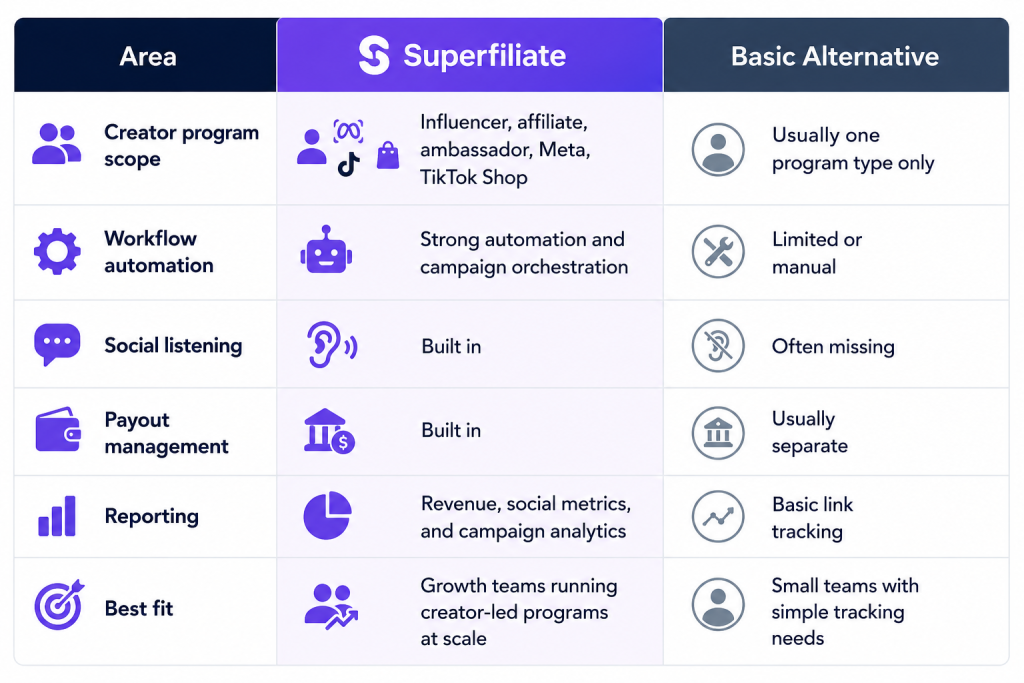
That table is the simplest way to see it. Superfiliate is the “we are serious about this channel” option.
Pricing Reality :
There is no public pricing page on the official site that I could verify, so the right assumption is that Superfiliate wants a demo-led sales conversation.
That is not unusual for this category. In fact, it makes sense if the buyer is running multiple channels and needs a tailored rollout rather than a self-serve checkout.
So the pricing comparison is less about a public monthly fee and more about total operational value:
- How much time does the team save?
- How much creator work gets automated?
- How much attribution becomes clearer?
- How much of the stack can be collapsed into one platform?
If those questions matter, book a Superfiliate demo here.
When Superfiliate Is The Better Choice :
Superfiliate is usually the better option when your brand:
- Runs multiple creator programs at the same time.
- Needs Shopify, Meta, and TikTok Shop in one place.
- Wants gifting, outreach, and payouts to feel connected.
- Cares about creator communications as much as attribution.
- Wants social listening and discovery to live inside the same workflow.
That is the kind of stack that cannot live comfortably in a spreadsheet for long.
When A Simpler Alternative Is Fine :
A lighter tool still wins if your team:
- Is just starting an affiliate program.
- Needs low-friction tracking and nothing more.
- Has only a few creators.
- Does not need social listening or ad-suite workflows.
- Wants the cheapest possible first step.
That is not a knock on Superfiliate. It is just the reality of software selection. If your program is small, buying a big platform too early can slow you down.
The Tradeoff Nobody Talks About :
Here is the honest part: a more complete platform asks for more discipline.
Once you bring creator discovery, messaging, gifting, payouts, and analytics into one system, you also need clearer internal ownership. Somebody has to run the process well. The software can streamline the work, but it cannot choose your operating model for you.
That said, the upside is real. Superfiliate can help a team move from “we dabble in creator marketing” to “we actually run creator-led growth.”
How I Would Choose In Real Life :
If I were choosing a platform for a brand today, I would use a very simple filter.
Choose Superfiliate if the creator program is already becoming a channel with real operational load. That means the team needs to manage discovery, gifting, outreach, payouts, analytics, and multiple channel types without losing the thread.
Choose a lighter alternative if the program is still tiny, experimental, or mostly about sending a few links and checking a basic report.
That sounds obvious, but it is the mistake many teams make. They buy for the future before the current workflow is stable. Superfiliate makes sense when the current workflow is already messy enough that the platform has a job to do.
It is also the better call when the team wants one shared place for creator data instead of a patchwork of tabs, inboxes, and one-off tools.
If that sounds like your reality, book a Superfiliate demo here and see whether the platform matches the way your team actually works.
Why This Category Keeps Getting Harder :
Creator-led growth is getting more complicated, not less. Brands now have to coordinate creators across storefronts, ad channels, social platforms, and payout workflows while still keeping attribution clean enough to trust.
That is why a platform like Superfiliate matters. It is not just solving the “how do we send a link?” problem. It is trying to solve the “how do we run this channel like a serious business function?” problem.
Once you frame the category that way, the alternative comparison gets easier. A basic tool may be fine for tracking a few links, but it will not help much when the program grows into gifting, social listening, ad support, or creator communications.
That is the gap Superfiliate is trying to close.
In 2026, that matters because creator programs are no longer side projects. They are becoming measurable revenue channels. The tools that win will be the ones that help the team operate the channel, not just observe it.
That is the bar Superfiliate has to clear, and it looks built for it.
Final Verdict :
Superfiliate is best for brands that want creator-led growth to behave like a real channel, not a side hustle. It beats simpler alternatives when you need unified workflows, automation, social listening, payouts, and analytics across Shopify, Meta, and TikTok Shop.
If you only need a tiny affiliate setup, a lighter tool might be enough. But if you want the full operating system for creator programs, book a Superfiliate demo here and use the conversation to pressure-test your workflow.
FAQ :
Does Superfiliate replace spreadsheets?
Yes, and that is one of the main reasons teams adopt it. The platform is built to move creator operations out of manual tracking and into a unified workflow.
Is Superfiliate just for affiliates?
No. The official site explicitly positions it across influencer, affiliate, ambassador, Meta, and TikTok Shop workflows.
Is it better for ecommerce brands?
It is especially strong for ecommerce because the homepage centers Shopify, creator relationships, gifting, and revenue tracking.
Does Superfiliate have public pricing?
Not on the official site I reviewed. The practical expectation is a demo-based sales process.
What is the main reason to choose it?
Choose it when you want one platform for the full creator-led growth workflow, not just link tracking.