

Quick Verdict :
Emergent is an ambitious AI app builder. The official site positions it around building full-stack web and mobile apps in minutes, with AI agents that design, code, and deploy from start to finish. That is a strong promise, and it is exactly why alternatives matter. When a product claims to compress the build cycle that aggressively, you want to know what to compare it against.
The cleanest way to think about the alternatives category here is not just “what else is like Emergent?” It is “what other route gets me to a shipped product with less friction?” For some teams that will mean another AI app builder. For others it will mean a code-first workflow, a no-code builder, or simply staying closer to a traditional dev stack.
If you want to inspect Emergent while you read, start with Emergent here.

When To Consider Alternatives :
You should consider alternatives to Emergent when one of these things is true:
- You need more control than a conversational app builder gives you.
- You want a different deployment or stack opinion.
- Your app requires a highly specialized workflow.
- Your team wants a more familiar development path.
- You need to compare speed against long-term maintainability.
That last point is the biggest one. AI app builders are exciting because they reduce the gap between idea and prototype. But as soon as the app becomes real, you start caring about code quality, workflow ownership, and how easy it is to extend the product later.
Alternative 1: A Code-First AI Assistant
One strong alternative is a code-first assistant that helps a team build inside a familiar framework instead of through a full conversational environment.
Use that route if:
- You already know your stack.
- You want more direct code ownership.
- You care about structure and maintainability.
Choose Emergent instead if:
- You want the fastest path from idea to app.
- You want the app-building process to feel more guided.
- You do not want to assemble the whole stack yourself.
This is the classic tradeoff. Code-first tools preserve control, while Emergent optimizes for speed and end-to-end generation.

If you want the fastest route to a working app before you compare other options, start with Emergent here and build one small product path first.
Alternative 2: A No-Code Builder
No-code builders are still relevant because they give non-developers a familiar visual path.
Use no-code if:
- Your team is more design and operations oriented.
- You want a visual workflow.
- Your app is relatively simple.
Choose Emergent if:
- You want AI to take you beyond drag-and-drop.
- You need the system to generate more of the app structure for you.
No-code is often better for teams that already know what the product should look like. Emergent is more interesting for teams that want AI to help shape the product itself.
Alternative 3: Traditional Development
Sometimes the best alternative is simply a normal engineering process.
Use traditional development if:
- You need fine-grained control.
- You have a strong engineering team.
- You expect a lot of custom logic or integration depth.
Choose Emergent if:
- You care more about speed than custom code craftsmanship at the start.
- You want a lower-friction way to get a working app in front of users.
This is the most important competitive comparison because a lot of teams are not really choosing between tool A and tool B. They are choosing between “ship now” and “build the right way with more time.”
Comparison Matrix :
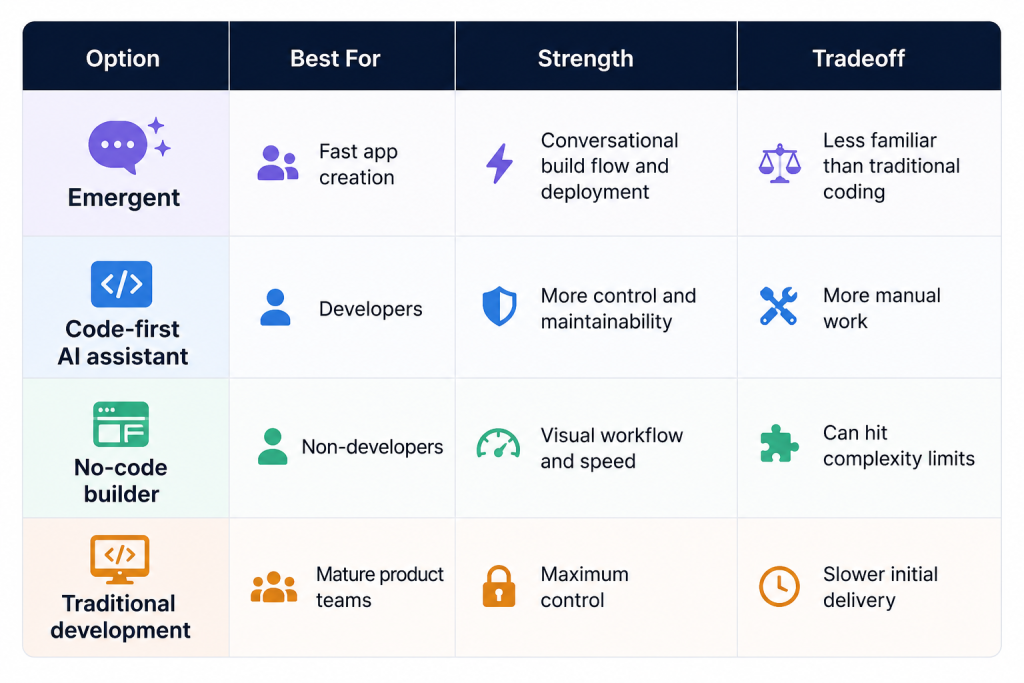
That matrix is the real decision point. Emergent wins when speed and completeness matter most. The alternatives win when control, familiarity, or long-term flexibility matters more.
Pricing And Commercial Model :
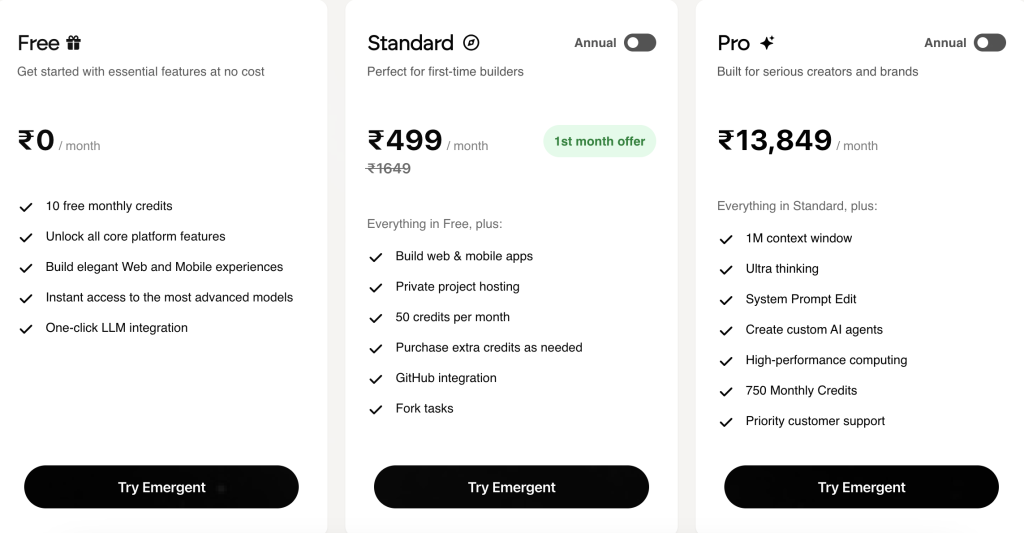
The public pages I reviewed clearly emphasize features, enterprise positioning, and solution paths, but they do not surface a simple public pricing table in the same way a classic SaaS pricing page would. That means the commercial motion is more demo and enterprise oriented than self-serve and transparent.
That can be good if you are serious about evaluating the product with a sales conversation. It can be less convenient if you want to compare headline numbers right away.
For an alternatives article, that is actually useful context. If pricing is not front-and-center, then the real buying choice is not just cost. It is confidence in the workflow.
When To Stick With Emergent :
You should stick with Emergent if:
- You need to get from concept to deployed app quickly.
- You want AI agents handling more of the build path.
- You prefer one guided workflow instead of stitching tools together.
- You are validating an idea before overinvesting in engineering.
That is where the product appears strongest. It looks designed to reduce time to a real app, not just to a prototype screenshot.
When Another Option Makes More Sense :
Another option makes more sense if:
- You already have a mature engineering team.
- You need more precise architecture control.
- You expect a lot of bespoke product logic.
- You are more comfortable with visual app builders or code-first workflows.
The alternatives are not necessarily better. They are just better fits for teams with different constraints.
A Practical Decision Framework :
The easiest way to decide is to ask what you value most right now.
If your answer is speed, Emergent probably belongs near the top of the list. If your answer is long-term architectural control, then one of the alternatives is probably a better fit. If your answer is visual simplicity, then no-code may feel safer.
That makes Emergent a very practical choice for early-stage ideas, prototypes, and fast internal tools. It is less obviously the best choice when the app is already complex and the team wants to own every implementation detail.
The other thing to remember is that early speed can create real business momentum. Getting to a usable app quickly can help you validate the idea before the team spends weeks debating stack decisions.
What A Good Pilot Looks Like :
A good pilot should be small enough to finish but real enough to matter.
The ideal pilot usually has:
- One core workflow.
- One small data model.
- One or two user actions.
- One clear success metric.
If Emergent can get you through that pilot quickly, it has already delivered a meaningful advantage. If you end up spending more time cleaning up the generated app than moving the product forward, then an alternative is probably the smarter path.
That is why this category is so context-dependent. The right tool is the one that gets your team to the next milestone with the least friction.
A Practical Pilot Plan :
The best pilot plan is small, specific, and visible.
Start with one idea that the business would genuinely use. Give it one success metric. Then let Emergent handle the quickest path to a running app. If the result is strong, you have validated the category. If the result needs too much repair, you have learned that the team should lean on a different build path.
That kind of pilot tells you more than a feature list ever will. It shows whether the product really saves time, whether the generated structure is usable, and whether the team can move forward without feeling trapped.
Why The Alternatives Still Matter :
The alternatives matter because the right app-building path is not universal. A founder with a prototype problem, a product manager with a validation problem, and an engineering team with a maintainability problem do not need the same tool.
That is why Emergent should be compared against whatever your team would do next if the platform were not available. For some teams that is no-code. For some it is a code-first assistant. For some it is the traditional stack. The point is to compare the real tradeoff, not just the branding.

What To Do If You Are Still Unsure :
If you are still unsure, do a one-day comparison instead of a theoretical one.
Build the smallest version of your app idea in Emergent, then compare the result with the next best path your team would use. The comparison should answer three questions:
- Which option gets you to a usable prototype fastest?
- Which option feels easiest to maintain?
- Which option gives your team the most confidence to keep going?
That quick comparison usually says more than a long feature checklist. If Emergent wins the speed test, it has already done its job well.
If you want to run that test yourself, start with Emergent here and compare it against your fallback path with one small build.
Verdict :
Emergent is compelling when speed is the top priority. Alternatives become important when you need more control, a more familiar workflow, or a different tradeoff between speed and maintainability. That is the right frame for this category.
If you want to validate the idea quickly and only then decide whether to switch to another path, start with Emergent here and build one narrow workflow before you compare it with the rest of your stack.
FAQ :
Is Emergent a full-stack app builder?
Yes. The official homepage describes it as a way to build full-stack web and mobile apps in minutes.
Does Emergent use AI agents?
Yes. The public copy says AI agents design, code, and deploy the application.
Are pricing details public?
Not clearly in the pages I reviewed. The commercial path looks more demo-oriented.
What is the best alternative category?
The best alternative category depends on your team: code-first AI, no-code, or traditional development.
Who should stay with Emergent?
Teams that want fast end-to-end app creation and less setup friction.