


Power User Intro :
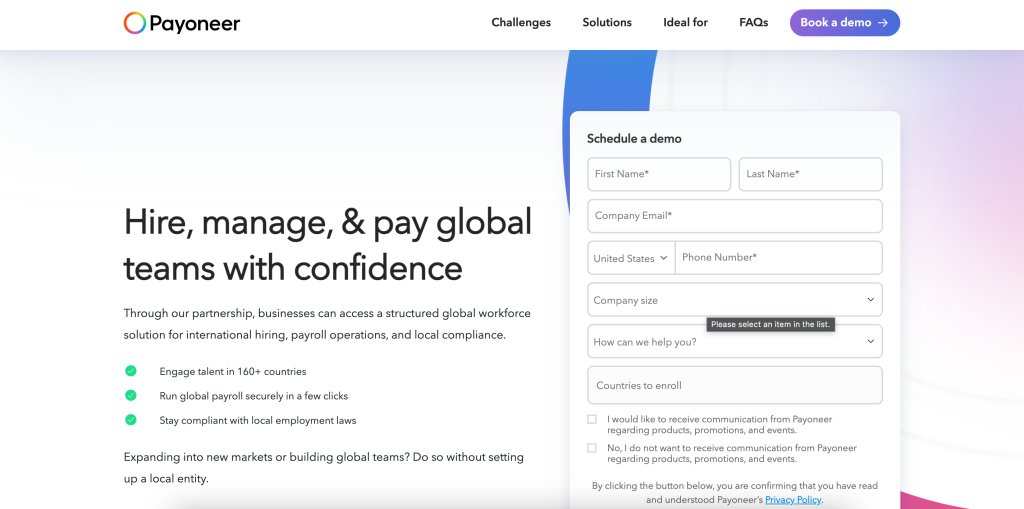
Payoneer Workforce Management gets much more compelling once you stop evaluating it like a simple payroll helper and start looking at it as a global workforce operations platform. The official partner and contractor-management pages frame the product around a bigger promise: hire, manage, onboard, and pay international employees and contractors across 160+ countries without setting up local entities, all while keeping payroll operations, compliance support, and contractor workflows in one system.
That is the advanced use case.
You are not here because one contractor needs a payout next Friday. You are here because global hiring turns messy fast, and you want fewer moving parts.
The public pages also make the product categories pretty clear:
- Employer of Record for employees.
- Agent of Record for contractor engagement.
- Contractor management and payouts.
- Multi-currency payment support.
- Local compliance support.
If you want to evaluate the platform while you read, start with Payoneer Workforce Management here.
What Makes This A Power User Platform :
The advanced story is not one feature. It is the combination of worker models, country coverage, payment coverage, and operational control.
On the official pages, Payoneer Workforce Management highlights:
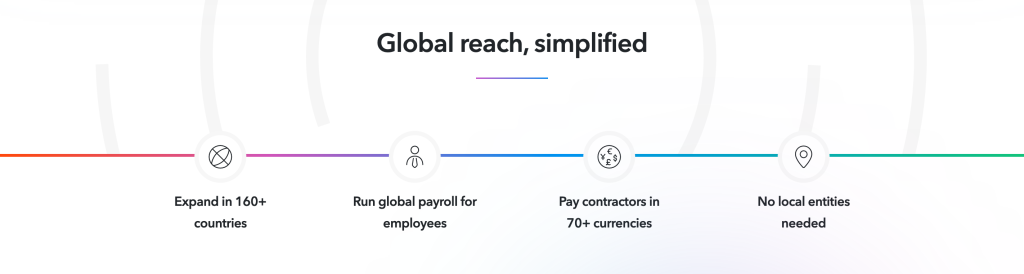
- 160+ countries for workforce support.
- 70+ currencies for contractor payments.
- EOR support in 110+ countries.
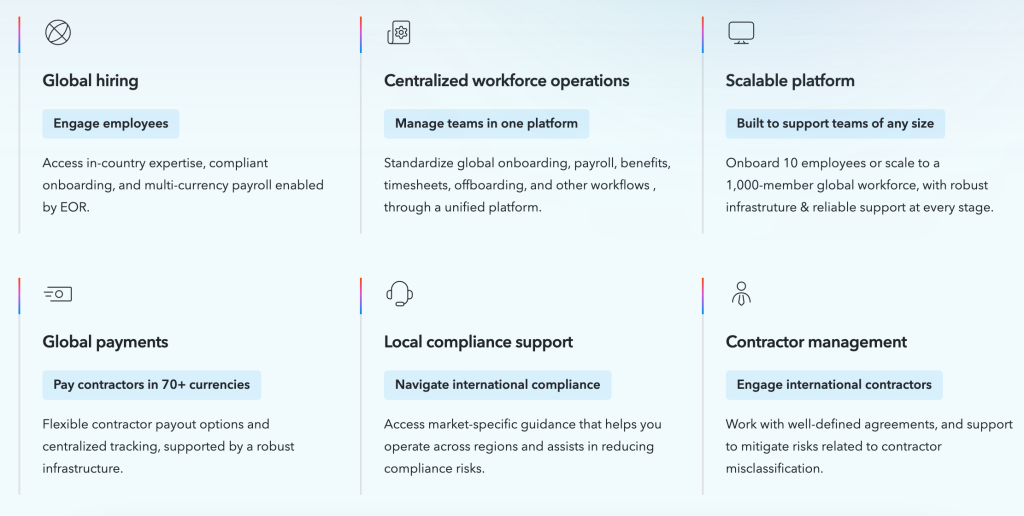
- Centralized onboarding, payroll, compliance, and contractor workflows.
- Localized support and operational guidance.
That matters because global workforce software usually breaks down in one of two places:
- The legal and compliance layer is too fragmented.
- The operational layer becomes a spreadsheet circus.
Payoneer is clearly trying to solve both.
Advanced Feature 1: Multi-Model Workforce Coverage
One of the most important advanced strengths is that Payoneer Workforce Management does not treat every worker type the same.
The official partner page and FAQs describe several operating models:
- Hire and manage employees via Employer of Record.
- Engage contractors through Agent of Record.
- Manage and pay contractors under your own entity.
- Add visa and immigration support via EOR in relevant cases.
That is a big deal for power users because global workforce problems are usually classification problems before they become software problems.
If your company is hiring in multiple regions, you may need:
- Employees in one market.
- Contractors in another.
- Different documentation standards by country.
- Different payment flows by worker type.
Platforms that flatten all of that into one vague workflow usually create risk. Payoneer seems more advanced precisely because it acknowledges the different operating models directly.
Advanced Feature 2: Global Compliance Support At Operating Scale
This is where the platform starts sounding serious.
The public FAQs and partner materials repeatedly emphasize local compliance support across 160+ countries, along with mitigation support for contractor misclassification risk. The pages also describe help with:
- Labor-law navigation.
- Tax obligations.
- Benefits requirements.
- Onboarding standards.
- Contractor agreements.
- Audit-readiness documentation.
That is not a small feature set. It is the operating core.
For advanced users, compliance is not a side tab. It is the thing that decides whether scaling globally is manageable or reckless. A platform that only helps with money movement but leaves classification and documentation messy is not really solving the hard part.
Payoneer is making the opposite pitch. It wants to be the layer that supports the operational and compliance logic behind the workforce.
If global compliance is your real bottleneck, start with Payoneer Workforce Management here and compare one employee or contractor expansion path against how you handle it today.
Advanced Feature 3: Contractor Management That Is Built For Repeatability
The official contractor-management page gives the clearest advanced operational detail on the public site.
It highlights:
- Contractor onboarding in as little as 3 to 5 business days.
- Payments in 70 currencies.
- Centralized contractor management.
- Support for hourly, milestone-based, and fixed-term contracts.
- Tax-form collection and invoice generation.
- Documentation that helps teams stay audit-ready.
That is the kind of detail power users care about because it affects monthly workload, not just abstract platform value.
The more contractors you handle, the more valuable repeatable onboarding, invoice generation, and payment configuration become. Otherwise, every pay cycle turns into a manual finance-and-ops chore.
This is where Payoneer seems especially strong for international contractor-heavy businesses. It is not just offering payment rails. It is offering a way to standardize the contractor operating rhythm.
Advanced Feature 4: Multi-Currency Payout Infrastructure
The public pages explicitly say contractors can be paid in 70+ currencies, and the contractor page describes low-fee payouts through ACH, credit card, or bank transfers from a centralized dashboard.
That is more important than it sounds.
Multi-currency support is not only a payments feature. It is a workflow simplifier. It affects:
- Finance operations.
- Contractor experience.
- Country-by-country scale.
- How often do payroll teams need exceptions and one-off fixes?
For advanced users, the best systems are the ones that reduce exception handling. If the platform can normalize contractor payments across many regions, that is real leverage.
Automation Workflows That Matter In Practice :
The strongest advanced Payoneer workflows are not flashy. They are the ones that reduce recurring administrative strain.
Based on the official pages, strong workflow use cases include:
- Onboard multiple contractors in one workflow.
- Generate digital contracts and collect required documentation.
- Standardize tax-form submission.
- Generate invoices on behalf of contractors where appropriate.
- Run employee payroll or contractor payouts from a centralized operational system.
That is a cleaner operational chain than the typical combination of local vendors, spreadsheets, email approvals, and finance follow-up.
It also means the platform can help different internal teams work from the same system:
- HR or talent teams.
- Finance.
- Legal or compliance stakeholders.
- Hiring managers in expansion markets.
That is where a workforce platform starts becoming infrastructure instead of just a service.
Custom Integrations And API Reality Check :
Here is the honest advanced-user read: the public pages we can verify talk much more about workflow coverage and centralized operations than about public developer tooling.
That does not mean integrations are impossible. It means the official public material is selling the operating platform first, not an open developer platform first.
So the right advanced question is not “does it have an API somewhere?” The right question is:
“How much of our real workflow can we standardize inside the platform before we need custom integration work?”
That is a healthier buying lens.
For many teams, the answer may be “quite a lot,” because the platform already covers onboarding, documentation, contracts, payroll administration, contractor engagement, and compliance support in one place. But if your company needs deep internal-system orchestration, confirm those paths early.
That is not a weakness. It is just disciplined procurement.
Performance Optimization For Global Teams :
Power users usually get the best value from Payoneer Workforce Management when they treat worker categories and process design seriously from the start.
Good optimization habits include:
- Deciding early when a worker should be EOR versus AOR versus direct contractor management.
- Standardizing onboarding documents across regions.
- Keeping payment rules consistent by worker type.
- Centralizing global hiring requests instead of letting every country invent its own process.
- Using one system of record for workforce operations rather than mixing disconnected vendors.
The platform’s public positioning suggests it is strongest when you want standardization, not improvisation.
That is exactly what mature global teams need.
Pricing Context :
The official public pricing signals are unusually helpful for a global workforce platform:
- Contractor management starts at $19 per month flat rate.
- EOR pricing starts at $199 per employee.
- The contractor-management page says there are no onboarding or offboarding fees and no hidden costs.
That does not mean every global workforce scenario is cheap. It does mean the public starting points are visible, which is better than what many workforce vendors offer.
Here is a simple view:
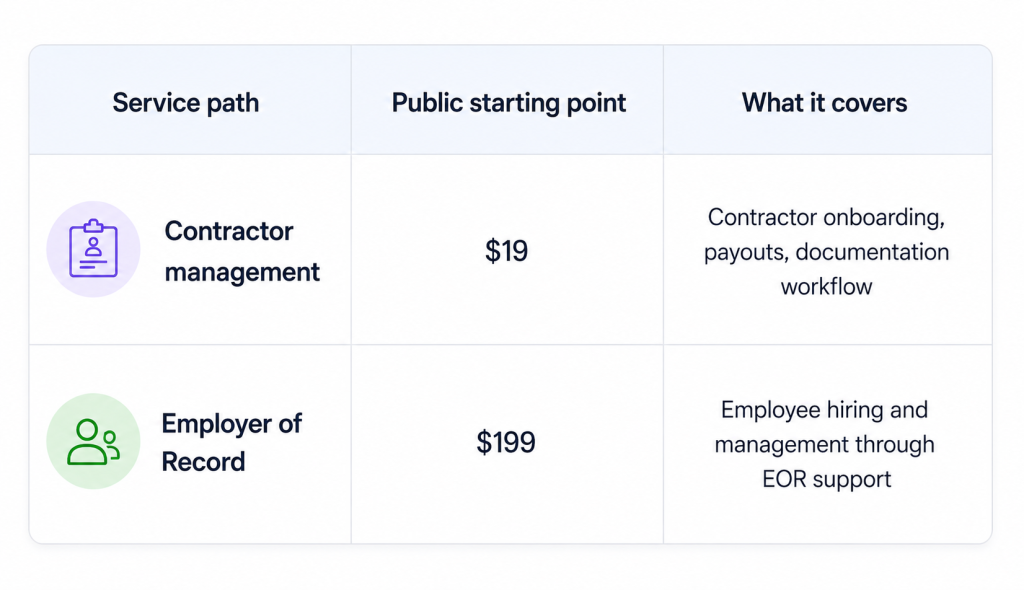
This is useful because power users can separate the contractor case from the employee case instead of mashing everything into one vague budget line.
If you are evaluating the platform against a patchwork of local providers, start with Payoneer Workforce Management here and compare one contractor-heavy region or one employee expansion market first.
Expert Workflow Example :
Imagine a company hiring:
- Full-time employees in two countries where it has no entity.
- Contractors in five more countries.
- A growing finance team that is tired of manual payout coordination.
That company does not need another “global hiring inspiration” slide deck. It needs classification clarity, payment consistency, and documentation discipline.
That is the kind of operating environment where Payoneer Workforce Management looks strong.
Employees can run through EOR support. Contractors can be managed through AOR or contractor workflows. Payments can be handled in multiple currencies. Documentation stays centralized. Compliance support becomes part of the workflow instead of a last-minute panic.
That is the advanced value proposition in one paragraph.
Verdict :
Payoneer Workforce Management has a strong advanced story in 2026 because it is built around the hard realities of global workforce operations: worker-type differences, country coverage, payout complexity, compliance support, and repeatable onboarding.
Its biggest strengths are multi-model workforce coverage, centralized contractor management, 70+ currency payouts, broad country support, and public starting prices that are clearer than many category peers.
It is especially compelling for businesses that are scaling internationally and want one operational layer instead of juggling separate local vendors, payroll fragments, and contractor paperwork systems.
If that is your use case, start with Payoneer Workforce Management here and test it against one real global hiring or contractor workflow before expanding wider.
FAQ :
What are the most advanced Payoneer Workforce Management features in 2026?
Its strongest advanced capabilities are EOR and AOR workforce models, contractor management, multi-currency payouts, compliance support, centralized onboarding, and global operational coverage.
How many countries does Payoneer Workforce Management support?
The official public materials say the platform supports workforce operations in 160+ countries, with EOR support in 110+ countries.
How much does Payoneer Workforce Management cost?
Public pricing starts at $19 for contractor management and $199 for EOR, based on the official workforce-management pages.
Can Payoneer Workforce Management pay contractors in multiple currencies?
Yes. The official site says contractors can be paid in 70+ currencies, with centralized payout and contractor-management workflows.