

Why This Comparison Matters
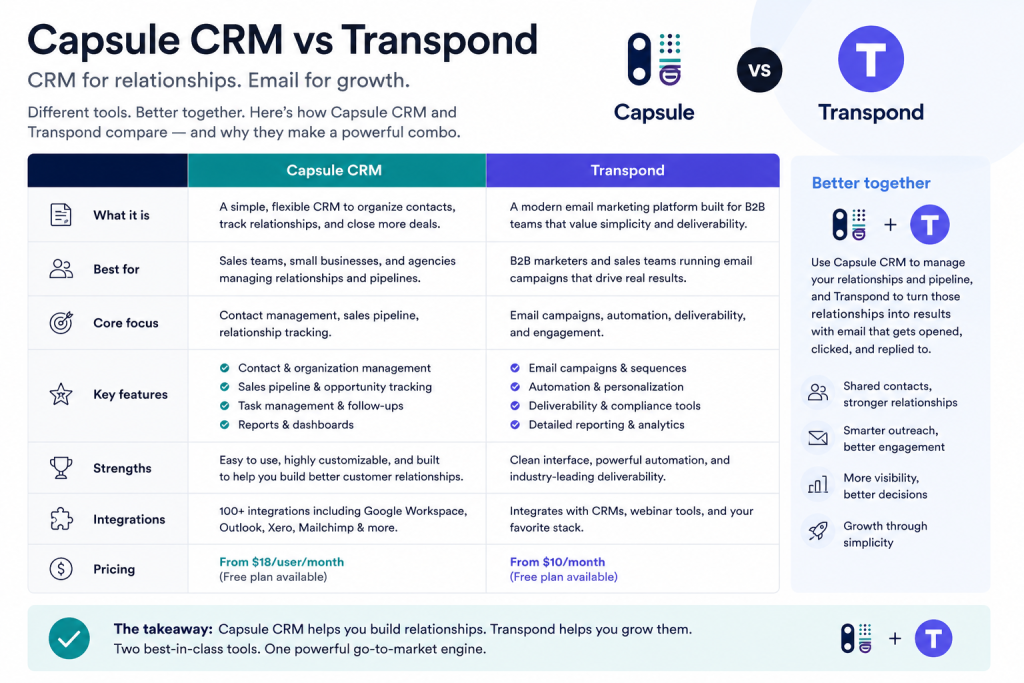
Capsule and Transpond make a lot of sense together because they cover two different jobs that usually get mixed up. Capsule is the CRM. Transpond is the marketing and communication layer. One is for managing customer relationships and pipelines. The other is for sending campaigns, automations, reply tracking, and transactional messages.
That split matters because many teams do not need a giant monolithic platform. They need a clean CRM plus a good email and automation engine. Capsule and Transpond try to give you that middle path without making you buy a bloated enterprise suite.
If you want the stack while you read, start with Capsule and Transpond here.
Quick Comparison Table
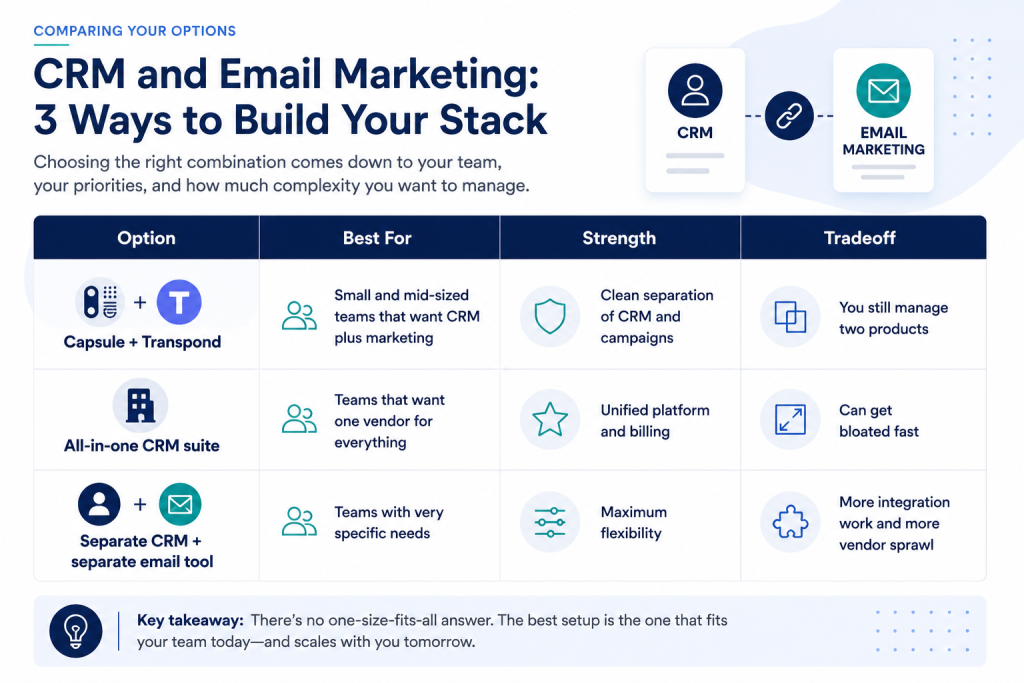
The real decision is not whether CRM and marketing belong together. They do. The question is whether you want them packaged inside one oversized suite or split into two focused tools that still work together.
Capsule Deep Dive
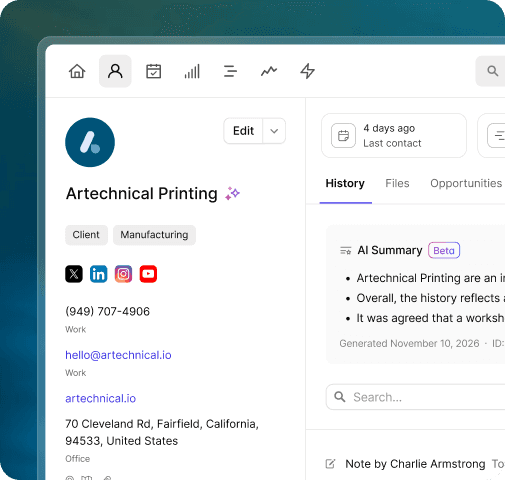
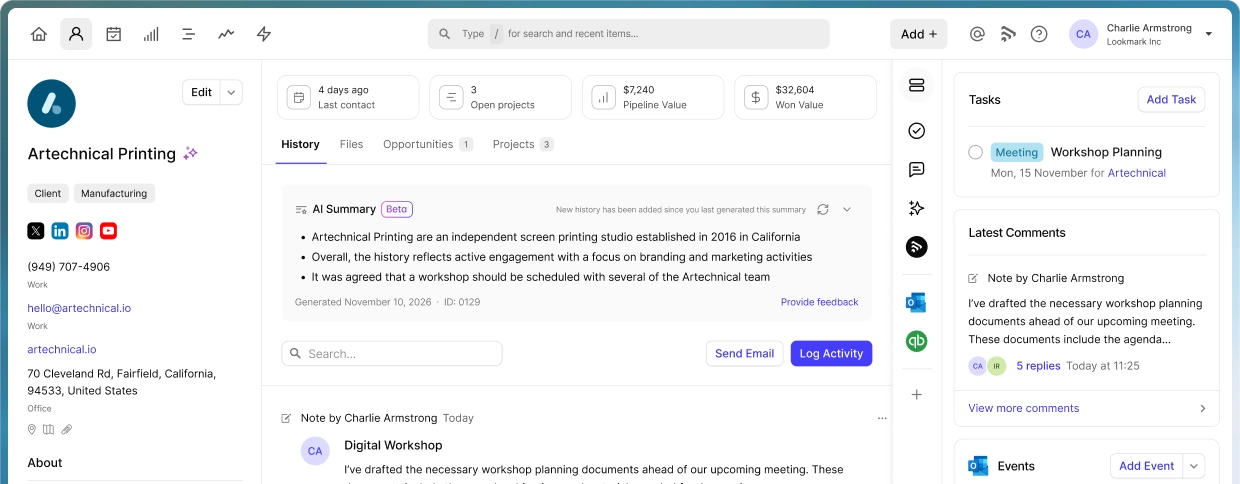
Capsule is the CRM side of the story. The official features page is organized around:
- Sales tools.
- Task management.
- Reporting.
- Automation tools.
- Contact management.
- Email tools.
- Security and permissions.
- Connectivity.
- Customization.
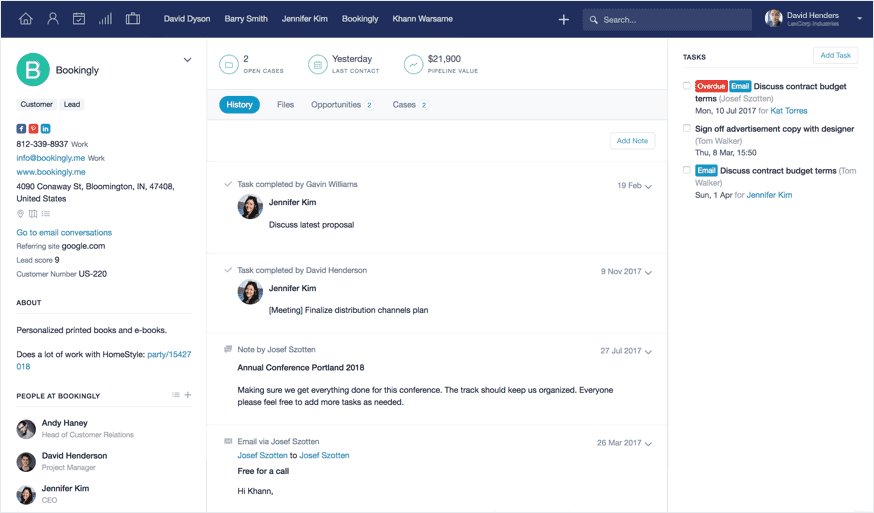
That is a good sign. It means the product is trying to help a team actually work a pipeline, not just store contacts.
The free plan is also genuinely useful. The official signup page shows:
- 250 contacts.
- 5 custom fields.
- 1 sales pipeline.
- Maximum 2 users.
- Free forever.
The paid plans expand the ceiling and the workflow:
- Starter adds 30,000 contacts, email templates, a shared mailbox, basic reporting, premium integrations, goals, and an AI pipeline generator.
- Growth adds workflow automations, advanced reporting, dashboards, multiple pipelines, project management, team and access controls, and AI enrichment.
- Advanced adds more scale for larger teams.
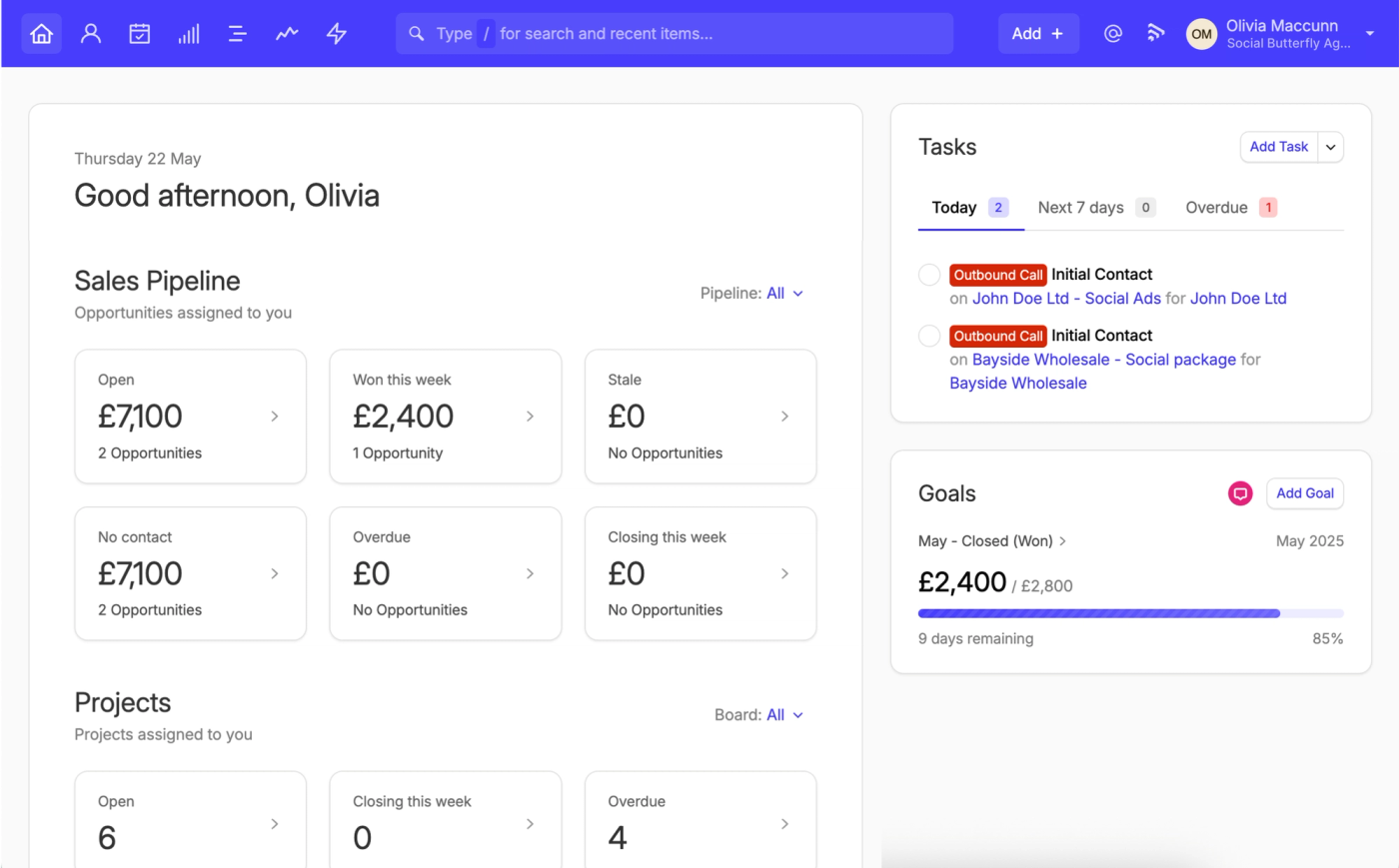
Capsule’s real strength is that it keeps the CRM opinionated but not heavy. You can still run a proper sales process without being forced into a giant enterprise implementation.
If your team needs a CRM that stays readable and usable, start with Capsule and Transpond here.
Transpond Deep Dive
Transpond is the marketing and communication layer. The official knowledge base describes it as an online email marketing service that lets you send campaigns, track opens and clicks, run automatic emails, manage subscribers, segment contacts, and build GDPR-compliant forms.
The feature surface is broader than basic newsletter software:
- Email campaigns.
- Automations.
- Transactional email.
- Signup forms.
- Website tracking.
- Reply tracking.
- Social campaigns.
- SMS campaigns.
- Conversations inbox.
- AI assistant.
- CRM integrations.
The pricing model is contact-based. The knowledge base explains that billing depends on the number of contacts that are active within your billing period. The free plan supports up to 250 contacts. Starter goes up to 25,000 active contacts and includes one automation, multiple mailboxes, and web tracking. Growth adds unlimited automations and more social campaigns, while Advanced and Ultimate scale the inboxes and contact limits further.
That is the important distinction. Transpond is not just “send emails.” It is built to automate the relationship around the CRM.
Feature Matrix
Here is where the stack becomes interesting.
Capsule Strengths
- Clean contact and opportunity management.
- Useful free plan.
- Visual sales pipelines.
- Tasks, calendar, and project boards.
- Reporting and dashboards on higher plans.
- AI pipeline and enrichment tools.
Transpond Strengths
- Email campaigns and automations.
- Transactional email.
- Reply tracking and social campaigns.
- Website tracking and signup forms.
- Contact-based billing that scales with usage.
- AI assistant and conversations inbox.
All-In-One Suite Strengths
- One login.
- One billing relationship.
- One dashboard for the whole team.
All-In-One Suite Weaknesses
- More bloat.
- Slower UI.
- More features than most small teams actually use.
Separate Stack Weaknesses
- More integration work.
- More room for data to drift.
- More tools to maintain.
Pricing Comparison
The pricing story is practical, not flashy.
Capsule offers a free forever plan with 250 contacts and two users. Paid plans add more contact capacity, better reporting, automation, and AI. The free trial on paid plans is 14 days.
Transpond offers a free plan with 250 contacts, then Starter, Growth, Advanced, and Ultimate. Starter supports up to 25,000 active contacts and one automation. Growth supports unlimited automations and more mailboxes. Advanced adds a conversation inbox. Ultimate removes the cap on active contacts, users, social campaigns, reply tracking mailboxes, and sites for web tracking.
The real pricing advantage of this stack is clarity. You can grow the CRM and the marketing layer at different speeds. You do not have to buy enterprise complexity just to get automation.
That said, there is still a management cost. Two tools means two settings pages, two admin surfaces, and more coordination. The stack wins only if the functional separation is worth that overhead.
If your team wants the CRM and the marketing side to stay focused, start with Capsule and Transpond here.
Use Case Recommendations
Capsule plus Transpond is best for:
- Small sales teams that need a proper CRM.
- Agencies that manage relationships and campaigns separately.
- Founders who want to keep the stack lean.
- Teams that want email automation without moving into a huge all-in-one suite.
All-in-one suites are best for:
- Large teams that want a single vendor.
- Organizations that are already committed to one ecosystem.
Separate CRM and email tools are best for:
- Teams with very specific requirements.
- Businesses with internal ops support to maintain integrations.
The practical decision rule is this: if you do not want to manage 12 disconnected tools, Capsule and Transpond are a smarter middle path than a patchwork stack. If you want total consolidation above all else, a bigger suite may be better.
When To Stick With The Stack
Stick with Capsule and Transpond if:
- You want CRM discipline without clutter.
- You want marketing automation that stays close to the contacts.
- You do not need a giant enterprise suite.
- You care about keeping sales and marketing manageable for a small team.
Consider alternatives if:
- You want one vendor for everything, even if it is heavier.
- You are already deep in another CRM ecosystem.
- You need complex enterprise workflows that go beyond the mid-market range.
What The Workflow Feels Like In Practice
The stack works best when sales and marketing are allowed to stay separate but connected.
Capsule keeps the relationship history, pipeline stage, and task list in one place. Transpond handles the follow-up motion: onboarding emails, nurture sequences, transactional updates, and re-engagement campaigns. That split is useful because the people responsible for the CRM and the people responsible for campaigns are often not the same people.
The workflow usually looks like this:
- A lead enters Capsule.
- Sales qualifies the contact and updates the pipeline.
- Transpond picks up the contact for an automated sequence.
- The team monitors clicks, replies, and campaign timing.
- The next sales or marketing action is based on the updated record.
That is a simple stack, but it is a disciplined one. It removes a lot of the copy-paste work that happens when CRM and email tools are too far apart.
Where Alternatives Fall Short
The biggest downside of the all-in-one alternative is usually bloat.
You may get more features on paper, but you also get more settings, more onboarding, and more UI that a small team never uses. For many businesses, that is the wrong kind of complexity.
The biggest downside of the separate-stack alternative is integration drift.
If the CRM and email tool do not stay synchronized, your reporting gets messy, segmentation gets inaccurate, and the team starts working around the system instead of through it. That is expensive in a subtle way because it looks fine until the process breaks.
Capsule and Transpond avoid both extremes. They are focused enough to stay usable, but separate enough to keep the tools from becoming one oversized mess.
Simple Buying Rule
Use Capsule and Transpond if your team wants:
- A readable CRM.
- Real email automation.
- Contact-based scaling.
- Less platform sprawl than a giant suite.
Consider a bigger suite if:
- You want one vendor for the whole customer lifecycle.
- You need enterprise governance across many teams.
- You already have a standard platform and do not want to change it.
The simplest way to judge the stack is whether your CRM and marketing work are currently helping each other or getting in each other’s way. If the answer is the second one, this combination is often the cleaner fix.
That is why the stack is appealing to teams that want discipline without enterprise bloat.
It is a practical middle ground, not a maximalist platform.
That middle ground is what makes it attractive to teams that hate unnecessary complexity.
It is the kind of setup that stays understandable after the first quarter.
That is usually enough to keep the team using it instead of replacing it.
That stability is the whole point.
Verdict
Capsule and Transpond are a good 2026 combination because they solve the real problem behind most CRM purchases: the CRM alone is not enough, but the all-in-one suite is often too much.
Capsule gives you contact and pipeline clarity. Transpond gives you campaigns, automations, transactional email, and tracking. Together they make a focused stack that is easier to understand than a bloated platform and easier to scale than a patchwork setup.
If your team wants a clean CRM plus a real marketing engine without buying enterprise sprawl, start with Capsule and Transpond here.
FAQ
Does Capsule have a free plan?
Yes. The free plan includes 250 contacts, 5 custom fields, one sales pipeline, and up to 2 users.
What does Transpond do?
Transpond is an email marketing and automation platform with campaigns, transactional email, forms, tracking, reply tracking, social campaigns, SMS campaigns, and a conversations inbox.
How does Transpond billing work?
It is based on the number of contacts active during the billing period.
Why use Capsule and Transpond together?
Because one handles CRM and sales workflow while the other handles messaging and automation.
Is this stack better for small teams?
Yes. Small teams usually benefit from the separation because it keeps the CRM manageable and the marketing layer focused.
What is the biggest risk?
Treating the tools as isolated products instead of one connected workflow.