


Quick Verdict :
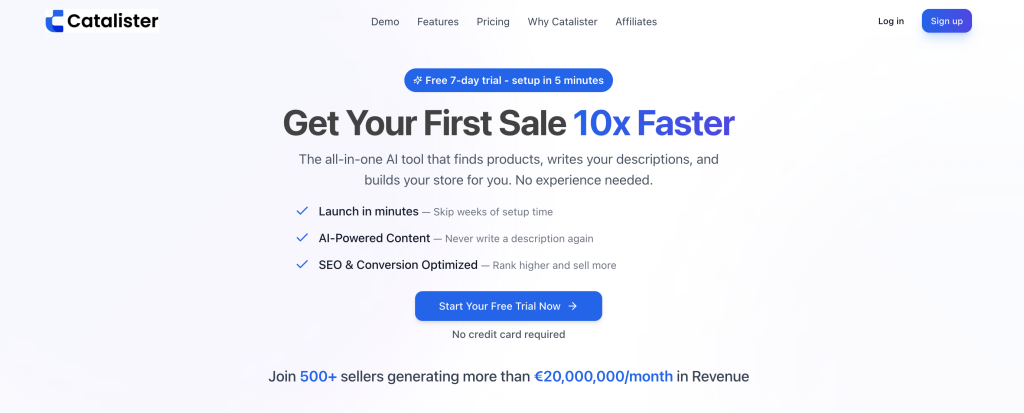
Catalister looks like a strong fit if your main problem is not traffic but product research, listing creation, and moving faster from idea to live catalog entry. The official positioning is pretty clear: it is an AI product research and listing expert, and the affiliate materials describe it in the context of automated product listing for ecommerce and dropshipping. That makes it interesting for operators who want less manual work and more consistent output.
My short take is that Catalister makes the most sense when your workflow already has a product source and you need help turning that source into something market-ready. If you are still doing everything by hand, the platform can save a lot of time. If your process is already highly customized, you will want to check whether its automation and listing logic match the way you work.
If you want to see the product in context while you read, start with Catalister here.
What Catalister Is :
Catalister is best understood as an AI assistant for product research and product listing work. Instead of treating product pages as a blank canvas every time, it is meant to help you move from research to listing faster. That matters in ecommerce because the tedious part is rarely the idea. It is the repetition around titles, descriptions, structure, and keeping catalog data clean.
The most useful way to think about Catalister is this: it sits in the middle of the product pipeline. You still need to choose the right product, validate the audience, and decide what should be sold. Catalister helps with the part after that by organizing the listing work and reducing the number of manual edits you need to do before a product is ready to launch.
That makes it especially relevant for dropshipping teams, marketplace sellers, and ecommerce operators who want a repeatable process instead of one-off product pages that feel inconsistent from item to item.
If you are trying to standardize the way you prepare product pages, start with Catalister here and test whether the workflow feels natural before you commit to a larger process change.
Pros And Cons :
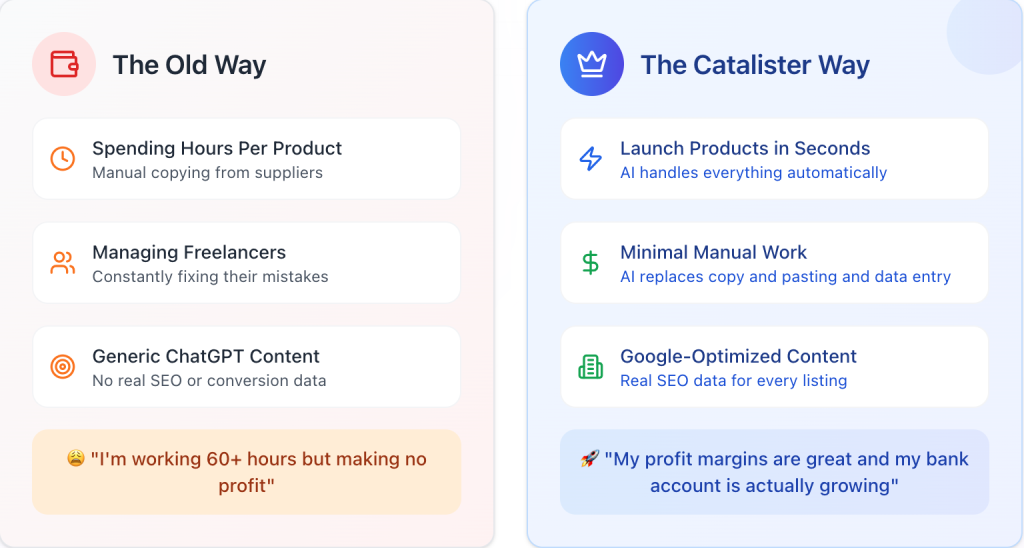
Catalister has a few obvious strengths.
- It is positioned directly around product research and listing work.
- It fits a real ecommerce pain point instead of trying to be everything.
- It can reduce repetitive writing and catalog setup.
- It appears useful for automated listing workflows.
- It may help smaller teams move faster without building a custom process from scratch.
It also has some tradeoffs.
- Public pricing is not clearly visible from the official home experience I reviewed.
- The site does not seem to surface a rich public feature matrix the way bigger SaaS tools do.
- You will probably need to confirm how much of the listing workflow is automated versus guided.
- Teams with very specialized ecommerce rules may still need manual review.
That combination is not a red flag. It just means Catalister is the kind of product you should evaluate by trying the workflow, not by reading a glossy comparison chart.
First Setup Steps :
The best way to begin with Catalister is to treat setup like a workflow design exercise, not just an account creation step.
1. Define The Product Source –
Start by identifying where your product data comes from. If your source is a supplier feed, a dropshipping catalog, or a manually curated spreadsheet, write that down first. The cleaner your source data, the better the listing output will be.
2. Decide What “Done” Means –
Before you generate anything, decide what a finished listing should include. For example, do you need a title, description, benefits section, keywords, bullets, or category metadata? A tool like Catalister works better when the output format is consistent.
3. Pick One Use Case First –
Do not try to automate every product type on day one. Start with one product family or one catalog segment so you can see where the system saves time and where you still need human review.
4. Keep Review In The Loop –
Even if the product claims to automate listing work, you should still review the output for tone, accuracy, and compliance. The goal is to make production faster, not to let low-quality copy slip into the store.
5. Save A Repeatable Template –
Once you like the workflow, freeze the structure so future listings feel consistent. That is where the real operational value usually shows up.
If you want the workflow to feel less manual from the start, start with Catalister here and map one clean product from intake to final listing before scaling up.
Dashboard Overview :
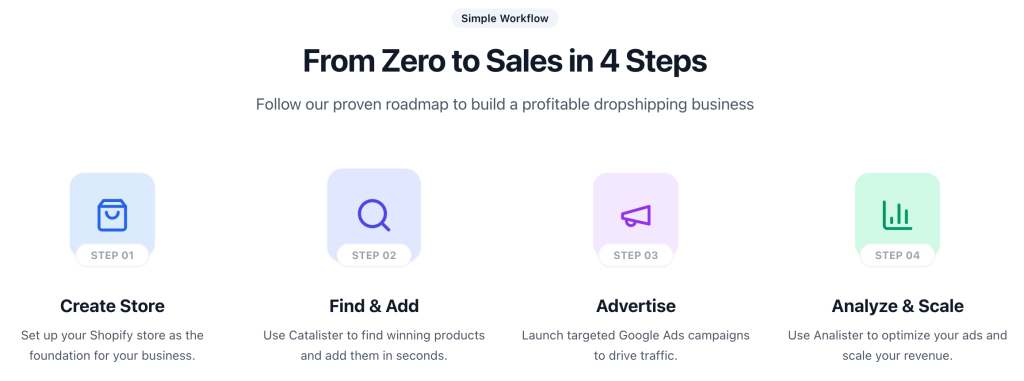
Because the public site is minimal on deep product documentation, the most useful dashboard question is simple: does Catalister help you stay organized around the product research and listing pipeline? That is the real value test.
In a good setup, the dashboard should help you see:
- Which products are ready to research.
- Which products need listing text.
- Which listings need review.
- Which items are still waiting for approval.
That kind of structure matters because ecommerce automation only works when the team can see what is happening. A tool that makes work faster but harder to inspect usually creates more cleanup later.
So when you open Catalister for the first time, do not look only for a fancy AI prompt box. Look for workflow clarity. A product research assistant should help you answer three questions quickly:
- What should I list?
- What should the listing say?
- What still needs a human check?
If the interface helps you answer those fast, the product is already doing something useful.
Your First Workflow :
The first workflow should be simple and practical.
Start with one product and move it through the same steps every time:
- Collect the source information.
- Confirm the product angle.
- Generate the listing draft.
- Review the copy for accuracy.
- Check whether the call to action and positioning make sense.
- Save the output in a repeatable format.
That sounds basic, but it is exactly how you avoid chaos later. Most ecommerce workflow problems do not come from the tool. They come from the team skipping the boring part where the process gets defined.
One thing worth remembering is that a good first workflow should be boring in the right way. If the listing generation step is too clever and keeps changing structure every time, the team will spend more time editing than saving time.
That is why Catalister should be judged on consistency, not just output speed.
Best Practices :
If you want Catalister to help instead of getting in your way, keep these habits in place:
- Use clean source data.
- Review product claims before publishing anything.
- Keep one listing structure for a whole catalog segment.
- Save the successful format as a template.
- Add a human pass for edge cases and compliance-sensitive products.
The biggest mistake teams make with AI product tools is assuming the first output is the final output. It almost never is. The best teams use AI to accelerate the first draft, then use human judgment to make the listing believable and commercially useful.
Another useful practice is to keep your product naming consistent. If your internal naming is messy, your AI output will usually echo that mess back to you.
If you are ready to move from manual listing work to something more repeatable, start with Catalister here and keep the first rollout small enough that you can actually review it properly.
Common Mistakes :
The most common mistake is trying to automate too much too early. A lot of teams buy a tool like this because they want speed, but speed without a clean process usually just creates faster mistakes.
Other mistakes include:
- Skipping product validation before listing.
- Letting AI invent details that were not in the source data.
- Using one workflow for every product type.
- Ignoring review and approval steps.
- Not keeping a record of what worked.
The last point matters more than people think. If you do not document the first few good listings, you will not know why they worked later. That turns a useful tool into a guess-and-check machine.
Treat the first month as a setup phase, not a scale phase.
Pricing :
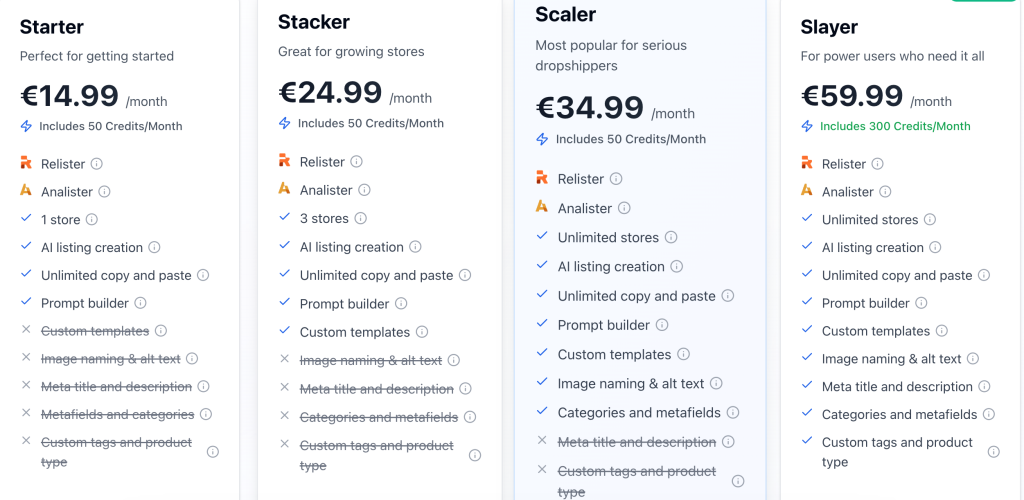
I could not find a clear public pricing table on the official Catalister site during this review. That is not unusual for a newer or more targeted product, but it does mean you should treat the current buying path as something to verify directly on the official site.
That leaves you with a simple rule:
- If the product fits your workflow, ask for the current pricing through the official flow.
- If the workflow does not fit, do not buy just because the idea sounds efficient.
When pricing is not public, the real question becomes value, not sticker shock. If Catalister saves you time on product research and listing creation, the cost only makes sense when it reduces repeated manual labor or helps you launch better product pages faster.
The safest thing to do is use the official site as the source of truth and verify the current commercial terms there before rolling it into your operating stack.
Verdict :
Catalister makes sense if your pain point is repetitive product listing work and you want a cleaner way to move from product research to publishable output. It is not trying to be a giant all-in-one SaaS platform. It is trying to remove friction from a very specific ecommerce task.
That specificity is a strength. It usually means the workflow is easier to adopt, the team has less to learn, and the first win is easier to see.
If you want to reduce manual listing work without building a custom system from scratch, start with Catalister here and test it on one product segment before you scale it.
FAQ :
Is Catalister a product research tool or a listing tool?
It looks like both. The official positioning points to AI product research and listing support, so the value is in moving from research to a usable listing faster.
Is Catalister useful for dropshipping?
Yes, that is one of the most obvious fits based on the official affiliate wording and the overall product positioning.
Does Catalister publish public pricing?
I could not find a clear public pricing table on the official site during this review, so you should verify the current offer directly on the site.
Should I trust the first AI output?
No. Use it as a strong draft, then review product claims, tone, and structure before relying on it.
Who is Catalister best for?
It is best for ecommerce operators, marketplace sellers, and dropshipping teams that want to standardize product listing work.