


In this guide
Why This Comparison Matters :
Tresorit lives in a category where “cloud storage” is not a precise enough description anymore.
Disclosure: Stack99 earns a commission if you buy through links on this page. It costs you nothing extra and never changes our assessment.
The official site positions Tresorit around zero-knowledge end-to-end encryption, secure cloud collaboration, data rooms, secure file exchange, eSign, data residency, and stronger control over who can access content and where that content lives.
That means the real alternatives are not just generic file-sync tools. They are products that answer a different question:
- Do you want the strongest security-first collaboration posture?
- Do you want a broader content and workflow platform?
- Or do you want general productivity-oriented cloud storage with business controls?
That is why this comparison matters. Tresorit is not buying into the same tradeoffs as every other storage platform.
If you want to inspect the source product while you read, start with Tresorit here.
Quick Comparison Table :
| Tool | Starts at | Free option | Best for |
|---|---|---|---|
| TresoritTHIS GUIDE | $10.42/mo | 14-day trial | Encrypted cloud storage |
| Box | $5/mo | Free plan | Cloud content management |
| Dropbox | $9.99/mo | Free plan | Cloud file storage |
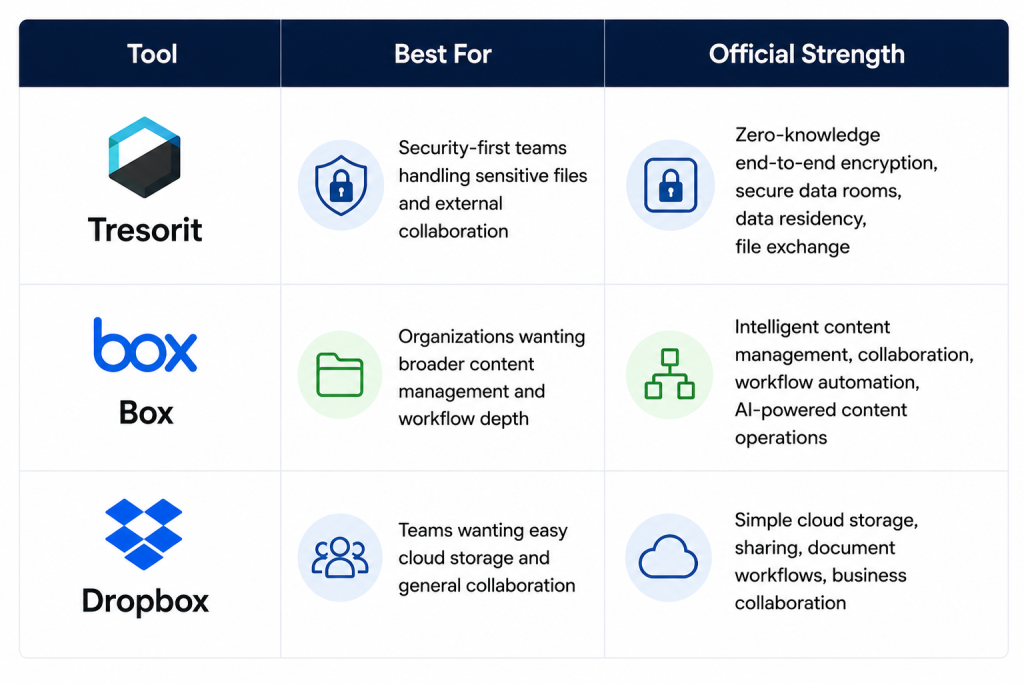
That table is the main buying map. Tresorit is optimized for trust and control first. The other tools start from different centers of gravity.
Product A Deep Dive: Tresorit
Tresorit’s official positioning is clear and unusually disciplined.
The company talks about:
- Zero-knowledge end-to-end encryption.
- SecureCloud.
- Engage.
- FileSharing.
- ESign.
- Data residency.
That matters because it tells you exactly what the product is trying to be: a secure collaboration platform for sensitive work, not only a place to drop files.
Why teams choose Tresorit:
- They need stronger confidentiality guarantees.
- They share sensitive information with clients or external partners.
- They care about access control, residency, and auditability.
- They want a product that is comfortable in regulated or trust-heavy environments.
Why some teams hesitate:
- They may not need this level of control.
- They may prefer broader workflow breadth over an encryption-first posture.
- They may care more about general collaboration convenience than security architecture.
Product B Deep Dive: Box
Box comes from a very different official angle.
Its site positions the platform as intelligent content management with collaboration, security, workflow automation, APIs, and AI-powered content operations. The official language is broader and more enterprise-process-oriented than Tresorit’s.
That means Box is often the stronger option when the organization cares about:
- Content management at scale.
- Workflow automation.
- Broader enterprise document operations.
- Integrations across a large app ecosystem.
Why teams choose Box instead of Tresorit:
- They want a wider content-management operating model.
- They need workflow and automation breadth around files.
- They prefer a larger enterprise content platform identity.
Why Tresorit may still win:
- Tresorit’s zero-knowledge end-to-end encryption posture is more central to the product identity.
- Security-sensitive teams may prefer the more focused trust model.
Box is strongest when content operations and enterprise workflow breadth matter as much as secure storage itself.
Product C Deep Dive: Dropbox
Dropbox remains a very relevant alternative because its official site is still built around secure cloud storage, file sharing, collaboration, and a broad set of business workflow tools like sharing, editing, signing, and team organization.
Dropbox is attractive when the company wants:
- Familiar cloud storage.
- Easier everyday sharing.
- General-purpose business collaboration.
- A platform that feels less specialized and more mainstream.
Why teams choose Dropbox instead of Tresorit:
- They want a lighter learning curve.
- They mainly need productivity-oriented storage and sharing.
- Their collaboration needs are broad, but not always highly sensitive.
Why Tresorit may still win:
- Tresorit is more explicitly built around zero-knowledge end-to-end encryption and secure exchange.
- Teams handling confidential legal, financial, healthcare, or client data may prefer its stronger security-first positioning.
Dropbox is often the better fit when the organization wants a broad, comfortable collaboration layer rather than a more security-driven operating model.
Feature Matrix :
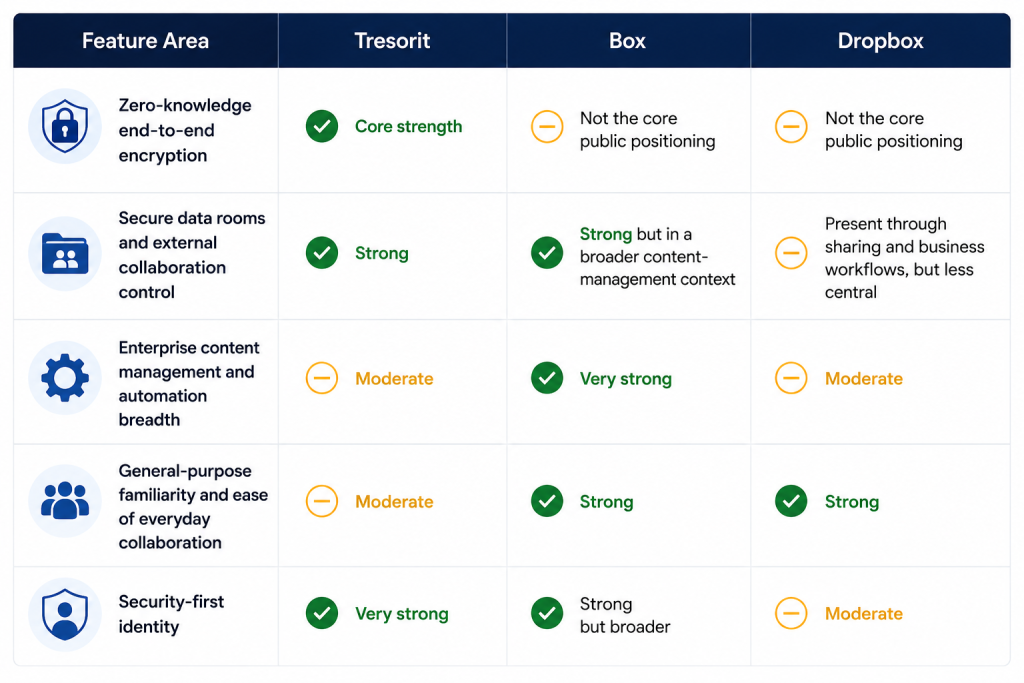
That matrix explains why these products are often compared but not actually interchangeable.
Pricing Comparison :
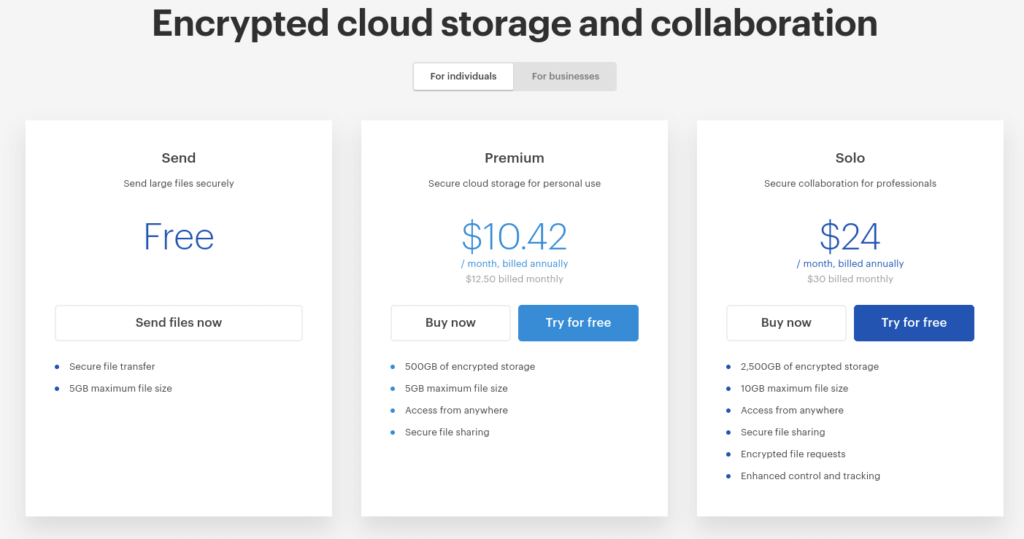
This category is easy to oversimplify, so I would keep the pricing read practical.
Tresorit’s official pages do publish public pricing for parts of the portfolio, including a free Basic plan and a Personal Essential plan at $11.99 per month, plus business plans with per-user pricing and storage levels. Box and Dropbox also have broad business pricing paths, but the real comparison is less about a raw plan number and more about what kind of file workflow you are buying.
The practical pricing questions are:
- Are you paying for stronger confidentiality and control?
- Are you paying for a broader content-management system?
- Are you paying for simpler everyday collaboration?
That is why the cheapest headline plan is often the wrong decision metric. A platform that better fits security and external collaboration needs can be cheaper operationally, even if the subscription looks higher at first glance.
If you want to evaluate the security-first side of that tradeoff, start with Tresorit here and compare one real document-sharing workflow instead of only comparing plan names.
Implementation Reality Matters Here :
Security-first collaboration tools should not be judged like casual file apps.
The better implementation question is whether the platform makes the team more deliberate without making the work feel miserable. Tresorit usually looks strongest when a business wants secure sharing to become a default habit rather than a special exception. Box looks stronger when the organization wants file workflows to connect into broader enterprise content logic. Dropbox looks stronger when the company mainly wants familiar collaboration that many users already understand immediately.
That is why the right comparison test is operational. Share one sensitive document set, one external collaboration flow, and one internal approval path through each type of platform if possible. The right answer usually becomes obvious once a real team touches the workflow.
Use Case Recommendations :
Choose Tresorit If –
- Your work regularly involves sensitive files.
- You share information with external clients, partners, or regulated teams.
- You care about zero-knowledge encryption, controlled sharing, and residency options.
Choose Box If –
- Your organization wants a bigger content-management and workflow platform.
- Automation and enterprise document operations matter heavily.
- You need a broad content-and-process layer around files.
Choose Dropbox If –
- You want general cloud storage and business collaboration with a familiar feel.
- Ease of use matters more than a strict security-first identity.
- Your files matter, but not every workflow needs the strongest confidentiality posture.
The Real Tradeoff :
The real tradeoff here is not “good storage versus bad storage.”
It is this:
Tresorit asks the buyer to prioritize trust, confidentiality, and control. Box asks the buyer to think more broadly about content management and process automation. Dropbox asks the buyer to prioritize familiar collaboration and productivity comfort.
That is why teams can look at all three and still make very different decisions without any of them being irrational.
If you run a legal, finance, healthcare, executive, client-services, or security-conscious operation, Tresorit’s narrower but sharper product identity can be exactly what you want. If you run a broader enterprise content machine, Box may feel more natural. If your main goal is comfortable cloud collaboration, Dropbox may be enough.
When Tresorit Is The Better Call :
Tresorit is usually the better call when the consequences of loose sharing are real.
That includes situations where:
- Client files must stay controlled.
- Access needs to be revoked cleanly.
- Data location matters.
- External collaboration needs structure.
- Security discussions are part of normal business, not only rare exceptions.
In those environments, Tresorit’s security-first posture stops being a premium curiosity and starts feeling like sensible process design.
It also helps reduce the “shadow workflow” problem. When teams do not trust the default file-sharing process, they create side channels. A stronger secure-sharing model can pull that behavior back into a system the business can actually govern.
That governance benefit is often more valuable than buyers expect at the start. It makes the secure process easier to defend internally, too.
It also gives leadership a cleaner answer when someone asks whether sensitive data is being handled intentionally or just hopefully.
That may sound soft, but it changes behavior. Teams are much less likely to bypass the approved system when the approved system is clear, secure, and usable enough to trust in daily work.
That is a very practical advantage for cautious teams handling sensitive work every day across departments and external relationships, especially when many people touch the files and permissions change often during active projects with outside stakeholders and outside reviewers at once during deadlines and audits alike for real businesses under pressure every quarter at scale globally today everywhere.
Verdict :
Tresorit is one of the best alternatives in 2026 for teams that want security-first collaboration rather than ordinary cloud storage with some extra settings.
Box is stronger for broader content management and workflow depth. Dropbox is stronger for mainstream collaboration comfort. Tresorit is stronger when zero-knowledge end-to-end encryption, controlled exchange, and secure external collaboration are central to the buying decision.
If that is your environment, try Tresorit here and compare one real secure-sharing workflow against your current process before you decide.
If you want to pressure-test the fit further, open Tresorit here and compare it against the exact way your team currently handles external sensitive files.
FAQ :
What Is The Closest Tresorit Alternative?
It depends on the need. Box is a strong broader enterprise content alternative, while Dropbox is a strong general collaboration alternative.
Is Tresorit More Secure Than Box Or Dropbox?
Tresorit’s official positioning is much more centered on zero-knowledge end-to-end encryption and security-first collaboration. That makes it especially compelling for sensitive-file workflows.
Does Tresorit Have Public Pricing?
Yes. The official pricing pages include a free Basic plan, a Personal Essential plan at $11.99 per month, and multiple business pricing paths.
When Should I Choose Box Instead?
Choose Box when the bigger need is content management, workflow automation, and broader enterprise content operations.
When Should I Choose Dropbox Instead?
Choose Dropbox when you want a more familiar general-purpose cloud collaboration platform and do not need Tresorit’s stronger security-first posture for most workflows.
Before You Choose, Compare These
Hand-picked guides to help you choose the right tool — no fluff.
 PricingTresorit Pricing 2026Real tier prices and what each plan actually includes.
 AlternativesTresorit Alternatives 2026Credible alternatives and when each one wins.
 FeaturesFreshteam Top Features 2026The standout features and whether they justify the price.
 TutorialsInstapage Beginner's Guide 2026A clean start-here walkthrough with no jargon.