


In this guide
Quick Verdict :
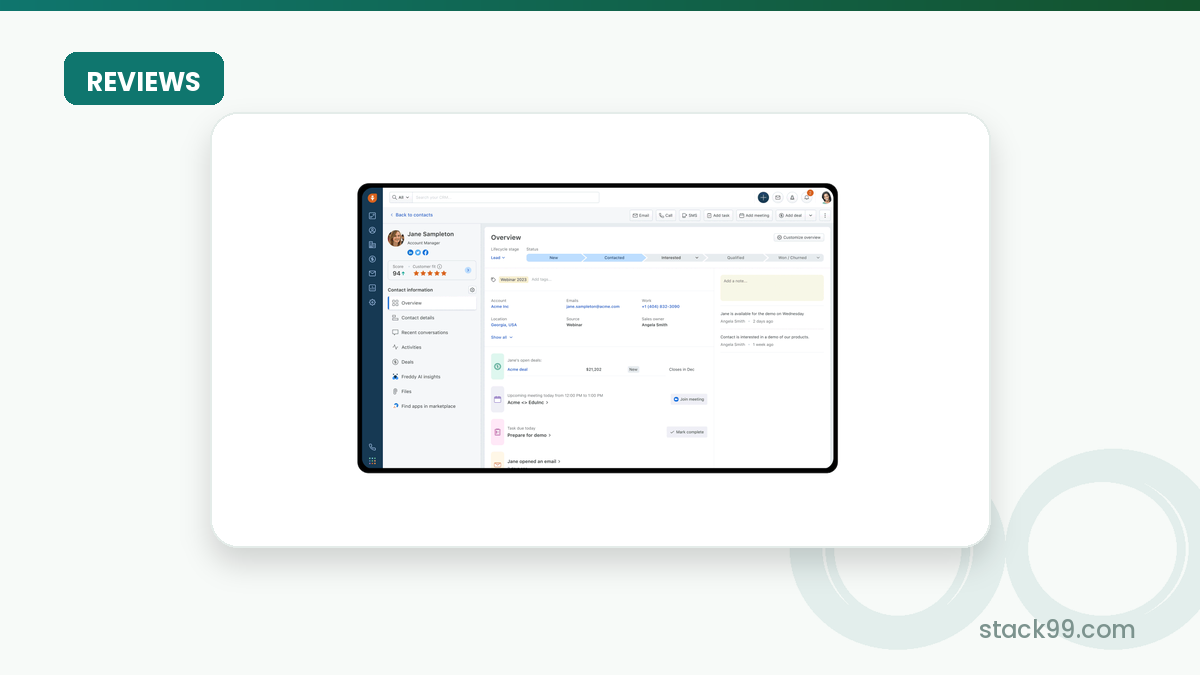
Freshsales is a strong sales CRM in 2026 if your team wants pipeline management, built-in communication, AI-assisted selling, and a clean path from small-team CRM to more advanced governance. It is not trying to be a generic spreadsheet replacement. It is trying to give sales teams one place to manage leads, contacts, deals, tasks, and outreach.
Disclosure: Stack99 earns a commission if you buy through links on this page. It costs you nothing extra and never changes our assessment.
The official Freshsales pages make that pretty clear. The product sits inside the Freshworks CRM family and leans on a few big ideas:
- Kanban-style deal management.
- Built-in chat, email, and phone.
- Freddy AI for productivity and insights.
- Sales automation that removes repetitive admin work.
- Mobile access and collaboration across teams.
If you want to review the platform while you read, start with Freshsales here.
Product Facts And Overview :
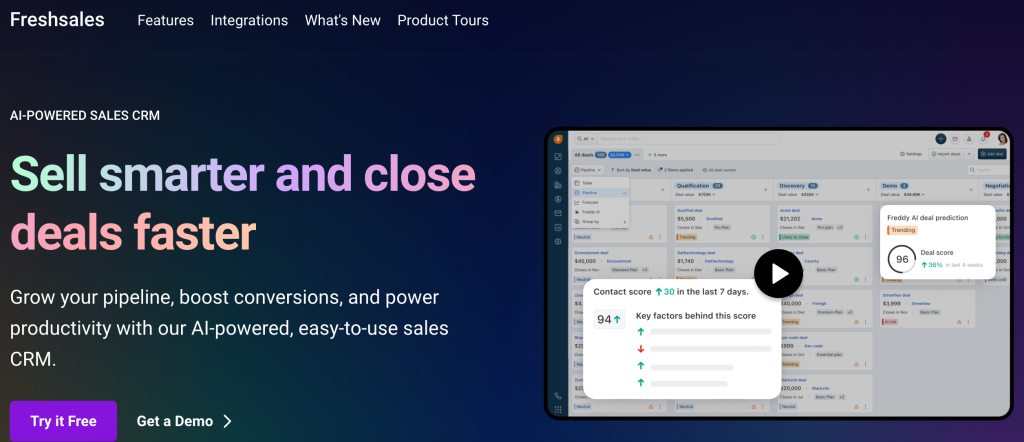
Freshsales is built as an AI-powered CRM for sales teams that need more than a contact list. The official pricing page says the suite is designed for sales and marketing together, and the features page shows how much of the workflow is built around context, automation, and visibility.
The public product story in 2026 centers on:
- Sales pipelines.
- Multichannel communication.
- Context-rich customer records.
- Productivity automation.
- Analytics and forecasting.
- Freddy AI assistance.
Freshsales also matters because it is not only a “sales rep tool.” It gives managers and ops teams better visibility into what is happening across the pipeline, which is where a lot of CRMs become useful or annoying.
Freshsales is trusted by tens of thousands of businesses, and the public pages position it as a practical CRM for teams that want to work faster without making the stack harder than it needs to be.
Pros And Cons :
What we liked
- Freshsales Has A Clear Sales-first Workflow
- Built-in Chat, Email, And Phone Cut Down On Tool Switching
- Freddy AI Helps With Sales Emails, Text Rewriting, And Deal Insights
- Custom Fields, Modules, And Reports Give Teams Room To Grow
What to watch
- The Best Features Move Up The Pricing Ladder Quickly
- AI And Advanced Governance Are Better On Higher Plans
- Teams With Very Simple Needs May Not Need This Much CRM
- You Still Need A Disciplined Sales Process To Make It Pay Off
Real talk: Freshsales can absolutely make a sales team more organized, but it will not magically fix sloppy pipeline habits. If your reps do not update stages or log activity, the CRM becomes a prettier version of the same mess.
Feature Deep Dive :
Pipeline Management That Actually Helps –
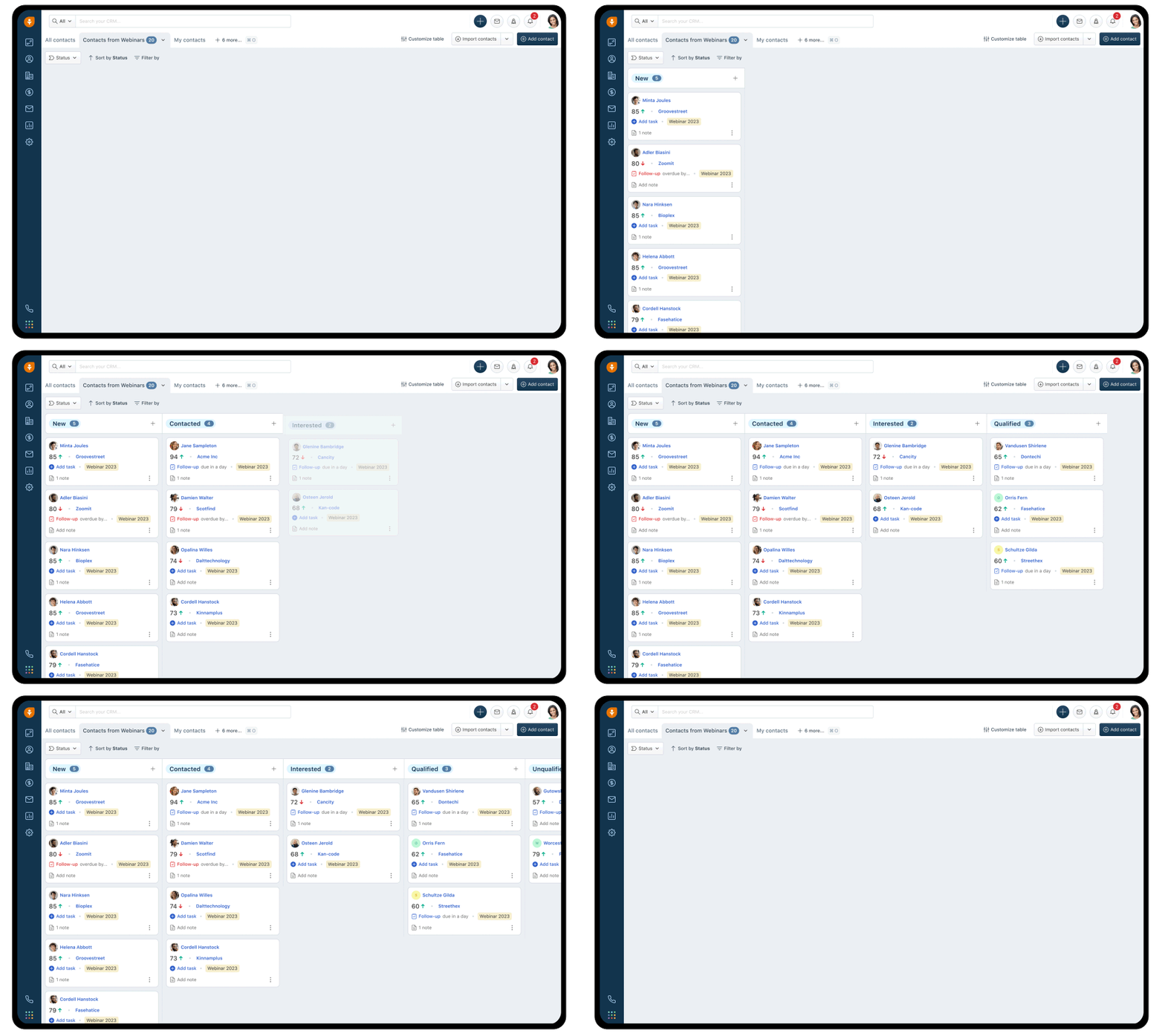
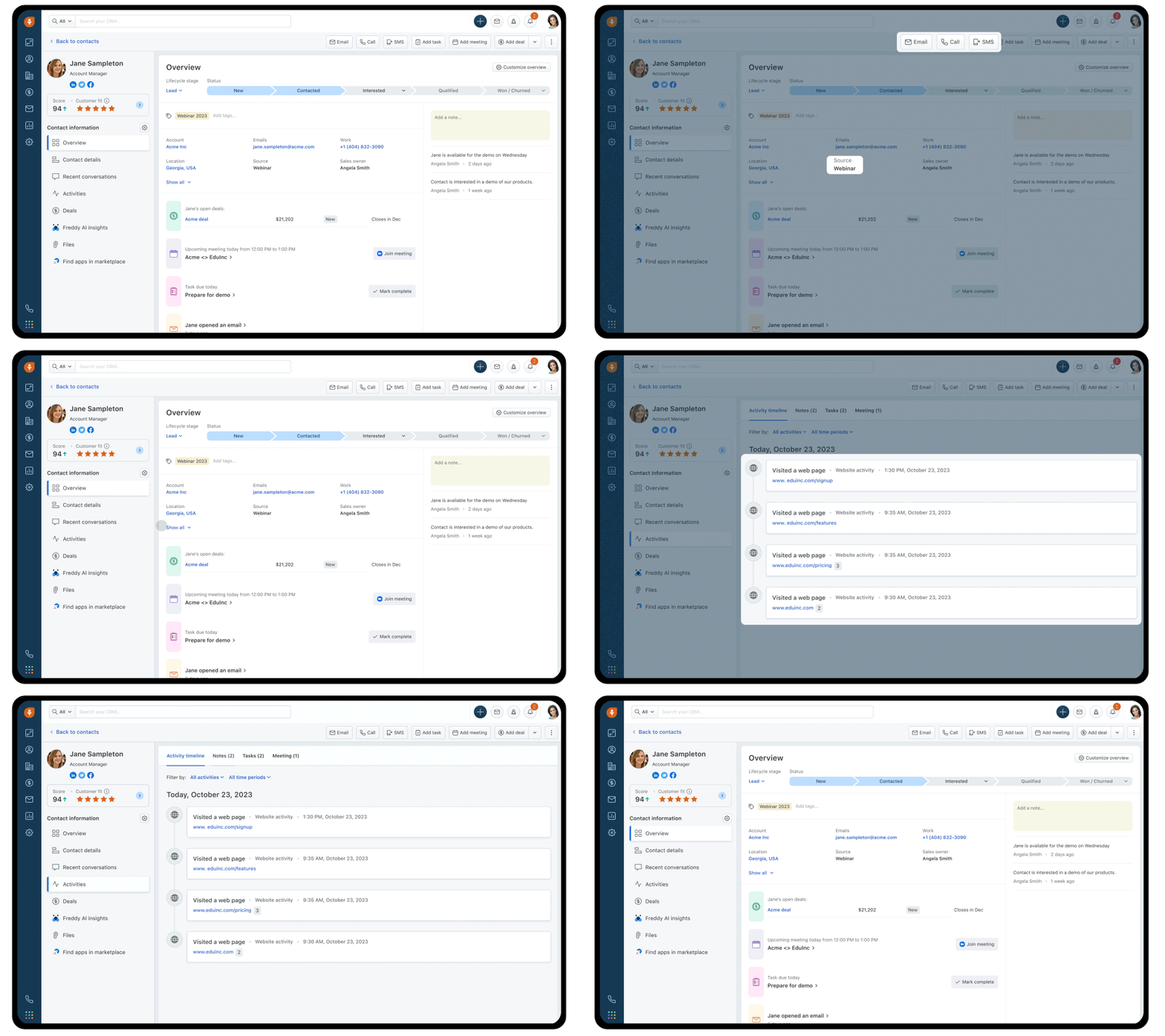
The features page gives Freshsales a strong pipeline story. You get multiple sales pipelines, kanban views, deal stages, product catalogs, goals, and forecasting. That is exactly what a sales leader wants to see in 2026: a pipeline that is visible enough to manage without being buried in clicks.
Kanban views are especially useful for teams that want a quick read on deal movement. They also make it easier for newer reps to understand where a prospect is in the process.
If your current sales process feels fragmented, start with Freshsales here and compare the pipeline view against what your team uses today.
Communication Built Into The CRM –
Freshsales does a nice job of reducing the excuse that sales tools and communication tools must live separately.
The Growth plan includes built-in chat, email, and phone. The features page also highlights SMS and WhatsApp engagement, email templates, reply tracking, and contextual collaboration with Slack. That means reps can stay in the CRM longer before hopping into separate tools.
That matters because the fastest sales teams are usually the ones with the fewest context switches.
Freddy AI For Sales Work –
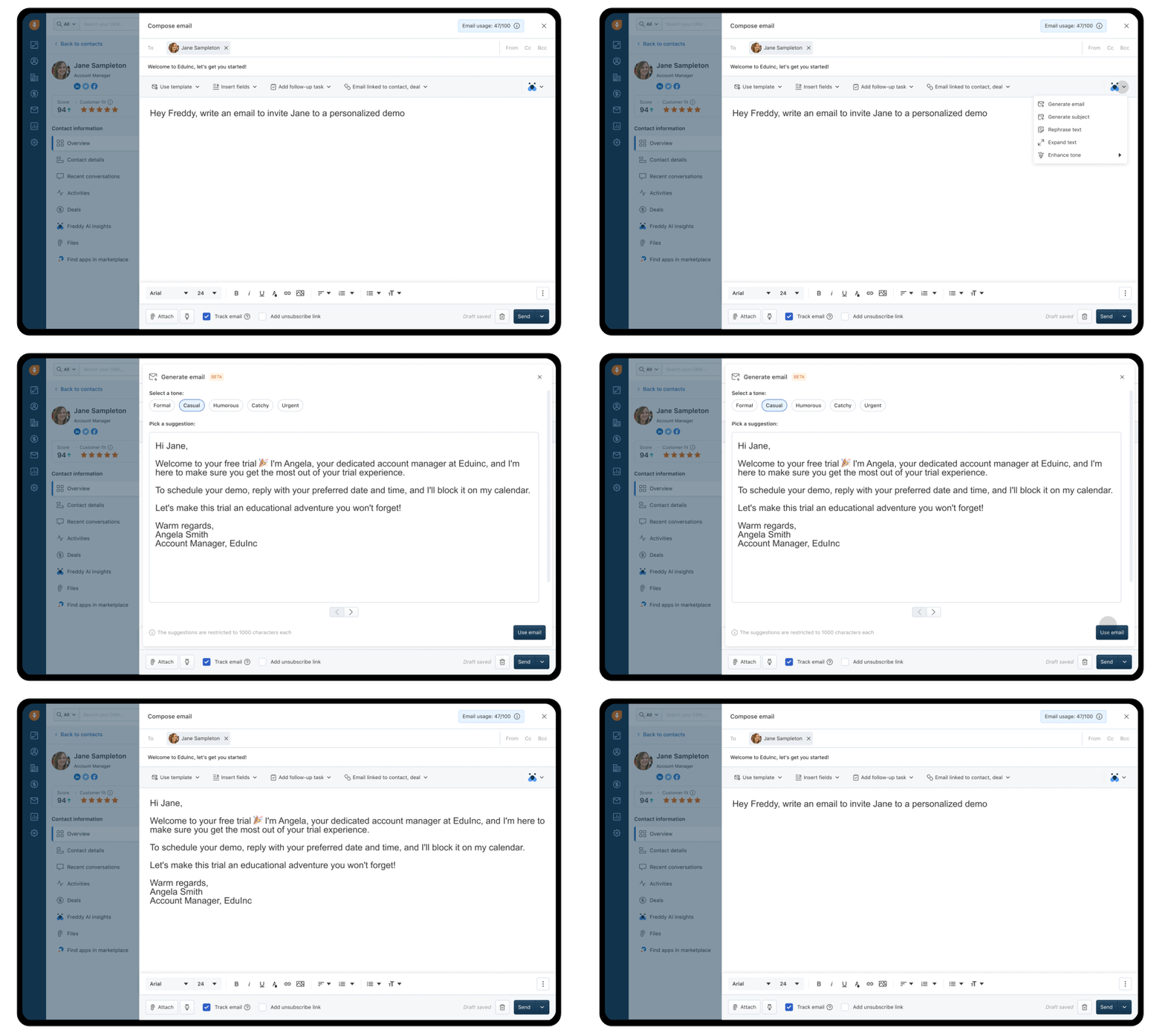
Freshsales uses Freddy AI in a practical way. On the Pro plan, the official pricing page highlights Contact Scoring, Sales Emails by Freddy AI, text rephrasing, SMS Content Generator, and Deal Insights by Freddy AI. On the Enterprise plan, it adds Forecasting Insights by Freddy AI.
That is the right kind of AI for a CRM. It is not trying to be a vague chatbot in a dashboard. It is trying to make actual sales work faster:
- Prioritize leads.
- Improve email drafting.
- Surface deal signals.
- Improve forecasting.
Customization And Governance –
The features page makes customization a big part of the product. Freshsales supports custom fields, custom modules, sales activities, multi-currency, multi-language, internal notifications, webhooks, and APIs.
That matters once a team grows beyond a very simple sales motion. You can adapt the CRM around your process instead of forcing every business into the same rigid template.
Enterprise adds field-level permissions, sandboxing, audit logs, and custom modules, which is the kind of governance layer larger teams need once more people are touching the same data.
Mobile And Cross-team Context –
Freshsales also keeps the mobile story practical. The public page points to mobile offline mode, Google Maps integration, Gmail and Outlook add-ons, and voice notes. That is useful for field reps, hybrid teams, and anyone who is moving between offices and meetings.
It is also a subtle reminder that CRM value is not just about storing data. It is about giving people enough context to act on the data in the moment.
Pricing Breakdown :
The official Freshsales Suite pricing page is refreshingly straightforward.
The visible annual pricing in 2026 is:
| Plan | Price | What you get |
|---|---|---|
| Free | Free | Up to 3 users |
| Growth | $9/mo | Per user |
| Pro | $39/mo | Per user |
| Enterprise | $59/mo | Per user |
The plan differences are meaningful:
- Growth gives you a practical starter CRM with pipelines, multichannel engagement, and basic workflows.
- Pro adds AI assistance, multiple pipelines, advanced workflows, and deeper automation.
- Enterprise adds governance features like permissions, custom modules, sandbox, and audit logs.
That ladder makes sense. Freshsales starts as a useful small-team CRM and gets more serious as the organization grows.
If you want to compare the plan fit with your sales process, start with Freshsales here.
Who Should Use Freshsales :
Freshsales is a strong fit for:
- Startups That Need A Real CRM Fast.
- SMBs That Want Sales, Email, Chat, And Phone In One Place.
- Teams That Care About Pipeline Visibility.
- Managers Who Want Better Forecasting And Reporting.
- Organizations That Want AI Help Without Buying A Separate AI Stack.
It is less compelling for teams that only need a contact database and almost no workflow. In that case, even the free plan may be more structure than they want.
Implementation Notes :
The easiest way to roll Freshsales out is to treat it as a process upgrade, not just a software purchase.
Start with a small pilot and map the current sales motion before you move data in. The official features page suggests the platform is strongest when your stages, activities, and communication rules are already somewhat defined.
That means the right rollout sequence usually looks like this:
- Define Lifecycle Stages And Pipeline Stages.
- Decide Which Fields Are Mandatory.
- Set Up Lead-routing Rules For The Right Owners.
- Connect Email, Phone, And Chat Only After The Core Model Is Clear.
- Add Freddy AI And Reporting Once The Team Is Actually Logging Data Cleanly.
That last step matters. AI can help a decent process become faster. It cannot rescue a process that nobody follows.
Freshsales is especially good when reps need a single place to see customer context before a call, email, or follow-up. The features page shows exactly that kind of workflow with summary cards, activity timelines, auto-profile enrichment, and context across sales, support, and marketing.
What Managers Should Expect :
Managers usually buy Freshsales for the same reason they buy any CRM: visibility.
The difference is that Freshsales aims to make visibility more actionable than a static report. The official pages emphasize:
- Forecasting.
- Attribution.
- Win-loss analysis.
- Rotten deals.
- Auto-assignment rules.
- Sales sequences.
That combination matters because a manager does not just want to know what happened last month. They want to know:
- Which deals need attention now.
- Which reps are overloaded.
- Which lead sources convert.
- Which stage is slowing revenue down.
Freshsales gives you enough structure to answer those questions without feeling like an old enterprise CRM from another era.
When Freshsales Beats A Spreadsheet CRM :
This is the simplest buying test.
If you only need to store names, emails, and notes, a spreadsheet may still be enough.
Freshsales becomes the better choice when you need:
- Lead routing.
- Multi-pipeline management.
- Follow-up automation.
- Sales email templates.
- Call logging and recordings.
- Shared visibility across sales, marketing, and support.
That is the point where a spreadsheet starts becoming a liability rather than a shortcut.
Pricing Fit By Team Stage :
The pricing ladder is also surprisingly good at matching company stage.
Free is useful for very small teams that are still proving a process.
Growth makes sense for startups that need an affordable CRM with communication built in.
Pro is the plan where the CRM starts feeling like a real sales operating system because Freddy AI, multiple pipelines, automation, and stronger workflows become part of the picture.
Enterprise is for teams that want governance and process control: field permissions, sandboxing, audit logs, and more structured admin.
That is the right progression. The product grows with you instead of forcing a huge leap on day one.
What Teams Should Expect In Month One :
The first month with Freshsales usually works best when the team keeps the rollout boring on purpose. That sounds unexciting, but it is the fastest way to get value out of a CRM without making the process feel heavy.
The practical goal is simple:
- Log every new lead in one place.
- Make sure every deal has an owner.
- Use one pipeline naming convention.
- Keep activity logging consistent.
- Let the team get used to the workflow before adding more automation.
Once that foundation is in place, the product starts paying off fast. Managers can see the pipeline, reps stop hunting through scattered notes, and the AI features become more useful because the underlying data is cleaner.
That is the real Freshsales story in 2026. It is not a flashy shortcut. It is a solid operating layer that becomes more valuable the more disciplined the team is. If your team already knows how it sells, Freshsales helps that process become visible, repeatable, and easier to coach. That makes the free-to-enter pricing ladder feel a lot more strategic than promotional. It is a quiet but meaningful advantage for teams that hate messy CRM rollouts. That is exactly the kind of detail that helps adoption stick. It really does.
Expert Verdict And CTA :
Freshsales works because the official pages is coherent. It gives sales teams a place to manage relationships, automate repetitive motion, and see the pipeline clearly without overcomplicating the workflow.
The best features are the pipeline tools, Freddy AI layer, built-in communication, and the path from free to enterprise-grade governance.
If you want a CRM that can scale with the team rather than forcing a later migration, start with Freshsales here and test the Growth or Pro plan against your actual lead flow.
FAQ :
How much does Freshsales cost in 2026?
The official pricing page shows Free for 3 users, Growth at $9 per user per month, Pro at $39, and Enterprise at $59 billed annually.
Does Freshsales include AI?
Yes. The official pages highlight Freddy AI features such as contact scoring, deal insights, sales email rewriting, SMS generation, and forecasting insights.
Is Freshsales good for small teams?
Yes. The free plan is designed for up to 3 users, and the Growth plan is a sensible low-cost entry point for startups and SMBs.
What makes Freshsales different from a basic CRM?
It combines pipeline management with built-in chat, email, phone, mobile tools, and AI assistance instead of forcing those workflows into separate apps.
Before You Choose, Compare These
Hand-picked guides to help you choose the right tool — no fluff.
 Use CasesWho Is Freshsales Best For? Use Cases & Fit (2026)Who gets the most out of it – and who should skip it.
 PricingFreshsales Pricing 2026Real tier prices and what each plan actually includes.
 Use CasesWho Is Leadpages Best For? Use Cases & Fit (2026)Who gets the most out of it – and who should skip it.
 IntegrationsWegic Integrations Guide 2026What it connects to and how well each link holds up.