


Quick Verdict
Hello Bar is still one of the clearest lead-capture tools for websites that want fast popup deployment without turning conversion optimization into a full development project.
The official pricing pages in 2026 tell a very specific story: Hello Bar is designed to help websites convert more visitors into leads, subscribers, and buyers through bars, modals, alerts, sliders, and page takeovers, with customization, A/B testing, analytics, and email integrations layered on top.

That is a solid value proposition.
My short verdict is this:
- Strong fit for sites that want fast lead capture and list growth.
- Better than do-it-yourself pop-up stacks when speed matters.
- Most compelling for marketers, publishers, and small business sites that need testing and targeting without heavy setup.
- Less compelling if you need a full marketing automation platform instead of an on-site conversion layer.
If you want to explore the product while you read, start with Hello Bar here.
Product Facts And Overview
Hello Bar’s public pricing pages make its positioning very clear.
The product is built around on-site conversion surfaces and lead capture. The official pages highlight:
- Bars.
- Modals.
- Alerts.
- Sliders.
- Page takeovers.
The same pages also emphasize conversion outcomes such as:
- Increase visitor engagement.
- Collect high-quality emails.
- Reduce cart abandonment.
That is useful because it tells you what Hello Bar is not trying to be. It is not pretending to replace your full email marketing system, CRM, or analytics stack. It is trying to be the conversion layer that sits on top of your website traffic.
That focused positioning is one reason the product still feels practical.
Pros And Cons
Pros
- The official pricing page is easy to understand.
- The plan ladder clearly separates free and paid usage.
- Unlimited popups and subscribers show up on multiple paid tiers.
- A/B testing is visible as a real feature, not buried in footnotes.
- The page shows multiple pop-up formats and customization options clearly.
Cons
- The platform is still mainly an on-site conversion tool, not a full lifecycle suite.
- Higher plans become meaningful if your traffic or view count grows quickly.
- Some advanced targeting and integration depth is tier-dependent.
- Teams looking for broader multi-channel automation may outgrow it.
Feature Deep Dive
Popup Format Variety
One of Hello Bar’s best features is simply the breadth of its on-site formats.
The official pricing page lists:
- Bars.
- Modals.
- Alerts.
- Sliders.
- Page takeovers.
That matters because different traffic sources and conversion goals do not respond to one format equally well.
A sticky bar might be enough for a newsletter push. A modal might work for a discount offer. A takeover might make more sense for a major campaign. That flexibility gives Hello Bar a practical edge over simpler single-format tools.
A/B Testing And Optimization
The official plan comparison also shows A/B testing clearly, with unlimited A/B testing on the Growth, Premium, and Elite tiers.
That is a real operational advantage.
The difference between a pop-up tool that can test and one that cannot is huge. Without testing, teams often just guess which message, timing, or design will work best. With testing, you can actually improve conversion performance over time.
That makes Hello Bar more than a quick website add-on. It becomes a lightweight optimization tool.
Analytics And Custom Reports
The pricing page also highlights analytics, custom reports, and testing/optimization in the feature story.
That matters because conversion tools should not only display offers. They should also help teams understand performance.
Useful questions include:
- Which pop-up format converts best?
- Which page or campaign performs strongest?
- Which message drives subscriber growth?
- Where are views high but results weak?
Hello Bar’s public positioning suggests it understands that reporting is part of conversion work, not an optional bonus.
Design And Customization
Another strength is how much the official page emphasizes design flexibility.
The public copy highlights:
- Hundreds of pre-built themes.
- Visual styling controls.
- Customization to match website style.
That is important because a lot of popup tools fail at the point of brand fit. If a tool looks obviously bolted on, it can hurt trust even if it technically converts.
Hello Bar’s visual editor and theme library are not the sexiest features on paper, but they are important in real-world usage.
Integrations And Email Capture
The Hello Bar plans also distinguish email integrations by depth.
The official plan comparison shows:
- Basic email integrations on Starter.
- Advanced email integrations on Growth.
- Premium email integrations on Premium and Elite.
That matters because a lead-capture tool is only as useful as the system it can hand leads into.
If pop-ups generate subscribers but your follow-up process is clumsy, the conversion lift gets weaker. Integration depth matters more than people think.
If your main goal is fast email capture with testing and targeting, start with Hello Bar here and compare how the plan-level integration options line up with your current email stack.
Pricing Breakdown
Hello Bar’s official pricing page currently shows these visible plan levels on the annual-billing view:
- Starter is
$0free forever. - Growth
$39per month billed annually. - Premium at
$69per month billed annually. - Elite at
$129per month billed annually.
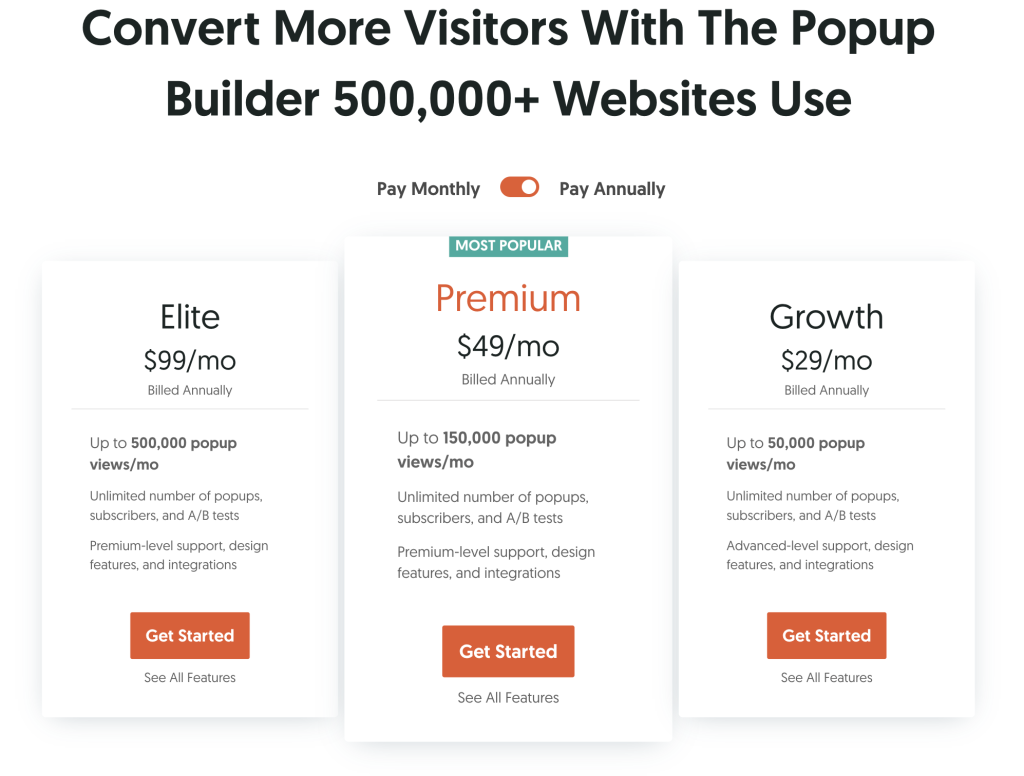
The same page also states:
- Starter includes up to
5,000views. - Growth includes up to
50,000popup views per month. - Premium includes up to
150,00010 pop-up views per month. - Elite includes up to
500,000popup views per month.
The detailed feature matrix also shows:
- Unlimited popups across all tiers.
- Unlimited subscribers across all tiers.
- A/B testing unavailable on Starter but unlimited on paid plans.
- The number of seats is rising from
1Starter to3on Growth and unlimited on Premium and Elite.
That is a very usable commercial ladder. It makes the main buying question pretty obvious: how much traffic, testing, and integration depth do you actually need?
Who Should Use Hello Bar
Hello Bar makes the most sense for:
- Content sites build email lists.
- Small businesses capturing leads without a complex setup.
- E-commerce or direct-response sites are reducing cart abandonment.
- Marketing teams that want rapid popups plus testing and reporting.
It is especially compelling for teams that already have traffic and need better conversion efficiency rather than more tooling sprawl.
Who Should Not Use Hello Bar
Hello Bar is less compelling for:
- Teams looking for full CRM or email automation replacement.
- Sites with almost no traffic yet, where the free tier may be enough for a while.
- Organizations that need very deep multi-step lifecycle orchestration from the same platform.
That does not make Hello Bar weak. It just means it is best when used for the job it is clearly designed to do.
Real Value In Practice
A tool like Hello Bar should be judged on operational simplicity.
That means asking:
- Can I launch a campaign quickly?
- Can I test offers without extra engineering?
- Can I capture leads cleanly?
- Can I align the design to my site?
- Can I understand what is working?
Hello Bar’s official feature set says yes to those questions more convincingly than many basic popup builders do.
If that matches your website goals, start with Hello Bar here and evaluate one real lead-capture campaign with Growth or Premium instead of trying to decide from a generic feature list alone.
Where The Paid Plans Start Making Sense
One useful thing about Hello Bar’s public pricing is that the upgrade logic is operational, not mysterious.
Starter works when you are experimenting or traffic is still modest. Growth makes more sense once you need materially higher monthly views, stronger testing, and better integration depth. Premium and Elite become easier to justify when traffic, reporting needs, and seat counts keep climbing.
That is a healthier commercial story than tools that hide the real thresholds for upgrading.
For many teams, the paid-plan question really comes down to:
- How many views do we need to support?
- How aggressively do we want to test?
- How many people need access?
- How important are stronger email integrations and premium support?
Hello Bar’s pricing page makes those thresholds much easier to understand than many lightweight pop-up products do.
Where Hello Bar Can Feel Limiting
Hello Bar is strong at focused on-site conversion work, but it still sits in a specific part of the marketing stack.
If your team wants deeper lifecycle orchestration, broader CRM behavior, or more complex cross-channel campaign logic from the same tool, you may eventually want more around it than Hello Bar alone.
That is not really a knock on the product. It just clarifies what the product is best at: capturing attention and turning website traffic into measurable lead or subscriber outcomes.
That is still a very valuable job, especially for publishers, growth marketers, and traffic-rich websites.
Why The Product Still Works For Real Teams
What I like about Hello Bar’s public positioning is that it stays close to practical website outcomes.
It does not overload the page with giant platform claims. Instead, it focuses on the things website owners actually care about:
- More engagement.
- More leads.
- More subscribers.
- Less abandoned opportunity.
That sounds simple, but it matters. A lot of tools make pop-up optimization feel far more complicated than it needs to be.
Hello Bar’s visible feature set keeps the product understandable:
- Multiple on-site formats.
- Clear traffic allowances.
- A/B testing on the paid tiers.
- Report and analytics support.
- Integration depth increases with plan level.
That combination is why the product still feels relevant. It is not trying to be your entire marketing stack. It is trying to improve one very important stage of the funnel cleanly.
That focus is a real strength for teams that do not want another oversized platform decision.
For a lot of teams, that kind of clarity is exactly the point.
It keeps the buying decision tied to website conversion performance instead of dragging it into a broader stack discussion before that is actually necessary.
That kind of narrow focus is often what makes smaller tools so effective.
It means the team can stay focused on actual lift in leads, subscribers, and buyer intent instead of spending weeks mapping a much larger platform category first.
That focus can save a surprising amount of time and decision fatigue.
It also keeps execution moving.
That matters when campaign timing is more important than tooling complexity.
Verdict And CTA
Hello Bar is a strong conversion-layer product in 2026 because it stays focused. It gives websites multiple pop-up formats, strong testing, visible analytics, practical integrations, and a clean pricing ladder without pretending to be every marketing tool at once.
The free plan is credible for small-scale testing. Growth is probably the practical starting point for many serious users. Premium and Elite make more sense once traffic and reporting needs grow.
If your main goal is to turn more visitors into leads, subscribers, and buyers without overcomplicating your stack, start with Hello Bar here and compare the free tier against Growth, Premium, and Elite using one real website campaign.
That kind of real-world trial tells you far more than a generic “best popup tool” roundup ever will.
FAQ
Is Hello Bar free?
Yes. The official pricing page currently shows a Starter plan at $0 free forever.
How much does Hello Bar cost?
The official annual-billing view currently shows Growth at $39 per month, Premium at $69 per month, and Elite at $129 per month, with Starter free.
What is Hello Bar best at?
Hello Bar is strongest at helping websites convert visitors into leads and subscribers through bars, modals, alerts, sliders, and page takeovers supported by testing and analytics.
Who should upgrade beyond the free plan?
Sites with higher traffic, stronger testing needs, and deeper email integration requirements should look closely at Growth, Premium, and Elite.