



In this guide
Quick Verdict :
Freshdesk is one of the easier customer-service platforms to recommend in 2026 when a team wants modern ticketing, AI assistance, omnichannel support, and cleaner workflows without signing up for an absurdly heavy implementation project.
Disclosure: Stack99 earns a commission if you buy through links on this page. It costs you nothing extra and never changes our assessment.
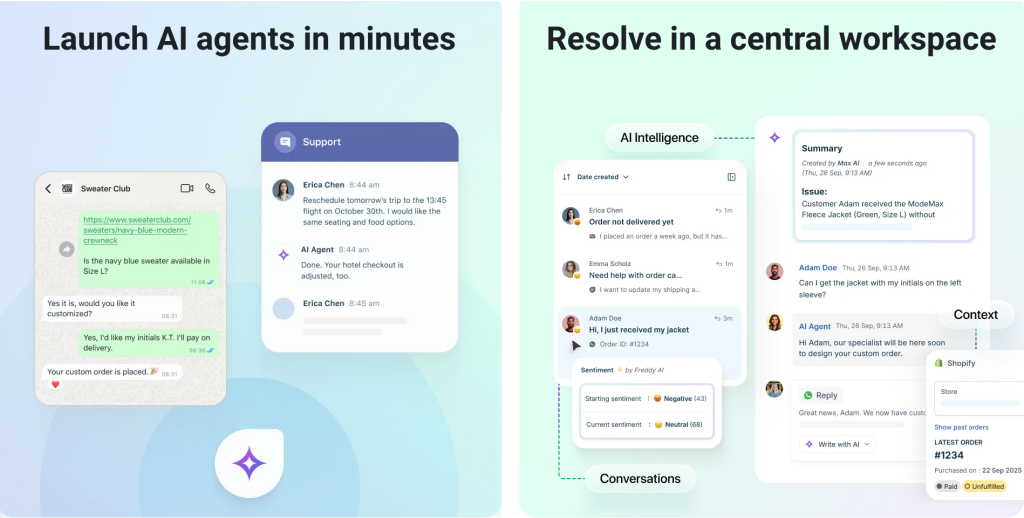
The official product pages frame the platform around one core idea: AI and human agents should work in one central workspace, not in separate disconnected layers. That positioning actually holds up pretty well.
Freshdesk’s strongest public product story right now is built around:
- Omnichannel customer support.
- The Freshdesk Command Center.
- Freddy AI Agent, Copilot, and Insights.
- Advanced ticketing and workflow automation.
- A large integration ecosystem.
It is not perfect. The product gets more expensive as soon as you need stronger reporting, deeper routing, and advanced security. But if your team is tired of messy inboxes and reactive support operations, Freshdesk is a serious option.
If you want to look at the platform while reading, start with Freshdesk here.

What Freshdesk Is Trying To Solve :
Freshdesk’s official homepage in 2026 is very direct about the problem: modern support teams are juggling too many channels, too much repetitive work, and too little context.
The site describes the platform as a customer-service solution where AI agents and human agents work together in one central workspace. That is more than brand language. It is actually the clearest way to understand the product.
Freshdesk is not just selling a help desk.
It is selling a support operating layer that tries to bring together:
- Email.
- Chat and messaging.
- Voice support.
- Knowledge base and self-service.
- AI-assisted replies, summaries, and insights.
- Workflow automation and routing.
That means the product is strongest when a team has outgrown basic email-ticketing but is not ready to suffer through a giant enterprise-service-desk rollout.
Product Facts And Overview
Freshdesk’s official pages highlight a few details that matter quickly.
The homepage says the platform is trusted by 74,000+ businesses worldwide. It also claims performance outcomes such as:
- Up to
80%resolutions with Freddy AI Agent. - Under
2 minsaverage conversational resolution time. 97%omnichannel first-contact resolution rate.60%improved agent productivity with Freddy AI Copilot.
Freshworks notes those numbers are sourced from customer results and benchmark reporting, so they should be read as platform marketing outcomes rather than guaranteed results for every deployment. Still, they show the official direction of the product: faster resolution, stronger automation, and better agent productivity.
The other important headline is the Freshdesk Command Center. Freshworks presents it as the place where every conversation, AI signal, and customer insight comes together. That centralization is one of the biggest reasons the tool feels more modern than an old-school help desk.
Pros And Cons :
Before we get into features, it helps to be honest about the trade-offs.
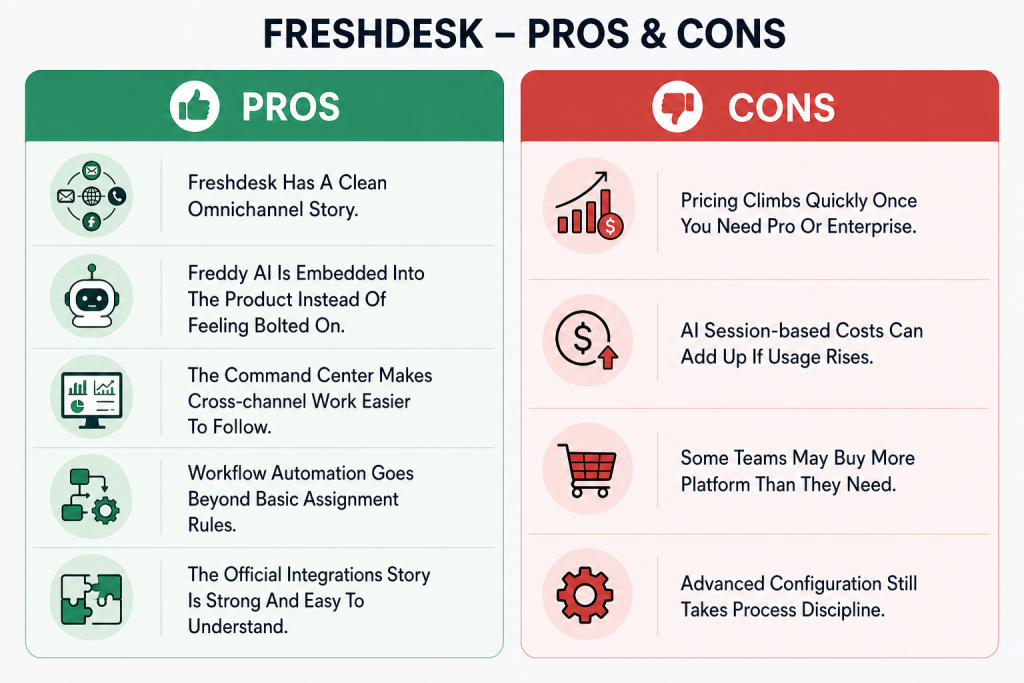
What we liked
- Freshdesk Has A Clean Omnichannel Story
- Freddy AI Is Embedded Into The Product Instead Of Feeling Bolted On
- The Command Center Makes Cross-channel Work Easier To Follow
- Workflow Automation Goes Beyond Basic Assignment Rules
What to watch
- Pricing Climbs Quickly Once You Need Pro Or Enterprise
- AI Session-based Costs Can Add Up If Usage Rises
- Some Teams May Buy More Platform Than They Need
- Advanced Configuration Still Takes Process Discipline
Real talk: Freshdesk can absolutely improve support operations, but it will not rescue a broken team structure by magic. If routing, escalation, ownership, and knowledge quality are messy, the product will expose that chaos fast.
Feature Deep Dive :
The Full Customer Service Experience :
Freshdesk’s homepage says the platform provides everything you need to support customers and empower teams out of the box. The best way to test that claim is to look at the major capability buckets it emphasizes.
Omnichannel Customer Service –
Freshworks puts omnichannel support at the center of the product story. The official page describes support across channels with AI, context, and workflows in one connected view.
That matters because support teams lose a ridiculous amount of time when channel history is split across separate tools.
The value here is not just that Freshdesk supports more than one channel. It is that agents can work from one operational view instead of bouncing between tools and losing context.
Freshdesk Command Center –
This is one of the stronger ideas on the site.
Freshworks says the Command Center brings every conversation, AI intelligence, and customer insight into a single central view. In practice, that should help with:
- Queue visibility.
- Cross-team coordination.
- Richer customer context.
- Faster decision-making for escalations.
If your current support stack feels like five windows and too much guessing, this part of Freshdesk is likely to feel immediately better.
Freddy AI Agent –
Freshworks says Freddy AI Agent can resolve complex, repetitive queries with ready-to-launch AI agents. That language matters because it pushes beyond simple chatbot deflection.
The homepage also mentions:
- Vertical AI Agents.
- Agentic workflows.
- AI Agent Studio.
- Email AI Agent.
That gives the product a much stronger automation story than older help desks that only sprinkled AI over macros and canned responses.
Freddy AI Copilot –
This is the part support teams will probably feel day to day.
Freshworks says Copilot helps agents with:
- Summaries.
- Live translations.
- Reply suggestions.
That is useful because a lot of “AI for support” conversations still ignore the human side of the workflow. Copilot looks like Freshdesk’s attempt to make agents faster without throwing them out of the loop.
Freddy AI Insights –
The official site says AI Insights gives leaders proactive visibility when issues arise and lets them ask questions for instant insights. That is a much stronger promise than standard dashboard reporting because it implies a faster path from data to interpretation.
Advanced Workflows And Routing –
Freshworks also highlights automation for routing, prioritization, SLAs, sentiment, agent skills, and workload. That is important because support quality depends heavily on how work moves before a human ever replies.
If your support team is scaling, this feature set can matter as much as AI itself.
Integrations And App Ecosystem –
Freshworks explicitly tells buyers to connect their business apps and explore integrations, which is a quiet but important strength in this review.
Support software becomes much more valuable when it can sit inside the broader operating stack instead of becoming one more isolated queue.
For most teams, that means integrations matter for:
- CRM Context.
- Internal Collaboration.
- Escalation Workflows.
- Reporting Continuity.
- Customer Data Visibility.
Freshdesk’s public product story does not hide this. It presents integrations as part of the default operating model, not a side feature buried in enterprise add-ons.
Pricing Breakdown :
Freshdesk’s official pricing pages are clearer than a lot of enterprise SaaS pages, which is refreshing.
The visible 2026 annual pricing for Freshdesk Omni shows:
| Plan | Price | What you get |
|---|---|---|
| Growth | $29/mo | Per agent |
| Pro | $79/mo | Per agent |
| Enterprise | $119/mo | Per agent |
The pricing page also says the first 500 AI sessions are included and additional sessions are charged at $49 per 100 sessions.
That detail matters. Teams sometimes focus on seat price and forget usage-based AI layers. If your support volume is high, the AI-session math deserves attention.
The public materials also emphasize:
- A free trial.
- No credit card required in the trial path.
- Stronger capabilities as you move up-plan.
What changes between tiers is not just raw feature count. It is the amount of operational control you can realistically build.
Growth looks like the entry point for teams that want modern ticketing and omnichannel support without overcomplicating the rollout.
Pro is where the platform becomes more interesting for teams that need customized portals, custom objects, deeper ticketing controls, and stronger reporting.
Enterprise is the serious option for organizations that care about audit logs, approval workflows, skills-based assignment, and additional security controls.
That progression makes sense. Support complexity compounds fast, and Freshdesk is clearly pricing around how much control and intelligence a team needs once it moves beyond basic queue management.
If you want to compare the pricing ladder against your team size and automation needs, start with Freshdesk here.
Who Should Use Freshdesk :
Freshdesk fits best for teams that need more than simple ticket intake but do not want support operations spread across several disconnected products.
It looks strongest for:
- SaaS Companies Handling Multi-channel Support.
- E-commerce Teams With High Conversation Volume.
- Mid-market Support Or Success Teams.
- Organizations That Want AI Help Without Replacing Agents.
It is also a strong fit for companies that want a clear path from foundational support to more advanced automation over time.
It fits less well for tiny teams with almost no workflow complexity. If you only need a lightweight inbox and a handful of tags, Freshdesk may be more platform than you need.
That does not mean smaller teams should ignore it. It just means they should be honest about whether they need:
- AI Agents.
- Advanced Routing Logic.
- Deep Reporting Layers.
- Higher-tier Security Workflows.
If the answer is “not yet,” a smaller rollout on the lower plan can still make sense. But buying too much support platform too early is a very real way to create unnecessary cost and admin overhead.
Who Should Probably Skip It :
Freshdesk is not the right fit for every team, and saying that out loud is useful.
If your support environment is extremely simple, your channel volume is low, and your team does not need AI assistance, deeper routing rules, or cross-functional reporting, a lighter tool may be enough for now.
Freshdesk also becomes harder to justify if your organization wants enterprise-level control but is not willing to invest time in queue design, knowledge quality, and ownership discipline. The platform can help a strong support operation scale, but it cannot invent operational clarity for you.
Honest Assessment :
Freshdesk is good because the official story feels coherent. The platform is not trying to be random software with AI sprinkled on top. It has a clear operational point of view:
- Put Customer Conversations In One Place.
- Help AI Resolve What It Can.
- Help Humans Resolve The Rest Faster.
- Give Leaders Better Visibility Into Performance.
That is a strong model.
The downsides are mostly commercial and operational, not conceptual. As you move into Pro or Enterprise, the spend rises. And if your internal support process is fuzzy, advanced features will not save you from weak ownership.
Still, the product makes sense. That is more than you can say for a lot of help-desk software.
Verdict :
Freshdesk is a strong customer-service platform in 2026 for teams that want AI-driven support workflows, omnichannel visibility, smarter routing, and a modern agent experience.
The best parts of the platform are the Command Center, Freddy AI layer, workflow automation, and the way everything is framed around centralizing support work instead of scattering it.
If your team wants to scale service without living inside inbox chaos, start with Freshdesk here and compare the Growth, Pro, and Enterprise tiers against the channel mix, reporting depth, and AI usage you actually need.
If you are at the point where support is affecting retention, agent morale, and response consistency, start with Freshdesk here and review the Command Center, Freddy AI, and routing stack with your real queue volume in mind instead of a hypothetical demo.
FAQ :
How much does Freshdesk cost in 2026?
The official annual pricing page shows Growth at $29 per agent per month, Pro at $79, and Enterprise at $119 for Freshdesk Omni.
Does Freshdesk include AI features?
Yes. The official site highlights Freddy AI Agent, Freddy AI Copilot, Freddy AI Insights, and additional AI workflow capabilities.
Is Freshdesk good for omnichannel support?
Yes. Omnichannel service is one of the core parts of the official pages, with email, chat, voice, context, and workflows brought together in one connected workspace.
What is the biggest downside to Freshdesk?
For many teams, it will be the rising cost as they move into higher plans and heavier AI usage rather than a weakness in the basic platform direction.
Before You Choose, Compare These
Hand-picked guides to help you choose the right tool — no fluff.
 ComparisonsFreshdesk by Freshworks vs Alternatives 2026The strongest competitors compared side by side.
 Use CasesWho Is Freshdesk by Freshworks Best For? Use Cases & Fit (2026)Who gets the most out of it – and who should skip it.
 FeaturesJarvio Top Features 2026The standout features and whether they justify the price.
 Case StudiesNickel Case Study 2026What actually happened when teams rolled it out.