

Why This Comparison Matters
Increff, Unicommerce, and Zoho Inventory all sit in the commerce operations conversation, but their official sites present very different product stories.
Increff positions itself around smart merchandising, planning, omnichannel fulfillment, warehouse and order management, dynamic allocation, replenishment, and assortment planning.
Unicommerce positions itself as a leading e-commerce enablement SaaS platform focused on simplifying e-commerce, accelerating growth, and reducing costs through warehouse, order, and retail automation.
Zoho Inventory presents itself more directly as inventory management software with broad features, integrations, mobile apps, and use-case coverage.
That means this is not a comparison of identical tools. It is a comparison of three different operating philosophies around inventory and e-commerce execution.

If you want to review one of the platforms while you read, start with Increff here.
Quick Comparison Table
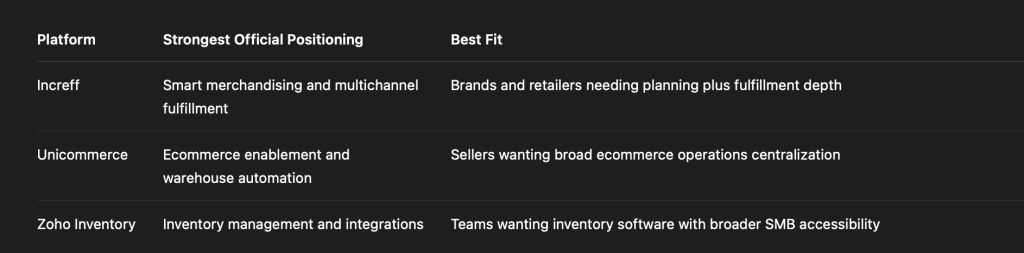
That table is the short version.
The longer version is that Increff looks strongest when planning and merchandising complexity are central. Unicommerce looks strongest when e-commerce operations automation is the priority. Zoho Inventory looks strongest when a more general inventory management platform is the goal.
Increff Deep Dive
Increff’s official homepage uses language that feels more strategic and merchandising-heavy than many inventory tools.
The site emphasizes:
- Smart merchandising.
- Multichannel fulfillment.
- Planning and buying.
- Merchandise financial planning.
- WSSI and MSSI.
- Multi-channel warehouse and order management.
- Dynamic allocation and replenishment.
That is a very specific value story.
Increff does not look like a basic stock tracker. It looks like software for brands and retail operations that want planning, allocation, and fulfillment decisions tied together more intelligently.
The homepage also highlights 700+ global brands across 35+ countries, which signals an enterprise-leaning market position.
If your operation has both planning complexity and multichannel fulfillment pressure, start with Increff here and compare its planning-plus-fulfillment story against your current stack.
Unicommerce Deep Dive
Unicommerce’s official homepage feels more explicitly e-commerce-automation oriented.
It emphasizes:
- Simplify ecommerce.
- Accelerate growth.
- Reduce costs.
- E-commerce automation needs.
- Warehouse management system.
The page also highlights:
- 7,000+ customers.
- Large order volume.
- Marketplace and retail enablement language.
Unicommerce looks like the strongest option in this comparison if your main problem is operational ecommerce orchestration rather than deeper merchandising and planning sophistication.
In other words, it feels more execution-centric than Increff’s merchandising-first posture.
Zoho Inventory Deep Dive
Zoho Inventory’s official site takes a broader software-platform approach.
The homepage emphasizes:
- Inventory management software.
- Features.
- Integrations.
- Use cases.
- Mobile app.
- Industry coverage.
That makes Zoho Inventory feel more accessible and general-purpose.
It may not lead with the same merchandising vocabulary as Increff or the same e-commerce enablement identity as Unicommerce, but it benefits from a clearer SMB software orientation and a broad ecosystem reputation.
For many businesses, that can be an advantage.
Feature Matrix
Here is the practical difference in how the official sites frame their strengths:
- Increff: planning, buying, merchandising, allocation, replenishment, multichannel fulfillment.
- Unicommerce: e-commerce enablement, warehouse management, cost reduction, growth acceleration, operational automation.
- Zoho Inventory: inventory management, integrations, mobile access, broader use cases, and SMB-friendly software framing.
That is why this comparison is useful. The right choice depends less on generic “features” and more on where your actual operational complexity lives.
Pricing Comparison
One major difference is public pricing visibility.
Based on the official sources reviewed for this comparison:
- Increff does not publish a simple self-serve pricing grid on the official homepage used here.
- Unicommerce’s homepage similarly emphasizes platform value and scale rather than a visible public self-serve price ladder.
- Zoho Inventory’s official site is product-led and publicly positioned, but this comparison is based on the homepage framing rather than a full pricing table readout.
So the honest takeaway is this: if transparent self-serve pricing is your first filter, this comparison is stronger on product direction than it is on side-by-side posted commercial numbers.
That does not make the products weaker. It just changes how evaluation works.
In practice, that usually means the buying process will depend more on scoping and fit conversations than on quick self-serve checkout logic.
Use Case Recommendations
Choose Increff if:
- Your team cares deeply about planning and buying.
- Allocation and replenishment are business-critical.
- Multichannel fulfillment needs to connect tightly with merchandising decisions.
- You want software that sounds built for the complexity of serious retail operations.
Choose Unicommerce if:
- E-commerce automation is your main priority.
- Warehouse and order management are central pain points.
- You want a platform that speaks clearly to growth and execution efficiency.
Choose Zoho Inventory if:
- You want inventory software with broad feature accessibility.
- Integrations and app ecosystem fit matter a lot.
- Your team is smaller or more SMB-oriented and wants a less enterprise-heavy product feel.
If your workflow leans more toward merchandising-plus-fulfillment than general inventory, start with Increff here and compare it directly against the ecommerce-automation-first feel of Unicommerce and the broader inventory-software posture of Zoho Inventory.
Operational Complexity Versus Accessibility
This is probably the most important decision frame in the whole comparison.
Increff feels more specialized. Unicommerce feels more ecommerce-operations oriented. Zoho Inventory feels more broadly accessible.
That means the choice is not only about features. It is also about how much operational complexity your business has right now and how much specialized control you are willing to trade for easier onboarding and software familiarity.
Which Product Feels Most Unique?
Increff feels the most unique in this group because of how strongly it leans into merchandising language.
Words like:
- Merchandise financial planning.
- WSSI and MSSI.
- Planning and buying.
- Dynamic allocation.
- Replenishment.
These are not generic inventory-tool phrases. They signal a more specialized retail operations worldview.
That can be a major advantage if you are the kind of buyer who needs that depth.
Where Unicommerce Wins
Unicommerce feels strongest when you want e-commerce execution software that is easy to explain internally.
Its official site leads with simplicity, growth, and cost reduction. That is easier for many teams to align around than a more specialized merchandising story.
For operations teams focused on warehouse and order automation, that clarity can be a big plus.
Where Zoho Inventory Wins
Zoho Inventory’s advantage is accessibility.
Its official site clearly organizes:
- Features.
- Integrations.
- Use cases.
- Mobile app.
- Industry framing.
That makes it feel easier to approach, especially for businesses that want capable inventory software without immediately stepping into a more retail-enterprise specific stack.
For many smaller or mid-sized teams, software accessibility can outweigh the appeal of a more specialized merchandising vocabulary.
Final Buying Lens
A clean way to think about this comparison is to ask one question: where does your business feel the most pain?
If the pain is merchandising, allocation, and replenishment complexity, Increff becomes much more attractive.
If the pain is in the execution, warehouse coordination, and order automation, Unicommerce gets stronger.
If the pain is broad, inventory control with easier software accessibility, Zoho Inventory usually becomes the simpler conversation.
That is the lens that makes this comparison genuinely useful in practice.
Implementation Reality
Another important difference is what rollout probably feels like.
Increff reads like a platform that will usually be evaluated in the context of larger retail operations, planning models, allocation logic, and multichannel fulfillment realities.
Unicommerce reads like a platform that will often be evaluated in terms of warehouse, order, and e-commerce execution efficiency.
Zoho Inventory reads like a platform that many teams can approach more quickly because the product framing is broader and more software-led.
That matters because the best product on paper is not always the best product for implementation speed, internal adoption, or organizational readiness.
Which Buyer Should Avoid Which Option
This comparison also gets clearer when you look at who should probably not choose each product first.
You should probably avoid Increff if your business does not need deeper merchandising, allocation, or planning sophistication.
You should probably avoid Unicommerce if your operation is not especially ecommerce-execution heavy.
You should probably avoid Zoho Inventory if your retail or ecommerce workflows are so specialized that a broader inventory platform may feel too general.
That reverse lens often makes software selection easier because it reduces category confusion.
It also keeps teams from buying for someone else’s complexity instead of their own.
That is often the difference between a good software fit and an expensive mismatch.
It is also why a broader tool can sometimes win over a more specialized one even when the specialized option looks stronger in a headline comparison.
That practical tradeoff is one of the most important hidden decisions in this whole category.
It matters because software fit is rarely about the most impressive headline. It is usually about which platform maps best to the actual operating model the team can support and benefit from right now.
That practical realism is what makes this comparison worth doing carefully.
It is usually a better buying guide than generic feature scoring.
That is especially true in operational software categories this complex.
It rewards realism over category hype.
That practical framing is often what leads to better software decisions and smoother implementations.
Verdict
Increff is the strongest choice in this comparison when your operation needs serious merchandising intelligence tied to multichannel fulfillment.
Unicommerce is the strongest when e-commerce automation and warehouse execution are the priority.
Zoho Inventory is the strongest when you want broader inventory software accessibility with strong ecosystem orientation.
So the real answer is not “which is best overall?” It is “which operating model matches your business?”
If you need planning, allocation, and merchandising depth more than generic inventory coverage, start with Increff here and evaluate it against your real replenishment, fulfillment, and buying workflows before defaulting to a more general platform.
FAQ
What makes Increff different from Unicommerce?
Increff’s official site leans more heavily into planning, buying, merchandising, allocation, and replenishment, while Unicommerce leans more into ecommerce enablement and warehouse or order automation.
Is Zoho Inventory the most SMB-friendly option here?
Based on the official homepage framing in this comparison, Zoho Inventory feels the most generally accessible and software-led for smaller teams.
Does Increff publish public pricing?
The official homepage used for this comparison does not present a simple public self-serve pricing grid, so teams should expect a more consultative evaluation path.
Who should choose Increff in 2026?
Retailers and brands with complex planning, buying, allocation, replenishment, and multichannel fulfillment needs should look hardest at Increff.