

Why This Comparison Matters :
Credit Repair Cloud is not a generic business app that happens to work for credit repair. The official site is much more specific than that. It is positioned as software for credit repair businesses, and the product story repeatedly focuses on helping firms start, run, and scale credit repair work without stitching together a pile of disconnected tools.
That distinction matters because credit repair businesses do not usually lose time in one giant failure. They lose time in tiny handoffs: lead intake, client tracking, agreements, report handling, messaging, and billing all drifting out of sync.
If you want to inspect the official product while you read, open Credit Repair Cloud here.

So the comparison here is not just “specialist software versus another app.” It is really “specialist credit repair workflow system versus a generic CRM and manual coordination.”
Quick Comparison Table :
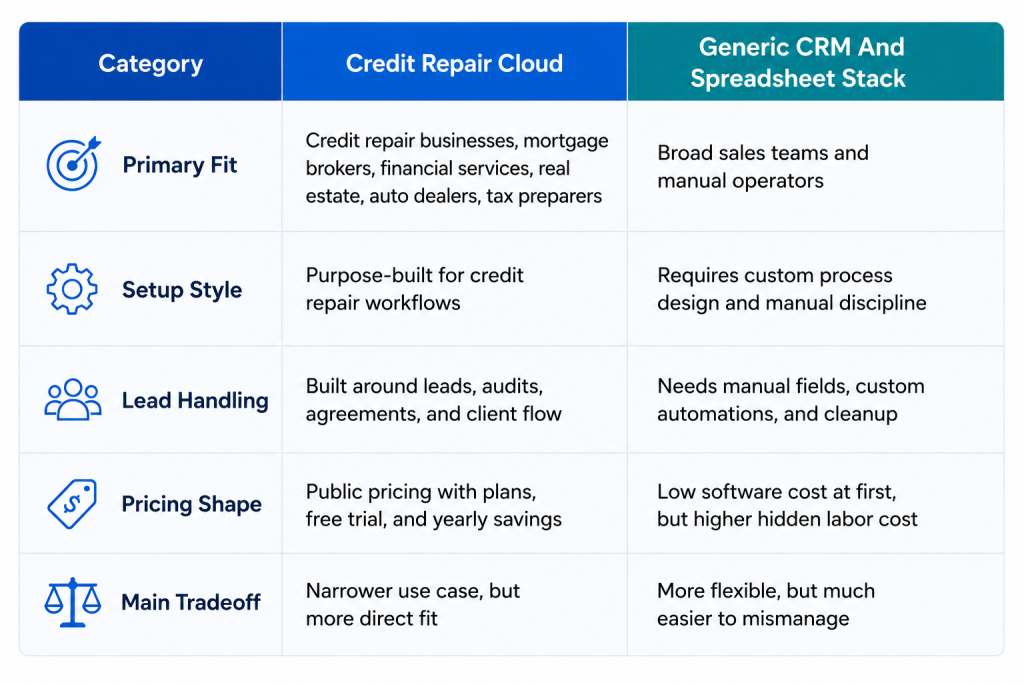
The short version: if your business is actually credit repair, the specialist tool is usually the cleaner starting point.
If you want the pricing and plan structure before we go deeper, open Credit Repair Cloud here and compare the live plans against your current setup.
Product A Deep Dive –
Credit Repair Cloud’s homepage says more than 20,000 people use the platform, and it makes the product’s intent very clear: help people start a credit repair business and change lives.
That kind of positioning matters because it tells you the platform is not trying to be a blank canvas. It is trying to be a working system for a very specific industry.
The official site and help content point to several recurring themes:
- Free Trial Available.
- Training For Beginners And Advanced Users.
- A Pricing Page With Public Plan Structure.
- Client Limits By Plan.
- Billing Controls For Monthly And Yearly Billing.
- Help Center Articles For Onboarding And Agreements.
The platform also shows up in its own content as a system for importing credit reports, running credit audits, creating client profiles, automating messages, and handling agreements. That is a very different promise from a generic CRM.
If you are going to build a real credit repair operation, try Credit Repair Cloud here and treat the trial like a live operations test, not a tour.
Product B Deep Dive –
A generic CRM and spreadsheet stack can absolutely be made to work. That is the honest alternative. It is cheaper on paper and more flexible at first.
The problem is that it forces your team to become the workflow engine.
You need to define the fields. You need to define the pipeline. You need to define the follow-up rules. You need to define agreement handling. You need to define the audit trail. You need to make sure nobody quietly uses a different version of the sheet.
That does not sound impossible. It just sounds tiring.
If your credit repair business is tiny and your process is still changing every week, a generic CRM can be a temporary bridge. But the moment the team starts handling real volume, the specialist platform starts looking a lot more attractive because the workflows are already sitting inside the product.
That is why this comparison is worth making carefully. The wrong tool can still work, but only if your team is willing to build the missing pieces by hand.
Feature Matrix :
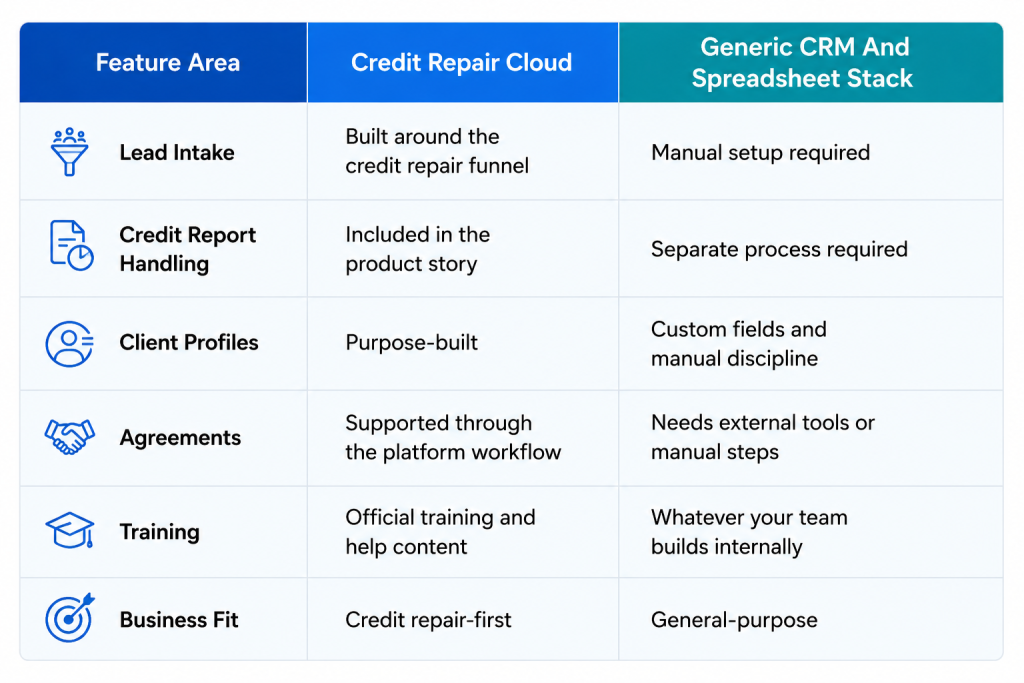
The practical takeaway is simple. Credit Repair Cloud does less, but it does the right less for this market.
Pricing Comparison :
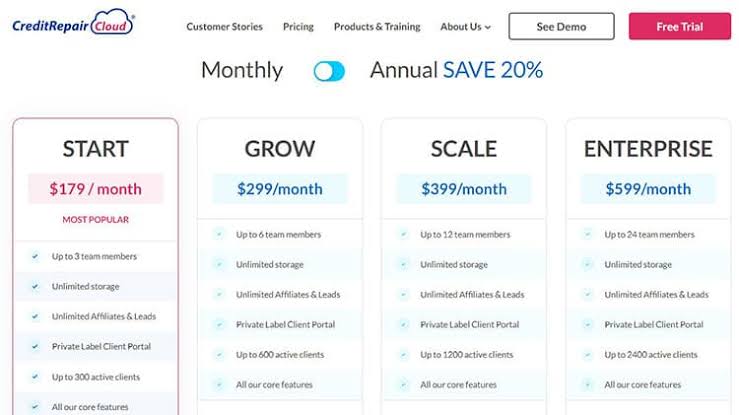
The official pricing page shows a public plan structure with monthly and yearly billing.
The current page highlights:
- Personal At $49 Per Month.
- Start At $179 Per Month.
- Yearly Billing Saves 20%.
- Personal And Start Plans Include Trial Access In The Public pricing flow.
The help center also lists plan caps by tier:
- Personal: 1 User.
- Start: Up To 3 Users.
- Grow: Up To 6 Users.
- Scale: Up To 12 Users.
- Enterprise: Up To 24 Users.
That is useful because the real cost is not only the monthly number. It is also whether the plan supports the number of people who need to touch the workflow.
The comparison to a generic stack usually looks cheap until you count the hidden labor:
- Building The Pipeline.
- Training The Team.
- Keeping The Data Clean.
- Connecting The Agreements.
- Preventing Follow-Up Gaps.
If you run a serious credit repair business, start with Credit Repair Cloud here and compare the plan limits against your actual team size before you try to duct-tape the process together.
Use Case Recommendations :
Choose Credit Repair Cloud If –
You run a real credit repair operation and want software that already understands the workflow.
Choose Credit Repair Cloud If –
You are a mortgage broker, financial services firm, real estate professional, auto dealer, or tax preparer adding credit repair as a service.
Choose A Generic CRM If –
You are still experimenting and do not want to commit to a specialist system yet.
Choose A Spreadsheet Stack If –
You are only testing the waters and the workflow is tiny enough that manual upkeep will not crush the team.
The important thing is honesty. A generic stack can work for a little while. It just usually demands more process discipline than people expect.
Real-World Flow :
The easiest way to picture the specialist advantage is to follow one client through the system.
A lead comes in from a form, referral, or campaign. Instead of bouncing through a general CRM with custom fields that somebody on the team invented last month, the lead enters a workflow that already expects credit repair work to happen next.
That is the key difference. Credit Repair Cloud is not asking you to invent the next step. It is already organized around the sequence of work that a credit repair business tends to repeat.
The official site and help pages reinforce that by showing how the software helps with client profiles, training, agreements, lead handling, and the broader business structure. The product is not only a database. It is a guided process.
That matters a lot once the business grows. At small scale, a generic stack can feel flexible. At larger scale, flexibility becomes the reason everyone has a slightly different way of handling the same client. Then the owner starts spending time fixing process drift instead of selling or managing the business.
Credit Repair Cloud reduces that drift by giving the business a common workflow to work inside. That is the real value the pricing page is pointing toward. The monthly fee is only one part of the story. The bigger question is whether the software reduces enough friction that the business can serve more clients without the team inventing the process from scratch each week.
For a credit repair operator, that usually makes the decision easier than it looks on paper.
It also gives the owner a better way to train people without repeating the same explanation every week. Once the steps are visible, the business can grow without turning every handoff into a custom conversation.
What A Smooth Rollout Looks Like :
A good rollout does not try to solve everything on day one. It starts with the first lead and works forward from there.
The team should know exactly where the lead comes from, how it becomes a client, where the report handling begins, and what the next follow-up is supposed to be. If those steps are clear, the system becomes a lot easier to trust.
That is where Credit Repair Cloud has a real advantage over a generic stack. The business does not need to spend time inventing the sequence. It can focus on doing the work inside a structure that already expects a credit repair process to exist.
The cleaner the rollout, the easier the rest of the business becomes:
- New Team Members Learn Faster.
- Follow-Ups Get Missed Less Often.
- Client Records Stay Cleaner.
- Agreements Stay Easier To Track.
- The Owner Spends Less Time Fixing The Process.
That is the real alternative story. The competitor is not just another software product. It is the hidden labor of manual process management.
Verdict :
Credit Repair Cloud is the better choice when the business is actually credit repair. The official product and help pages make that pretty clear. It is built for leads, audits, client tracking, agreements, training, and a business model that has already decided what it wants to do.
The alternatives are more flexible at the start, but that flexibility comes with a tax. You have to build the workflow yourself, enforce it yourself, and keep it clean yourself.
If you want to reduce that friction, the specialist product is the smarter bet.
If you want to test the official system against your current process, open Credit Repair Cloud here and run one real client workflow through it before you make the call.
FAQ :
Is Credit Repair Cloud only for credit repair businesses?
That is its core focus, yes. The official site positions it specifically for credit repair businesses.
Does Credit Repair Cloud offer a free trial?
Yes. The homepage and help content both point to a free trial flow.
How much does Credit Repair Cloud cost?
The public pricing page currently shows Personal at $49 per month and Start at $179 per month, with yearly billing saving 20%.
How many users can use it?
The help center lists 1 user on Personal, 3 on Start, 6 on Grow, 12 on Scale, and 24 on Enterprise.
What is the biggest advantage over a generic CRM?
It is already built around the actual credit repair workflow instead of asking your team to assemble the process from scratch.