


When To Consider Alternatives :
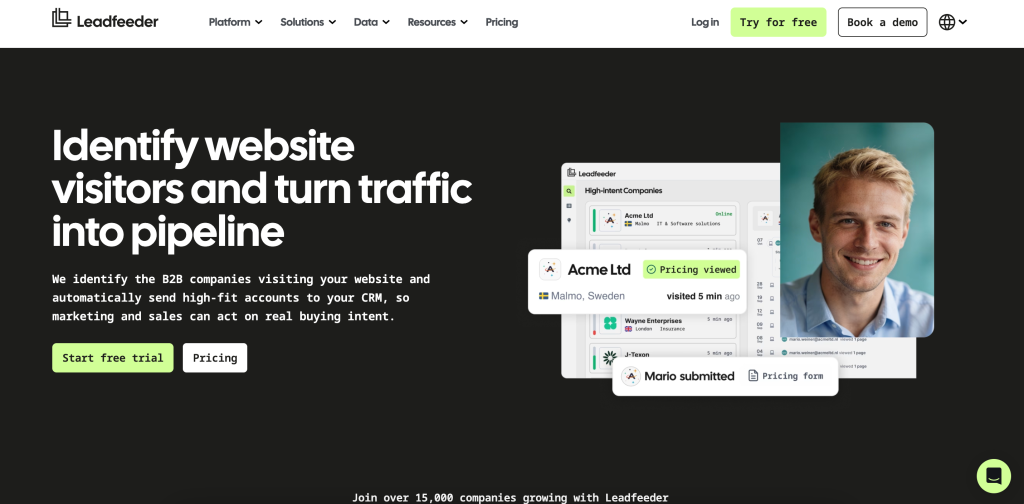
Leadfeeder, now positioned through Dealfront’s website visitor identification offering, is one of the clearest tools in its category. The official Dealfront pages emphasize website visitor identification, buyer intent, CRM delivery, high-intent page monitoring, and the ability to identify companies that visit your site even if they never fill out a form.
That is a strong value proposition. It is also specific enough that there are real reasons to consider alternatives.
You should compare Leadfeeder alternatives when:
- You want a broader sales intelligence platform than just web visitor identification.
- You need more built-in account or contact enrichment beyond visitor data.
- You want a lighter entry tool before committing to a dedicated visitor-identification workflow.
- Your sales team needs a stronger intent-data layer across more channels than website visits.
- Your traffic volume or ICP alignment is still too weak to justify a visitor-ID-first purchase.
In other words, the question is not “Is Leadfeeder good?” The question is “Is Leadfeeder the right shape of tool for the way your team actually sources pipeline?”
If you want to compare the source product while you read, start with Leadfeeder here.
Alternative #1: ZoomInfo
ZoomInfo is the obvious alternative when a team wants a much broader go-to-market intelligence stack.
Its official site positions the platform around:
- Sales intelligence.
- Buyer intent.
- Conversation intelligence.
- Data enrichment.
- Workflow automation.
- Revenue operations support.
That makes ZoomInfo a very different type of purchase than Leadfeeder in one important way. Leadfeeder starts from site visitors and turns them into actionable accounts. ZoomInfo starts from a much larger data and intelligence universe.
Why teams choose ZoomInfo instead of Leadfeeder:
- They want one larger platform for prospecting, enrichment, intent, and sales workflows.
- They need more than website-visitor identification.
- They already run a mature outbound motion and want deeper data coverage.
Why Leadfeeder may still win:
- Leadfeeder is simpler to explain and adopt if the core problem is “who is visiting our site right now?”
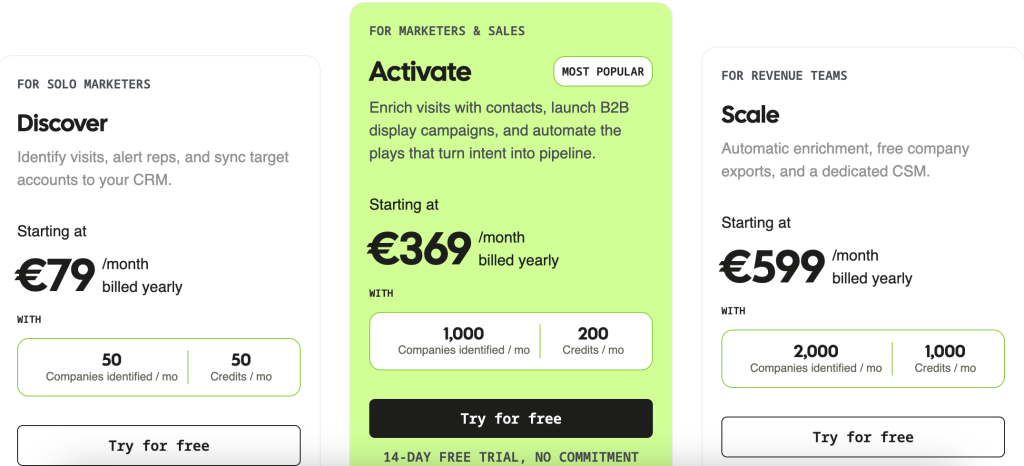
- Leadfeeder’s pricing story is easier to enter than a larger enterprise-intelligence motion.
ZoomInfo is best when the team wants a bigger sales-intelligence operating system, not only a visitor-identification tool.
Alternative #2: Albacross
Albacross is a very relevant alternative for teams that want website visitor identification with an account-based marketing flavor.
Its official site emphasizes:
- Website visitor identification.
- Company intent insight.
- Account-based marketing and sales use cases.
- Lead routing and engagement workflows.
This makes Albacross feel closer to Leadfeeder than ZoomInfo does. The main difference is often in the surrounding go-to-market style. Leadfeeder feels very sales-actionable from the Dealfront side, while Albacross often feels especially attractive for ABM-minded teams that want company-level visit intelligence tied into marketing and sales alignment.
Why teams choose Albacross instead of Leadfeeder:
- They are running a more explicitly ABM-driven motion.
- They want visitor intelligence shaped around account-level marketing use cases.
- They want a platform framed around both sales and marketing orchestration.
Why Leadfeeder may still win:
- Leadfeeder’s official product message is very direct and easy for sales teams to operationalize.
- Dealfront’s buyer-intent framing can feel more focused if your immediate need is pipeline actionability.
Alternative #3: Factors.ai
Factors.ai is a strong alternative when the team wants marketing analytics, attribution, and account intelligence to sit together more tightly.
The official site positions Factors.ai around:
- Website visitor identification.
- Marketing attribution.
- Pipeline analytics.
- Account intelligence.
- B2B marketing measurement.
That makes it an appealing alternative for teams asking a different question from pure sales prospecting. If the biggest internal need is, “Which campaigns influence the right accounts, and how do we prove that?” then Factors.ai can be a cleaner fit than a visitor-ID-first tool by itself.
Why teams choose Factors.ai instead of Leadfeeder:
- They care deeply about attribution and marketing analytics.
- They want account identification tied closely to campaign measurement.
- Their marketing team needs more than a list of visiting companies.
Why Leadfeeder may still win:
- Leadfeeder is often easier to explain to sales.
- The workflow from visit to follow-up can feel more direct and less analytics-heavy.
Factors.ai is strongest when marketing measurement and account intelligence need to work together tightly.
Alternative #4: Manual Analytics Plus CRM
This is the least glamorous but most common alternative.
A lot of teams still rely on some combination of:
- Web analytics.
- CRM notes.
- Manual research.
- Ad platform data.
- Sales judgment.
That stack can work for a while. It is cheap on paper, familiar, and flexible.
It also has the same recurring weaknesses:
- Anonymous traffic stays anonymous.
- The handoff between marketing and sales is slower.
- Buyer intent is easier to miss.
- Follow-up timing becomes inconsistent.
- The process depends too much on individual discipline.
Manual analytics plus CRM is a valid alternative when traffic is still low or the team is not ready to operationalize website visitor data yet. But the hidden labor cost is real.
If your team is starting to feel that friction, open Leadfeeder here and compare a free trial against the way your team currently handles anonymous traffic.
Quick Comparison Matrix :
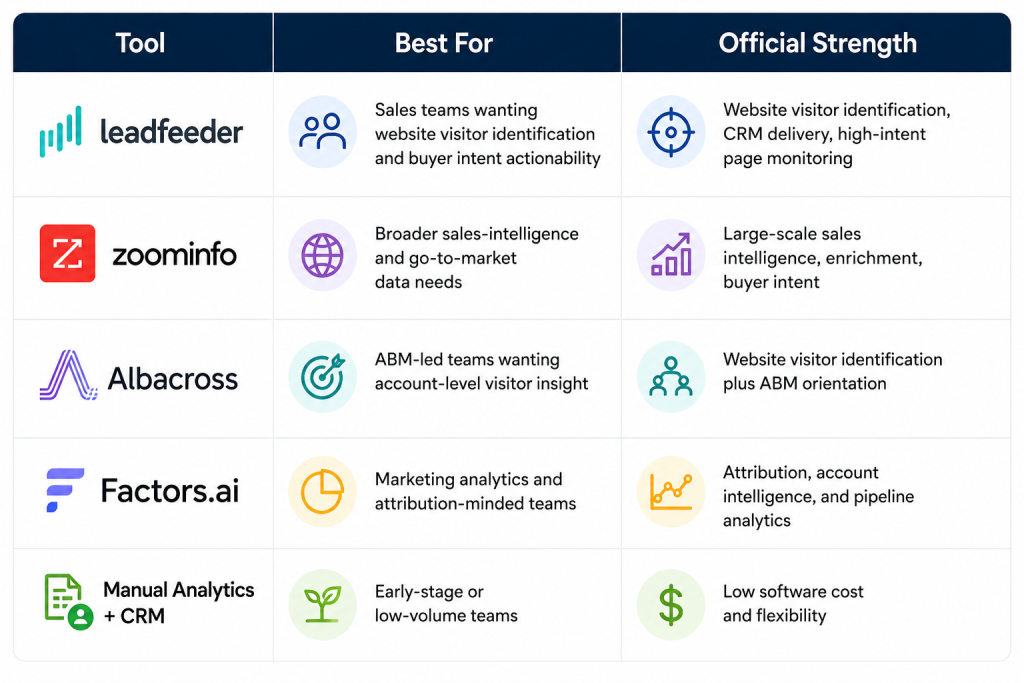
That table tells the real story. “Best alternative” depends almost entirely on whether the team wants:
- Bigger sales intelligence,
- Tighter ABM support,
- Deeper attribution,
- Or just a simpler manual starting point.
Another useful way to make the decision is to look at which team is driving the purchase. If sales owns the project and wants fast account follow-up from site traffic, Leadfeeder usually stays very competitive. If marketing owns the evaluation and cares more about attribution or campaign influence, a tool like Factors.ai may look more natural. If leadership wants one broad prospecting and enrichment platform, ZoomInfo starts making more sense, even if it is a heavier buy.
That is why the wrong evaluation process creates bad software decisions. Teams compare products as if they are feature twins, then wonder why adoption feels uneven later. These tools often solve adjacent problems, not identical ones.
When You Should Stick With Leadfeeder :
You should probably stay with Leadfeeder if your main business question is still the simple one:
Which companies are visiting our site, what are they doing there, and when should sales act?
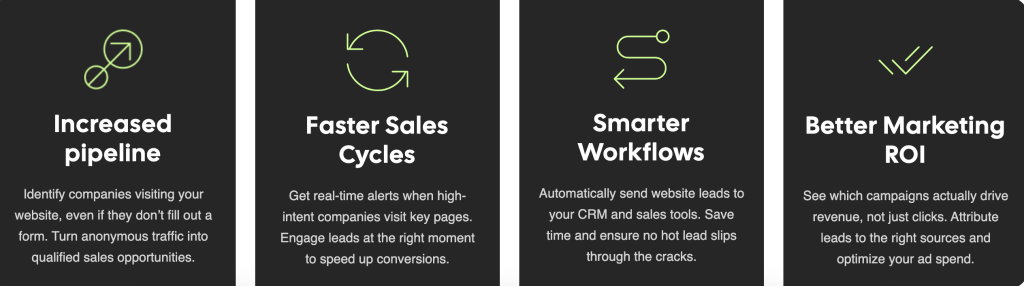
The official Dealfront pages make Leadfeeder strong for exactly that use case because they emphasize:
- Website visitor identification.
- Buyer intent.
- High-intent pages.
- CRM delivery.
- Lead-scoring and account actionability.
That is a tighter story than many alternatives offer.
If your team does not need a giant intelligence platform and really just wants to stop letting valuable site traffic disappear anonymously, Leadfeeder remains a very compelling fit.
If that sounds like your use case, start with Leadfeeder here and judge the alternatives against your real website traffic instead of against generic feature lists.
Common Buying Mistakes In This Category :
The biggest mistake in this category is buying for theoretical scale instead of actual workflow pain.
A lot of teams say they want the broadest intelligence platform available, but what they really need is a clean answer to a simpler question: which companies are showing intent on our site right now, and how quickly can we act on that signal? In those cases, a bigger platform can create more implementation work without improving day-to-day sales behavior.
The second common mistake is ignoring traffic quality. Visitor-identification tools work best when the site already attracts the right kind of accounts. If traffic is weak, no tool will magically convert random visits into a qualified pipeline. That is why it helps to test with real pages, real intent patterns, and a real SDR or AE workflow instead of evaluating in a spreadsheet.
If you want to test the practical way, try Leadfeeder on your real traffic here and compare how quickly your team can turn visitor insight into usable follow-up.
How To Choose Between Them :
The fastest decision rule is this:
- Choose ZoomInfo if you want a much broader data and sales-intelligence stack.
- Choose Albacross if your team is more ABM-led and wants account-level visitor intelligence in that context.
- Choose Factors.ai if your marketing team needs both attribution and account intelligence.
- Choose manual analytics plus CRM if traffic is still low and you are not ready to operationalize visitor-ID software.
- Choose Leadfeeder if the cleanest next step is simply identifying the right visiting companies and acting on that signal faster.
That last point matters a lot. Sometimes the best tool is not the broadest tool. It is the one the team can actually use every week.
Verdict :
The best Leadfeeder alternatives in 2026 are ZoomInfo, Albacross, Factors.ai, and the usual manual analytics-plus-CRM stack. They are not interchangeable, and that is exactly why this comparison matters.
ZoomInfo wins on breadth. Albacross wins for a more ABM-shaped visitor-intelligence motion. Factors.ai wins when attribution and account insight need to stay together. Manual stacks win only on short-term simplicity and low apparent cost.
Leadfeeder still wins when your biggest immediate need is turning anonymous website traffic into named companies, buyer intent, and CRM-ready follow-up.
FAQ :
What Is The Closest Alternative To Leadfeeder?
Albacross is one of the closest alternatives when the team wants website visitor identification with an account-based marketing angle.
Is ZoomInfo Better Than Leadfeeder?
It depends on the need. ZoomInfo is broader and more enterprise-style. Leadfeeder is often the better fit when the core problem is website visitor identification and immediate sales actionability.
Is Leadfeeder Good For Marketing Teams?
Yes. The official Dealfront pricing page explicitly says the product is ideal for marketing teams that want to generate leads from website traffic.
When Should I Stay With Leadfeeder?
Stay with Leadfeeder when your team mainly wants to identify the companies visiting your site, understand buyer intent, and route that signal into sales workflows.
Is Manual Analytics A Real Alternative?
Yes, but usually only for earlier-stage or lower-volume teams. The hidden labor cost becomes obvious once website visitor insight needs to drive regular sales follow-up.