


Why This Comparison Matters :
airSlate’s SignNow is one of those products that makes more sense when you stop thinking about it as “just e-signatures” and start thinking about it as a document workflow layer. The official pages talk about pricing flexibility, unlimited users at no additional cost, embedding signatures into apps and websites, and API-driven document workflows.
That is a useful combination if your team wants signatures to live inside the process instead of sitting off to the side as a final step nobody enjoys.
If you want to inspect the official product while you read, open SignNow here.
The comparison here is not only about price. It is about whether your signing workflow should be a dedicated product or a patchwork of forms, email reminders, cloud storage, and manual follow-up.
Quick Comparison Table :
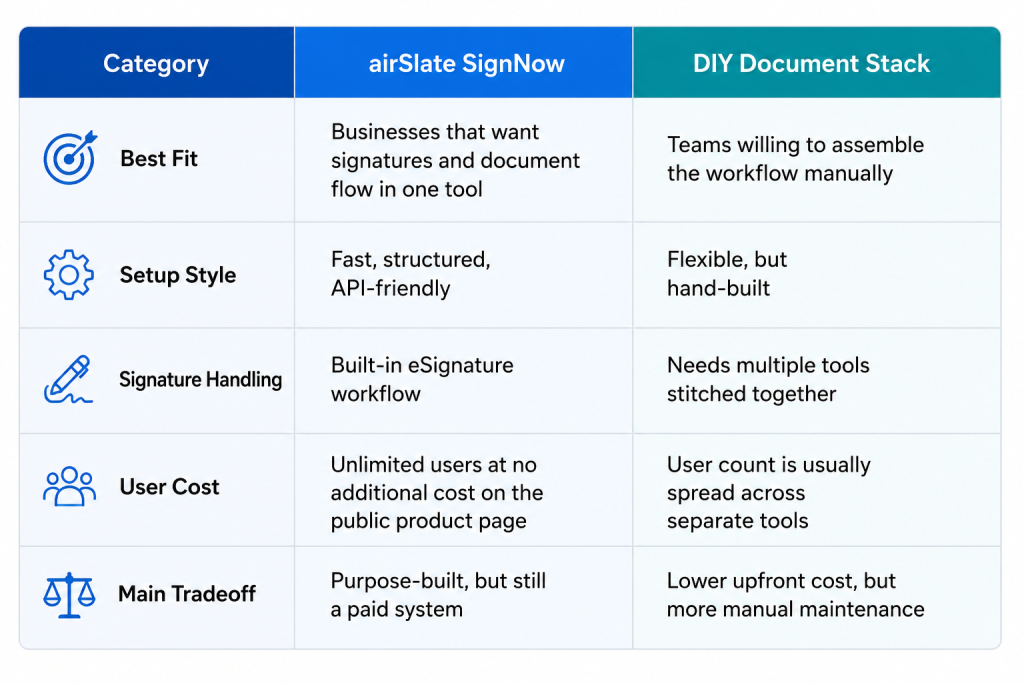
The short version: airSlate SignNow is better when you want the signing process to be a system, not a chore.
If you want to see the pricing story before going deeper, open SignNow here and compare the live plan page against your current document workflow.
Product A Deep Dive :
The official SignNow pages are clear about a few things.
First, the product lets you pay for what you use without overcharges for extra sends or templates. Second, it emphasizes unlimited users at no additional cost. Third, it offers a free trial flow, and the pricing pages show entry points such as Business Premium at $15 per month.
That pricing model matters because document tools often become expensive when every small increase in usage turns into a new seat charge. SignNow tries to avoid that trap.
The official resources also show a fairly broad workflow story:
- Embed Signatures Into Apps, Websites, CRMs, And Cloud Storage.
- Use API Plans For Developer Workflows.
- Collect Payments From Signers.
- Use Template Reuse.
- Support Offline Mobile Signing.
- Support In-Person Signing.
- Use Conditional Fields And Calculated Fields.
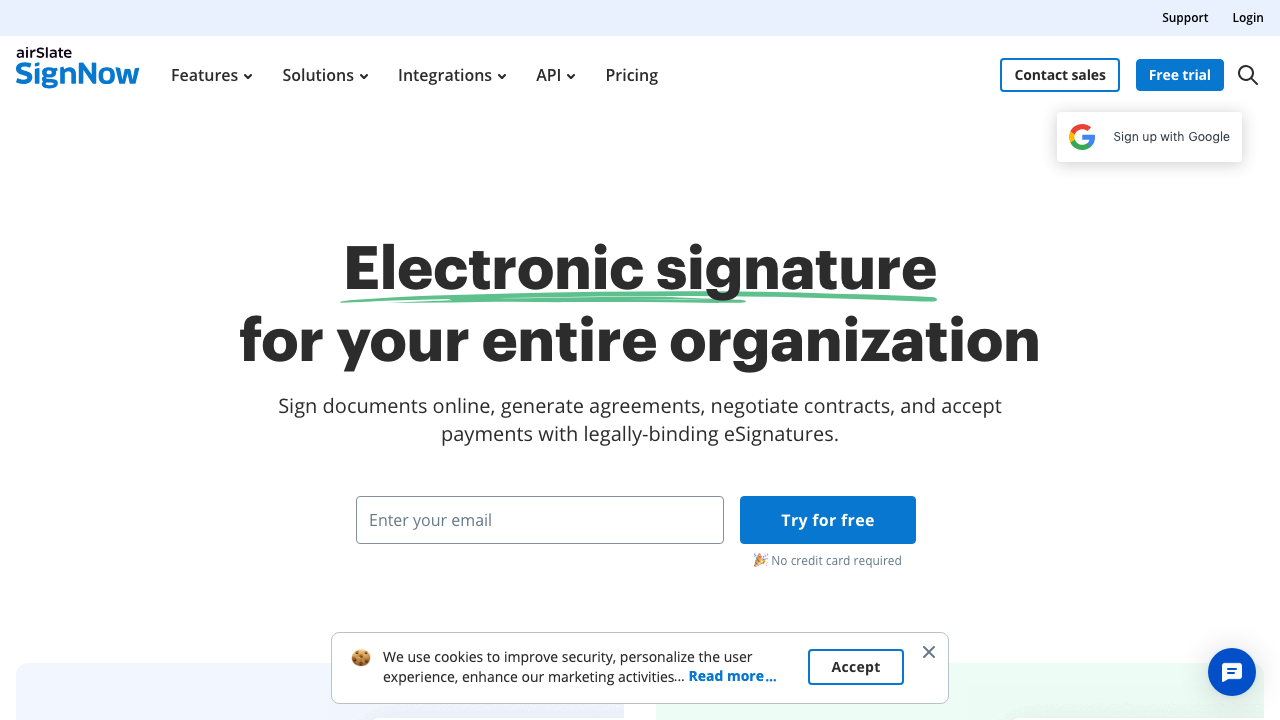
That is not a minimal e-signature tool. That is a document workflow platform with a pricing story that tries to stay practical.
If you want to test the official product fit, start with SignNow here and see whether the trial and pricing shape match your document volume.
Product B Deep Dive :
A DIY document stack usually means you combine a form builder, email reminders, cloud storage, maybe a spreadsheet, and whatever signing step you can cobble together.
That stack can work.
It just tends to leak time in all the obvious places:
- Someone Forgets A Reminder.
- Someone Uploads The Wrong Version.
- Someone Signs The Wrong Copy.
- Someone Can’t Find The Final File Later.
- Someone Asks Who Owns The Next Step.
The upside of the DIY stack is control. The downside is that the team becomes the workflow engine. That is fine for tiny operations. It gets old very quickly once document volume starts growing.
So the choice is not really “can the manual stack work?” It can. The real question is whether you want your team spending its time running the process or just using the process.
Feature Matrix :
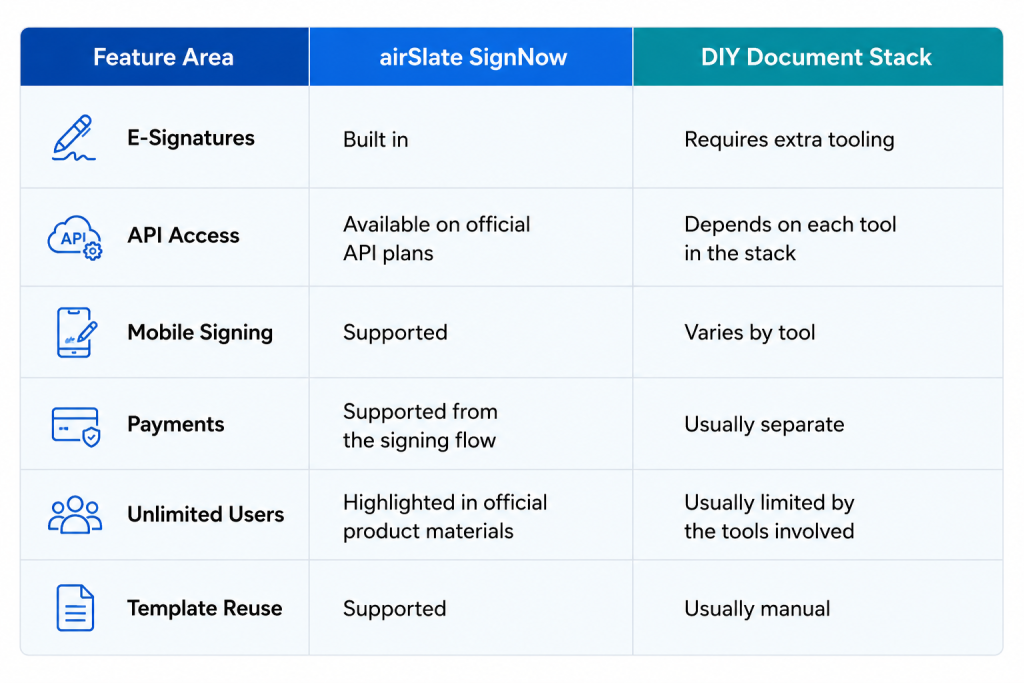
The better comparison is not “low cost versus high cost.” It is “integrated workflow versus stitched-together workflow.”
Pricing Comparison :
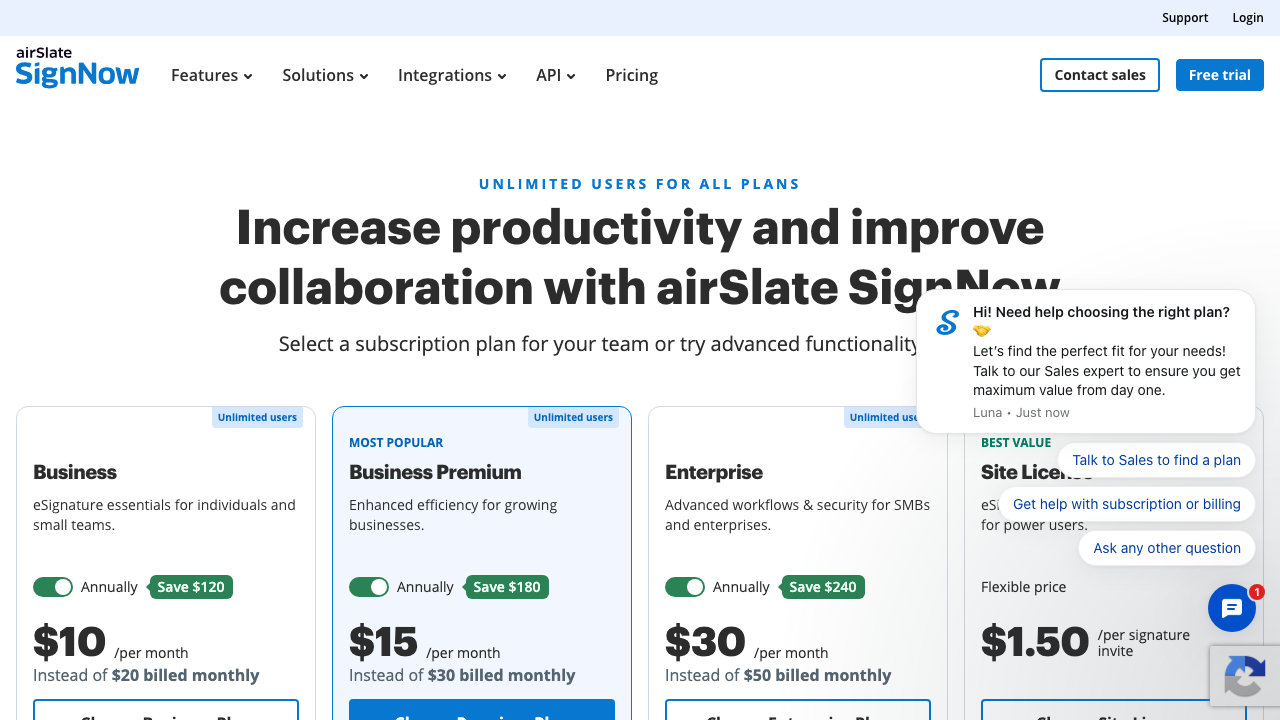
The official pricing and help pages point to a few concrete details:
- Business Premium Starts At $15 Per Month.
- A 7-Day Free Trial Is Available.
- API Free Trial Includes 250 Free Signature Invites.
- Some Public Plan Comparisons Show Business Pro at $40 Per User Per Month.
- The Product Messaging Says You Only Pay For What You Use.
That gives you a pretty clear buying lens.
If your business needs document signing occasionally, a smaller setup may be enough. If your business does document flow all the time, the structure and seat model become more important.
The advantage of SignNow is that the public pricing story is not trying to hide the basic shape of the decision. It is letting you evaluate the tradeoff between capability and cost without too much mystery.
If that sounds like the kind of clarity you need, compare the live pricing page against your current document volume and see whether the workflow is actually easier to run than the stack you have today.
Use Case Recommendations :
Choose SignNow If –
You want signatures embedded in the tools your team already uses.
Choose SignNow If –
You want API access or a document workflow that can be built into other systems.
Choose SignNow If –
You want unlimited users at no additional cost to keep the workflow from becoming a seat-count problem.
Choose A DIY Stack If –
You only need to sign a few documents, and do not want a dedicated platform yet.
The practical truth is that the DIY stack is a good temporary answer and a weak long-term system. SignNow is stronger when the workflow matters enough to deserve its own place.
Operational Notes :
The strongest reason to choose SignNow is that it reduces the number of places a document workflow can go wrong.
When a team handles contracts, approvals, or customer paperwork by hand, the trouble usually starts in the small gaps. Someone sent the wrong version. Someone forgets to follow up. Someone stores the signed copy in the wrong folder. Someone has to explain the process again because the last person who knew it left the team.
SignNow’s official materials aim directly at those problems. Unlimited users at no additional cost means the workflow does not punish collaboration. API access means the process can be embedded where the rest of the business already works. Template reuse means the team is not recreating the same document over and over. Mobile signing and in-person signing make the workflow usable in more than one real-world scenario.
That also changes the psychology of the process. When signing feels like a stable system, people stop avoiding it. They trust it. They know where the document is, who still needs to act, and what happens after it is signed.
That matters more than it sounds. A document workflow that people trust gets used. A workflow that feels brittle gets bypassed.
When The DIY Stack Still Wins :
There are still a few cases where the manual stack is good enough.
- You Send Very Few Documents.
- You Are Still Prototyping The Process.
- You Do Not Need API Or Embedded Signing.
- You Want To Delay Another Subscription.
That is fair. Early-stage teams do not always need the full platform right away. The problem is that many teams stay in the DIY mode long after the process stops being tiny.
Once the document flow becomes regular, the hidden maintenance cost starts to matter more than the software bill. At that point, a dedicated system usually becomes the calmer choice.
If that is where you are headed, open SignNow here and compare the live trial and pricing pages against the way your team actually handles signatures today.
What A Better Setup Changes In Practice :
The biggest improvement is not only speed. It is predictability. When a team knows where the document starts, who receives it, how the signature request moves, and where the completed file lands, the whole process becomes easier to delegate.
That matters in real businesses because document work rarely stays with one person. Someone in sales sends the agreement, someone in operations checks the fields, someone in finance wants the payment link or invoice flow, and someone else needs the signed copy later. A platform that keeps those steps in one place reduces the number of “where is this?” messages that waste time and create mistakes.
It also makes training simpler. New hires do not need to learn a patchwork of apps, naming conventions, and follow-up habits. They just learn the system. That is where SignNow’s combination of unlimited users, embedded signing, API support, and template reuse becomes more than a feature list. It becomes a workflow people can actually remember and repeat.
That repeatability is the part people usually underestimate. A workflow that is easy to explain is also easier to audit, easier to improve, and easier to keep consistent when the team gets busy. In document operations, that kind of calm is often worth more than a flashy feature that looks good in a demo.
It also reduces the “who owns this?” problem that slows teams down. When the signing path is obvious, people stop improvising. The result is fewer duplicate reminders, fewer missing attachments, and fewer last-minute scrambles to find the right version before a deadline.
Verdict :
airSlate SignNow is the better choice when signing is part of the business process rather than a side task. The official pages are strong on embedded workflows, API access, no extra user charges, and pricing that starts low enough to be approachable.
The DIY alternative can work, but it usually works because your team is doing extra unpaid process management in the background.
If you want the signing step to feel calm and repeatable, SignNow is the more mature option.
If that is the direction you want, open SignNow here and test the current pricing and API pages against your own document workflow before you decide.
FAQ :
What is airSlate SignNow?
It is an eSignature and document workflow product that can be embedded into apps, websites, cloud storage, and CRM workflows.
Does SignNow have a free trial?
Yes. The official pricing pages show a free trial flow.
How much does SignNow cost?
The official pricing pages show entry pricing, such as Business Premium at $15 per month, with other plan references on the current comparison pages.
Does SignNow support API access?
Yes. The official API pricing pages and comparison pages make that clear.
Is unlimited user access really included?
The official product messaging says unlimited users come at no additional cost.